
How to Find Your Ring Size and Choose a Diamond Using Zales's Guides
Step-by-step use of Zales's Ring Sizing Guide and size chart (US 3 to 13.5 with internal diameters), its 4Cs of Diamonds page, and the return, exchange and resizing rules that protect you if the size is wrong.
Disclosure: This page may contain affiliate links. They do not influence our editorial conclusions. Read the disclosure.
Our pick
- See price at Zales
Top pick
Zales
US jewelry retailer founded in Texas in 1924, part of Signet Jewelers, selling engagement rings, lab-grown and natural diamond jewelry, gold and silver jewelry...
Steps in this guide
Buying a ring online comes down to two questions: what size do you need, and which stone is worth the money? Zales answers both with free tools on its own site, a Ring Sizing Guide on every ring page and a 4Cs of Diamonds education page. This guide walks through how to use them, what Zales's size chart says, and how its returns, exchanges and resizing services protect you if you get it wrong.
All measurements, prices and policies here come from zales.com as of November 10, 2026.

Step 1: Open the Size Guide on the ring you want
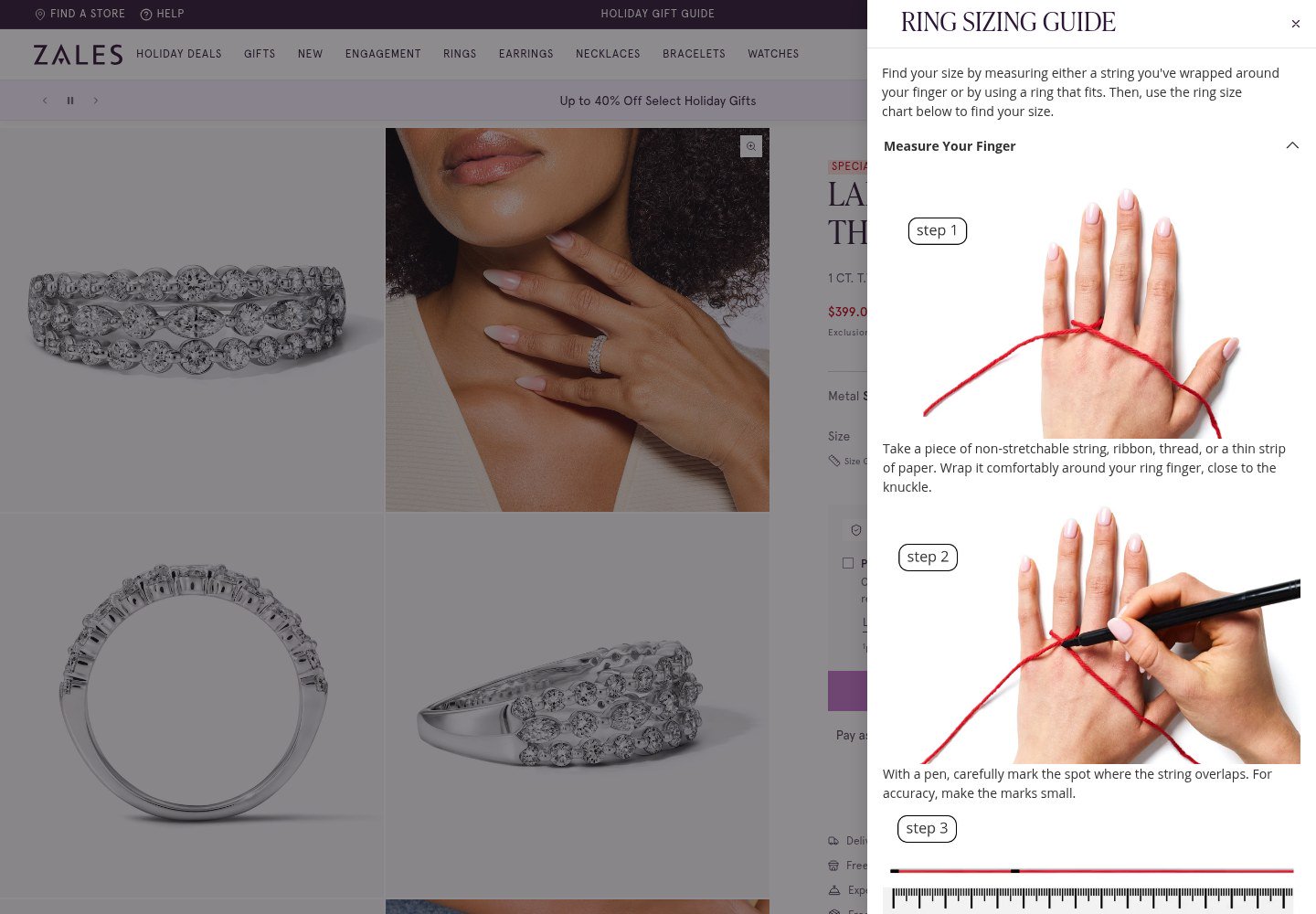
On any Zales ring product page, look for the Size Guide link above the "Select a Size" dropdown. Zales's help center points shoppers to the same place. Clicking it opens a panel titled "Ring Sizing Guide" with three sections: Measure Your Finger, Size Comparison Chart and Printable Ring Sizer.
The guide offers two ways to find your size. You can measure a string wrapped around your finger, or measure a ring that already fits. Either way, you end up with a number in millimeters that you match against Zales's chart.
Step 2: Measure your finger with a string
Zales's instructions are short:
- Take a piece of non-stretchable string, ribbon or thread, or a thin strip of paper. Wrap it comfortably around your ring finger, close to the knuckle.
- With a pen, carefully mark the spot where the string overlaps. Keep the marks small for accuracy.
- Unwrap the marked length and measure it in millimeters with a ruler.

A few practical points help the string method:
- Use a material that will not stretch. Yarn or elastic thread gives a reading that is too small.
- Get the knuckle right. A ring has to slide over the knuckle, so the string should pass over it comfortably, not just fit the base of the finger.
- Measure more than once. Fingers swell with heat and shrink in the cold. Measuring at different times of day gives a better average.
- Measure the correct hand. Your dominant hand is often slightly larger.

The string gives you the circumference of your finger. Zales's chart, however, lists each size by internal diameter. To convert, divide your circumference in millimeters by pi (about 3.14). For example, a 54.4 mm string divided by 3.14 is about 17.3 mm, which is a US size 7 on Zales's chart.
Step 3: Or measure a ring that already fits
If you have a ring that fits the intended finger, measure straight across the inside of the band, edge to edge, in millimeters. That is the internal diameter, and you can read it directly against the chart. Zales also offers a Printable Ring Sizer in the guide. It says you can use the printable chart with a ring that fits and follow the on-page instructions. If you print it, make sure your printer is set to 100% scale so the sizes are not distorted.
Step 4: Match your number on the Zales size chart
Here is Zales's Size Comparison Chart, with US sizes, internal diameter and European sizes:
| US size | Internal diameter | European size |
|---|---|---|
| 3 | 14.0 mm | — |
| 3.5 | 14.4 mm | 46 |
| 4 | 14.8 mm | 47 |
| 4.5 | 15.2 mm | 48 |
| 5 | 15.6 mm | 50 |
| 5.5 | 16.0 mm | 51 |
| 6 | 16.45 mm | 52 |
| 6.5 | 16.9 mm | 53 |
| 7 | 17.3 mm | 54 |
| 7.5 | 17.7 mm | 56 |
| 8 | 18.2 mm | 57 |
| 8.5 | 18.6 mm | 58 |
| 9 | 19.0 mm | 60 |
| 9.5 | 19.4 mm | 61 |
| 10 | 19.8 mm | 62 |
| 10.5 | 20.2 mm | 64 |
| 11 | 20.6 mm | 65 |
| 11.5 | 21.0 mm | 66 |
| 12 | 21.4 mm | 67 |
| 12.5 | 21.8 mm | 69 |
| 13 | 22.2 mm | 70 |
| 13.5 | 22.6 mm | 71 |
Each half size is about 0.4 mm of diameter. If your measurement falls between two sizes, choosing the larger size is the usual approach, especially for wide bands, which tend to feel tighter than thin ones. For sizes outside the chart, Zales's guide says to chat with its experts about a custom size.
Step 5: Use the 4Cs to choose the stone
Once the size is settled, the bigger decision is the diamond. Zales's 4Cs of Diamonds page explains the four grading factors and how they affect price:
- Carat is weight, not size. One carat equals 200 milligrams. Zales notes that larger diamonds are rarer, but carat alone does not decide value.
- Clarity describes inclusions, such as tiny white points, dark dots or scratches. Fewer inclusions mean a more valuable stone, and Zales says only about 2% of the world's diamonds are flawless.
- Color is graded on a scale of 23 letters in five groups. Colorless stones are valued most, but Zales points out that a diamond does not need to be colorless to look bright when the other Cs are strong.
- Cut covers a stone's shape, facets and polish, and the cut grade reflects its sparkle.

Zales's budgeting advice is practical: you can focus on cut and step down a few levels on color and clarity, or choose a slightly smaller carat weight, and the difference is often hard to see while the price drops a lot.
Read the grade letters in the product name
Zales puts the grades right in many listings. The "1 CT. T.W. Marquise-Cut and Round Lab-Grown Diamond Three-Row Ring in Sterling Silver (F/VS2)", for example, is listed at F color and VS2 clarity, with 0.95 ct. t.w. of lab-grown diamonds in the product details. "CT. T.W." means carat total weight, the combined weight of every diamond in the piece, not the size of one stone. A 1 ct. t.w. three-row band and a 1-carat solitaire are very different things.

Natural or lab-grown?
Zales sells both. Its disclosures say lab-grown diamonds have the same optical, chemical and physical properties as earth-created diamonds. One practical difference is trade-in: lab-grown diamonds can only be traded toward lab-grown pieces, while natural diamonds can go toward either.
Check the metal
The 4Cs are about the stone, but the metal affects price and upkeep. Zales's help center explains that white gold is an alloy of yellow gold with light-colored metals, while platinum is naturally white and more durable. Both may be rhodium-plated, and that plating can wear off over time. Many lower-priced lab-grown pieces are set in rhodium-plated sterling silver.
Step 6: Know your safety nets before you buy
Even with careful measuring, sizes are sometimes off. Zales's policies help:
- Returns and exchanges. Jewelry can be returned within 30 days and exchanged within 60 days of the purchase or shipment date. Exchanges are handled in stores. If you return a ring that was sized to order, Zales refunds the sizing fee. For the 2026 holidays, purchases made between October 20 and December 24, 2026 can be returned through January 24, 2027.
- Exceptions. Custom designs and jewelry that has been engraved or altered beyond sizing or stone setting cannot be returned. If the size is uncertain, hold off on engraving.
- Resizing. Zales's Lifetime Protection Plan, a paid add-on, includes ring sizing up or down two sizes. Without it, the plan page lists typical ring sizing costs of $58 to $215 or more.
- Expert help. You can chat with a Zales jewelry expert, text, message on WhatsApp, or book a virtual or in-store appointment. Stores also offer free cleaning and inspection.
For a full rundown of shipping, financing and protection-plan rules, see our Zales shopping guide. To weigh Zales as a store overall, read our research-based Zales review.
Quick checklist
- Open Size Guide on the exact ring you plan to buy.
- Measure with non-stretch string near the knuckle, or measure a ring that fits.
- Convert circumference to diameter (divide by 3.14) and match it on the chart.
- Go up a half size for wide bands or if you land between sizes.
- Compare stones by cut first, then color, clarity and carat total weight.
- Hold off on engraving until you are sure of the size.
References
- Zales. Ring Sizing Guide (Size Guide panel on ring product pages), shown on "1 CT. T.W. Marquise-Cut and Round Lab-Grown Diamond Three-Row Ring in Sterling Silver (F/VS2)." https://www.zales.com/1-ct-tw-marquisecut-round-labgrown-diamond-threerow-ring-sterling-silver-fvs2/p/V-20632518. Accessed November 10, 2026.
- Zales. "The 4Cs of Diamonds." https://www.zales.com/education/diamonds/4cs. Accessed November 10, 2026.
- Zales. "Help Center" (FAQs on ring size, metals and lab-created stones). https://www.zales.com/customer-service. Accessed November 10, 2026.
- Zales. "Returns and Exchanges." https://www.zales.com/return-and-exchange-policy. Accessed November 10, 2026.
- Zales. "Lifetime Protection Plan." https://www.zales.com/lifetime-protection-plan. Accessed November 10, 2026.
- Zales. "Trade-In and Upgrades." https://www.zales.com/trade-in-and-upgrades. Accessed November 10, 2026.
Meet your guide
Lipeiguan
author
What to read next
 Garmin vívoactive 6 vs Venu 4 vs Venu X1: Which Garmin Smartwatch to Buy Garmin's three lifestyle smartwatches compared from official specs and prices: the $249.99 vívoactive 6, $449.99 Venu 4 with ECG and fall detection, and $499.99 Venu X1 with a 2-in...
 Garmin Forerunner 970 vs Apple Watch Ultra 4 for Running: Battery, GPS, Maps and Price Compared Garmin's $649.99 Forerunner 970 vs Apple's $799 Apple Watch Ultra 4 for runners, compared from official specs: GPS and workout battery life, maps, training metrics, safety features...
 Best Garmin Forerunner 2026: Forerunner 70 vs 265 vs 570 vs 970, Which Running Watch to Buy Garmin's four current Forerunner running watches compared from official specs and prices: the $249.99 Forerunner 70, $299.99 Forerunner 265, $449.99 Forerunner 570 and $649.99 Fore...