
Bambu Lab H3C Review: Specs, Price and Who the Nine-Tool Printer Is For
A research-based look at Bambu Lab's H3C: the Swaptek nine-tool changer, FlexFeed for soft TPU, a 330×320×325 mm build volume, and the $2,499 Combo price on the U.S. store.
Disclosure: This page may contain affiliate links. They do not influence our editorial conclusions. Read the disclosure.
Our pick
- See price at Bambu Lab
Top pick
Bambu Lab
Consumer desktop 3D-printer maker whose current lineup includes enclosed AMS machines such as the P2S and the nine-tool H3C, sold through bambulab.com and the U...
Our verdict
Based on Bambu Lab's published specifications, the H3C is a nine-tool desktop printer that starts at $2,499 and is built to keep nine filaments loaded so it can change materials in about six seconds, at a price and complexity well above the company's AMS models.
The Bambu Lab H3C is a desktop 3D printer built around a nine-tool changer rather than a single nozzle that loads and unloads filament. Bambu Lab introduced it on November 3, 2026, as its first third-generation desktop machine. On the U.S. store on November 8, 2026, the H3C Combo started at $2,499. This review is based on that press release, the official H3C product page and the U.S. store listing. It does not include hands-on printing.

What Bambu Lab says the H3C is for
The press release frames the H3C as the machine that finally removes a tradeoff that has followed multi-material FFF printing: you could have speed, reliability or simple filament changes, but not all three. Earlier X1 and P1 printers, the company said, made multi-color work more dependable after they launched in 2022, yet switching among several filaments in one job was still slow and labor-heavy.
The H3C is the first Bambu Lab printer "conceived from the ground up around a dedicated tool-changer." It combines nine ready tools, a flexible-material extruder and an integrated filament system in a footprint the company compares to a single-spool A-series printer. The promise is that reaching for nine filaments should feel as ordinary as using one spool.
That is a marketing claim, and it should be read as one. What can be checked today are the published mechanics, dimensions and price.
The launch itself was announced from Austin, Texas, in an English-language press release on November 3, 2026, with a Spanish-language version following on November 7. Both versions describe the same hardware and the same nine-tool pitch. Neither names a street date beyond the product being listed for sale on the U.S. store by November 8, 2026, so anyone waiting on a specific ship-week should read the current listing rather than the press copy.
Swaptek: nine tools and six-second material changes
Swaptek is the core of the machine. Each of the nine print tools has its own filament path and heater, so material stays loaded and pre-heated. When a change is coming, Active Pre-Heat reads upcoming G-code and starts warming the next nozzle while the current tool is still printing. After the mechanical swap, a short priming step is supposed to put fresh filament back on the model in six seconds with little waste.
The official product page lists three related figures: a 3.4-second tool change, a 6-second material switch and 0.038 grams of low purge, the last of those marked with an asterisk. The press release describes the same six-second material change and "minimal waste." Those numbers come from Bambu Lab, not from independent timing tests.
A retractable rack folds guide tubes back during printing. The company says that keeps the view of the part clearer, cuts vibration, frees Z height for taller builds and stops tubes from hitting each other on long multi-material jobs. Swaptek is also described as handling automatic docking, tool-offset compensation and a full bed-leveling pass before every print.

The same architecture is what lets the H3C carry different nozzle sizes at once. The product page describes printing a watch-style part with a 0.2 mm nozzle for fine dial details, a 0.4 mm nozzle for the case and a dedicated 0.4 mm TPU nozzle for a soft band. Bambu Studio's mixed-diameter toolpath planning, the company says, lets each nozzle use a layer height that suits it instead of forcing every tool onto one height.
FlexFeed, TPU and AMS 3H
The FlexFeed extruder accepts both 1.75 mm and 2.85 mm filament and can switch between them. A dedicated 2.85 mm path is meant to keep soft TPU from buckling before it reaches the nozzle. Bambu Lab says that allows up to three times the flow rate of a "classic printer" and reliable printing of TPU as soft as 75A, for uses such as shoe parts, wearables, flexible hinges and soft-robotic pieces. The "3×" figure is another company measurement, marked with an asterisk on the product page.
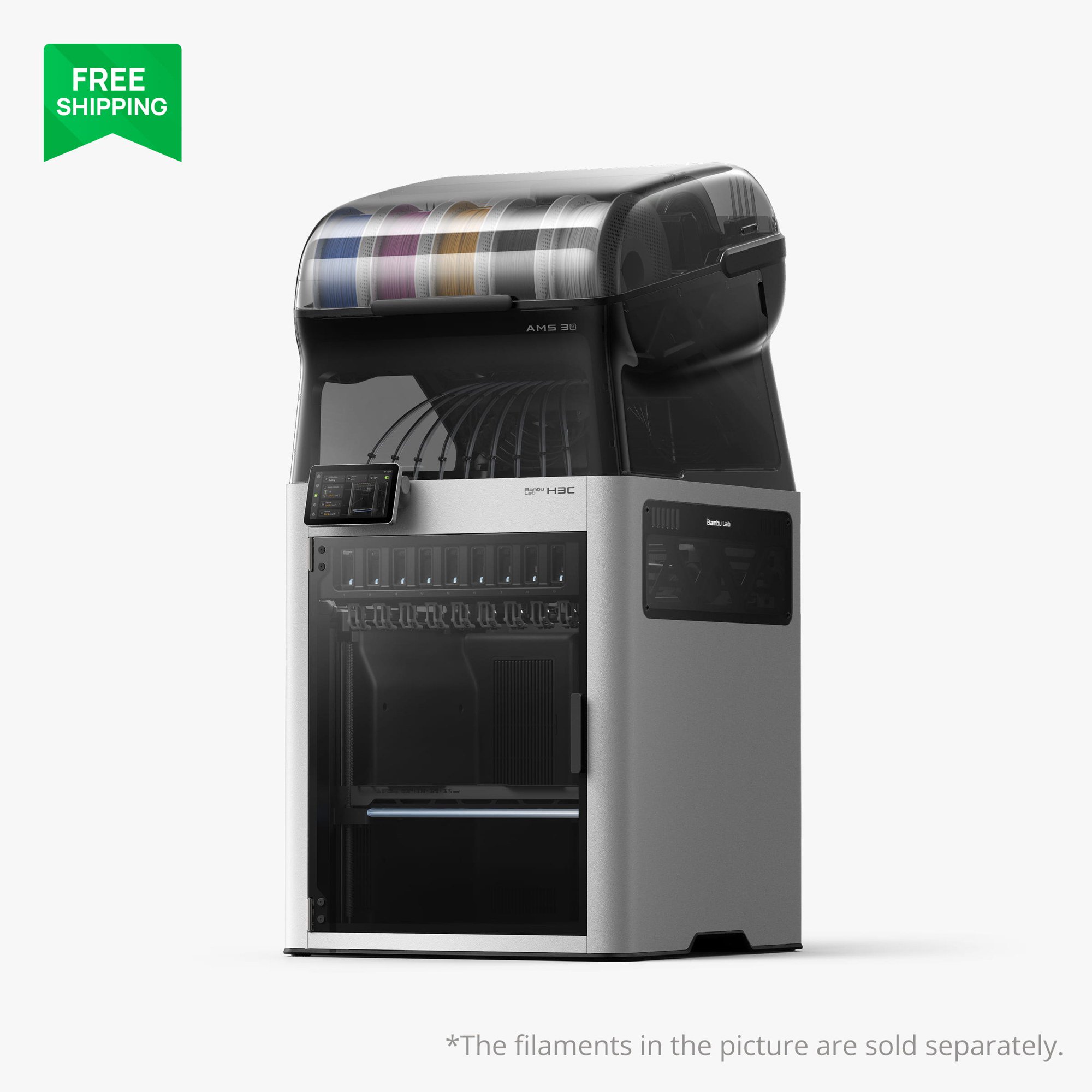
All nine spools live in AMS 3H, a sealed chamber that the release says protects filament from moisture and can dry it as part of the print flow. Filament feeds automatically to the matching tool. Dedicated TPU inlets let flexible material come straight from the AMS. The U.S. store photo of the H3C shows that AMS 3H module on top of the printer, loaded with multiple spools, and notes that the filaments in the picture are sold separately.

The store listing also calls out built-in filament drying aimed at PA, PC and carbon-fiber-filled materials, plus active chamber heating and cooling "for engineering materials."
Size, extras and software claims
The U.S. store lists a usable build volume of 330 × 320 × 325 mm. That is larger than the P2S, which the same store lists at 256 × 256 × 256 mm.
Optional "expandable crafting tools" are part of the pitch: the machine can print, cut, draw and deboss by docking different tools, with the process described as automated. The product page marks that capability with an asterisk and describes it as official accessories rather than something every box includes. Confirm what a given combo actually ships before you treat cutting or foiling as standard.
The product pages reviewed on November 8, 2026, also state that the printer is "cybersecurity compliant with EU RED Article 3.3(d)(e) and ETSI EN 303 645 V2.1.1:2020," with a link to learn more. That is a compliance statement from the manufacturer, not a third-party audit summarized here.
Bambu Lab's press release mentions MakerWorld as a source of free models — the U.S. store page repeats "2M+ free models" — and Bambu Studio as the slicer that plans mixed-nozzle toolpaths.
Price and store terms as of November 8, 2026
The U.S. store listed the H3C Combo at $2,499, with filament starter-pack bundles and a Bambu Station L FRAME full combo at higher prices (the raw listing data included $2,589 and $2,799 figures). The product page advertised free shipping in the 48 contiguous states, 30-day returns, 30-day price protection and a two-year warranty. How those policies work in detail is covered in the Bambu Lab shopping guide.

At $2,499 before filament, the H3C sits far above the P2S, which the same store listed at $649 with a typical price of $749 on November 8, 2026. Buyers who mainly want AMS-style multi-color printing, not a nine-tool changer, will see that gap immediately. The comparison is spelled out in H3C vs P2S.
Who it appears to suit — and who it does not
Based only on the published specs, the H3C is aimed at people who already know they want frequent material changes in a single print: multi-color and multi-flex jobs, mixed nozzle sizes, or TPU soft enough that a standard Bowden path struggles. The 330 × 320 × 325 mm volume and enclosed, heated chamber also point at larger or more temperature-sensitive parts than an A-series machine is built for.
It is a weaker match if you want a first printer under $1,000, if you mostly print a single material, or if you were already happy with AMS-based color changes on a P2S or similar model. Those buyers would be paying for a tool-changer architecture they may not use.
Because this review does not include print samples, noise measurements or long-term reliability data, anyone buying an early H3C should treat the six-second swaps, 0.038-gram purge and 3× TPU flow as manufacturer figures and watch independent tests as they appear.
Verdict
Based on Bambu Lab's published specifications, the H3C is a nine-tool desktop printer that starts at $2,499 and is built to keep nine filaments loaded so it can change materials in about six seconds, at a price and complexity well above the company's AMS models.
References
- Bambu Lab. "Tool changer. Game changer. Bambu Lab presents H3C - the defining new generation of 3D printers." PR Newswire, November 3, 2026.
- Bambu Lab. H3C product page. bambulab.com/en/h3c. Accessed November 8, 2026.
- Bambu Lab US Store. H3C product listing. us.store.bambulab.com/products/h3c. Accessed November 8, 2026.
- Bambu Lab US Store. P2S product listing. us.store.bambulab.com/products/p2s. Accessed November 8, 2026.
Meet your guide
Lipeiguan
author
What to read next
 Best Makera CNC Machines (2026): Z1, Carvera Air, A1S and Carvera A research-based 2026 guide to official Makera Z1, Z1 Pro, Carvera Air, A1S and Carvera desktop CNC specs and November 20, 2026 U.S. prices, including work areas, tool changers, in...
 Makera A1S vs TwoTrees ED1: 600W Desktop CNC Specs, Pre-Order Prices and Shipping Compared A research-based comparison of official Makera A1S and TwoTrees ED1 600W enclosed desktop CNC specifications, November 20, 2026 pre-order prices, work areas, tool changers, and shi...
 Google Adds Computer Use to the Gemini App for Mac in the U.S. On November 19, 2026, Google said computer use is available in the Gemini app for Mac, in English in the U.S. Official requirements include an Apple Silicon Mac on macOS Sequoia 15...