
Bambu Lab H3C vs P2S: Nine-Tool Changer or AMS Multi-Color Printer?
How Bambu Lab's $2,499 H3C nine-tool changer differs from the P2S AMS printer on material changes, build volume, flexible filament and November 8, 2026 U.S. store prices.
Disclosure: This page may contain affiliate links. They do not influence our editorial conclusions. Read the disclosure.
Our pick
- See price at Bambu Lab
Top pick
Bambu Lab
Consumer desktop 3D-printer maker whose current lineup includes enclosed AMS machines such as the P2S and the nine-tool H3C, sold through bambulab.com and the U...
Bambu Lab now sells two very different answers to multi-material printing from the same U.S. store. The H3C, announced November 3, 2026, is a nine-tool changer that starts at $2,499 as a Combo. The P2S is an enclosed AMS-style printer listed at $649, with a typical price of $749, on November 8, 2026. This comparison uses those store listings, the official H3C product page and Bambu Lab's press release. It is not a side-by-side print test.


The short version is that the H3C keeps multiple tools ready so it can swap materials without unloading a single nozzle, while the P2S uses AMS to feed several filaments through one print head. That difference shows up in price, build volume and the kinds of jobs each machine is built for.
How each machine changes material
On the H3C, Swaptek holds nine print tools. Each tool has its own filament path and heater, so the next material can sit loaded and pre-heated. Bambu Lab says Active Pre-Heat reads upcoming G-code and starts warming the next nozzle while the current one is still working. After the mechanical change, a short priming step is meant to put fresh filament back on the part. The official page lists a 3.4-second tool change, a 6-second material switch and 0.038 grams of low purge.
A retractable rack folds guide tubes away during printing. The company says that keeps the view of the part clear, reduces vibration, recovers Z height and stops tubes from colliding on long multi-material jobs. Because each tool is independent, the same print can mix nozzle diameters — the product page's example is a watch-style part that uses 0.2 mm for fine dial work, 0.4 mm for the case and a dedicated 0.4 mm TPU nozzle for a soft band.
The P2S works the older way. Its store page describes a second-generation AMS with filament drying, multi-color printing and quick filament swapping through a single print system rather than a rack of separate tools. That is the architecture Bambu Lab popularized with earlier X- and P-series machines: several spools, one nozzle, and a purge or transition when the color or material changes. The P2S page does not publish a 3.4-second tool-change time or a 0.038-gram purge figure, because it is not a tool changer.
If your main goal is multi-color PLA or PETG, the P2S's AMS approach is the cheaper and more familiar path. If your main goal is keeping nine materials, including soft TPU, parked and ready — or mixing nozzle sizes in one job — the H3C is the machine Bambu Lab built for that.
Build volume and enclosure
The H3C's usable volume on the U.S. store is 330 × 320 × 325 mm. The P2S is listed at 256 × 256 × 256 mm. That is a meaningful gap for larger parts or for packing several pieces on one plate.
Both machines are enclosed. The H3C listing adds active chamber heating and cooling "for engineering materials" and built-in drying aimed at PA, PC and carbon-fiber-filled filament. The P2S listing also highlights an enclosed design and AMS drying, but it does not publish the same chamber-heating language or the same 330 mm-class envelope.
For a buyer who prints small figures or bench-size parts, the P2S volume is often enough. For a buyer who was already bumping into a 256 mm cube, the H3C's extra space is one of the clearer hardware differences that does not depend on believing a speed claim.
Flexible filament and extra processes
FlexFeed is unique to the H3C in this pairing. It accepts 1.75 mm and 2.85 mm filament and can switch between them. A dedicated 2.85 mm path is meant to keep soft TPU from buckling, which Bambu Lab says allows TPU as soft as 75A and up to three times the flow of a "classic printer." Dedicated TPU inlets let that material come from AMS 3H. Those figures are manufacturer claims, marked with asterisks on the product page.
The H3C is also sold with optional tools that cut, draw and deboss in addition to printing. The product page marks that as an expandable, official-accessory feature rather than a guarantee that every combo includes a full craft kit. The P2S store page reviewed on November 8, 2026, does not advertise the same print/cut/draw/deboss set.
If TPU parts, mixed hardness or extra crafting tools are why you are shopping, the H3C is the closer match on paper. If you almost never leave rigid filament, those extras do not justify the price gap by themselves.
Price, shipping and after-sales on November 8, 2026
On the U.S. store that day:
- H3C Combo: $2,499, with other bundles listed higher.
- P2S: $649, typical price $749. The store image reviewed that day also carried a "$100 OFF" badge, which matches the gap between those two figures.
Both product pages showed free shipping in the 48 contiguous states, 30-day returns, 30-day price protection and a two-year warranty. Those store-wide promises are described in more detail in the Bambu Lab shopping guide. Two shipping notes are specific enough to mention here. The H3C can be sent to Hawaii and Alaska, unlike several H2-series machines; the shipping policy listed an H3C AMS Combo at $370.16 to Hawaii and $446.32 to Alaska. The same policy listed a P2S at $145 to remote regions, or $165 for a Combo.
At list, the H3C Combo costs about four times a discounted P2S. That is the practical decision most shoppers will face, independent of any speed graphic.
What each listing actually includes
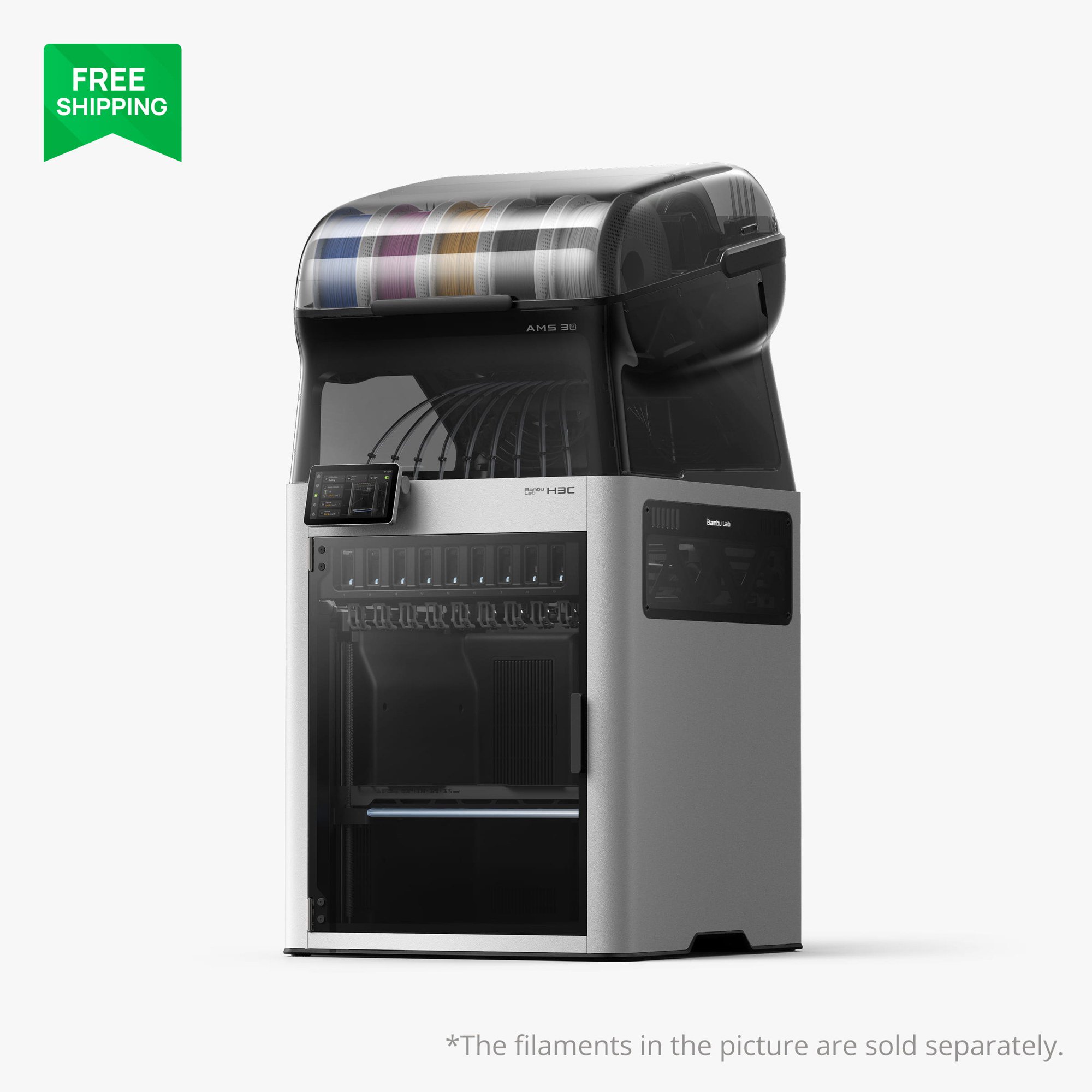
The H3C image on the U.S. store shows the enclosed printer with an AMS 3H module on top and several spools loaded. The listing notes that the filaments in that picture are sold separately. Combo and full-combo bundles on the same page were listed above the $2,499 starting price — raw listing data on November 8, 2026 included $2,589 and $2,799 figures for filament starter-pack and Bambu Station L FRAME configurations. Read the current variant picker; a "Combo" headline does not automatically mean every accessory in the hero photo ships in the box.
The P2S page is simpler: one enclosed printer at $649, with a typical price of $749. The store image reviewed that day carried a "$100 OFF" badge, which matches that $100 gap. Second-generation AMS is part of the P2S pitch, but shoppers should still confirm whether a given SKU is a printer-only listing or an AMS combo before comparing it with an H3C Combo.
Neither machine's store page, as reviewed, published a complete packing list in the short product summary. If a cutter, drawing tool, extra nozzles or a station frame matters to you, check the selected variant rather than assuming it is standard.
Software and shared ecosystem
Both printers sit in the same Bambu Lab software world. The H3C press release and store page point to Bambu Studio for mixed-nozzle toolpath planning and to MakerWorld for free models; the U.S. store repeats a "2M+ free models" line. The P2S is a current Bambu Lab machine and is sliced in the same Studio workflow, even though it does not need mixed-diameter tool-changer planning.
That shared software is useful if you already own another Bambu Lab printer or already have a MakerWorld library. It is not a reason by itself to pick H3C over P2S or the other way around. The machines still differ in how they physically change material.
The H3C product pages reviewed on November 8, 2026 also state that the printer is "cybersecurity compliant with EU RED Article 3.3(d)(e) and ETSI EN 303 645 V2.1.1:2020," with a link to learn more. That is a manufacturer compliance statement. The P2S page excerpt reviewed for this comparison did not repeat the same sentence, so it should not be treated as a documented P2S claim here.
Generation and timing
Bambu Lab called the H3C its first third-generation desktop printer and its first machine "conceived from the ground up around a dedicated tool-changer." The English press release went out on November 3, 2026, from Austin, Texas; a Spanish-language version followed on November 7. The P2S was already on the U.S. store as a current AMS printer when the H3C listed, which is why the two can be compared as live SKUs rather than as a rumor versus a shipping product.
Because the H3C is new, independent long-term reliability data was not part of the public record used for this article. The P2S inherits the more familiar single-nozzle AMS approach that Bambu Lab has sold on earlier P- and X-series machines. Buyers who want a longer public track record will find more of it on the AMS side of the lineup than on a printer announced in November 2026.
Who should pick which
Choose the P2S if you want an enclosed Bambu Lab printer with AMS multi-color printing, a 256 mm cube and a price under $750. That profile matches hobbyists and small studios that print PLA, PETG and occasional other rigid filaments, and who are fine with one nozzle handling color changes.
Choose the H3C if you already know you need frequent material changes, mixed nozzle sizes, or soft TPU in the same job, and you can spend $2,499 before filament. The larger 330 × 320 × 325 mm volume and the published six-second material switch are the reasons Bambu Lab gives for that price.
Skip both if you need a verified independent print comparison. None of the numbers above come from side-by-side testing in this article. They come from Bambu Lab's own pages on November 8, 2026.
For a fuller look at the new machine, see the H3C review. Launch coverage is in Bambu Lab introduces the H3C.
References
- Bambu Lab. "Tool changer. Game changer. Bambu Lab presents H3C - the defining new generation of 3D printers." PR Newswire, November 3, 2026.
- Bambu Lab. H3C product page. bambulab.com/en/h3c. Accessed November 8, 2026.
- Bambu Lab US Store. H3C product listing. us.store.bambulab.com/products/h3c. Accessed November 8, 2026.
- Bambu Lab US Store. P2S product listing. us.store.bambulab.com/products/p2s. Accessed November 8, 2026.
- Bambu Lab US Store. Shipping policy. us.store.bambulab.com/policies/shipping-policy. Accessed November 8, 2026.
Meet your guide
Lipeiguan
author
What to read next
 Best Makera CNC Machines (2026): Z1, Carvera Air, A1S and Carvera A research-based 2026 guide to official Makera Z1, Z1 Pro, Carvera Air, A1S and Carvera desktop CNC specs and November 20, 2026 U.S. prices, including work areas, tool changers, in...
 Makera A1S vs TwoTrees ED1: 600W Desktop CNC Specs, Pre-Order Prices and Shipping Compared A research-based comparison of official Makera A1S and TwoTrees ED1 600W enclosed desktop CNC specifications, November 20, 2026 pre-order prices, work areas, tool changers, and shi...
 Google Adds Computer Use to the Gemini App for Mac in the U.S. On November 19, 2026, Google said computer use is available in the Gemini app for Mac, in English in the U.S. Official requirements include an Apple Silicon Mac on macOS Sequoia 15...