
How to Choose a Rain Barrel Size: VEVOR Collapsible 53 vs 66 vs 100 Gallon
How to size a rain barrel from your roof area and watering needs, what local rules like Colorado's 110-gallon limit mean, and how VEVOR's 53-, 66- and 100-gallon collapsible rain barrels compare on material, size and price.
Disclosure: This page may contain affiliate links. They do not influence our editorial conclusions. Read the disclosure.
Our pick
- See price at VEVOR
Top pick
VEVOR
Home improvement and equipment brand founded in 2007, selling tools, kitchen equipment and appliances on vevor.com and through online marketplaces.
Steps in this guide
A rain barrel is one of the simplest ways to make a yard more eco-friendly: it catches roof runoff you'd otherwise lose down the storm drain and stores it for watering plants. The hard part is choosing a size. Too small and it overflows in the first decent storm; too big and it may not fit your space or, in some states, your local rules. This guide shows how to estimate how much water your roof can send to one downspout, then compares VEVOR's three collapsible rain barrels (53, 66 and 100 gallons) using VEVOR's product listings as of November 16, 2026. We haven't used these barrels ourselves; specs and prices come from VEVOR, and the sizing and safety advice comes from university extension services and state agencies cited below.

Step 1: Work out how much water reaches your barrel
Extension services use the same rule of thumb: one inch of rain on 1,000 square feet of roof produces about 623 gallons of runoff. The University of Nebraska–Lincoln Extension gives the formula as:
Roof area draining to the downspout (sq ft) × rainfall (inches) × 0.623 = gallons
The key is to count only the part of the roof that drains to the downspout you'll use, not the whole house. Nebraska Extension's example: if one-fourth of a 1,200 sq ft roof (300 sq ft) drains to one downspout, about 185 gallons could flow toward the barrel in a one-inch rain, so a typical 55-gallon container will overflow. Clemson's Home & Garden Information Center adds that as little as 100 square feet of roof can fill a single barrel quickly, and Massachusetts' state guide notes that just a quarter inch of rain on a typical roof will fill a rain barrel.
The takeaway: almost any downspout will fill even the largest barrel here in a moderate storm, so capacity is limited by your space, budget and how quickly you use the water, not by your roof. Nebraska Extension recommends choosing the largest container feasible for your site.
Step 2: Think about how fast you'll use it
A barrel only helps if it's empty-ish before the next rain. The University of Tennessee's rain barrel fact sheet makes the point that the real challenge is using the stored water before the next storm. If you water a small patio garden by hand, a 53-gallon barrel may be all you can realistically empty between storms. If you're watering beds or a lawn edge with a hose, a 100-gallon barrel gives you more to work with. Massachusetts' guide says a full rain barrel will water a 200 square foot garden.
Step 3: Check your local rules
Rain barrels are allowed for most homeowners, but some places set limits. In Colorado, for example, state law allows a household to use no more than two rain barrels with a combined capacity of 110 gallons or less, collected from a residential rooftop and used outdoors on the same property, and the water can't be used for drinking or indoor household purposes. Under that law, VEVOR's 100-gallon barrel on its own fits the limit, but pairing it with a second barrel of 53 or 66 gallons would exceed it. If you live elsewhere, check with your state water agency or local extension office.
VEVOR collapsible rain barrels compared
| 53 gallon | 66 gallon | 100 gallon | |
|---|---|---|---|
| Capacity | 53 gal (201 L) | 66 gal | 100 gal (380 L) |
| Material | 1000D PVC | 500D PVC | 1000D PVC |
| Size (diameter x height) | 23.6 x 28.7 in | 23.6 x 35 in | 27.6 x 40.6 in |
| Net weight (empty) | 5.73 lbs | 8.47 lbs | 9.24 lbs |
| Price on vevor.com | $39.90 | $49.90 | $49.90 |
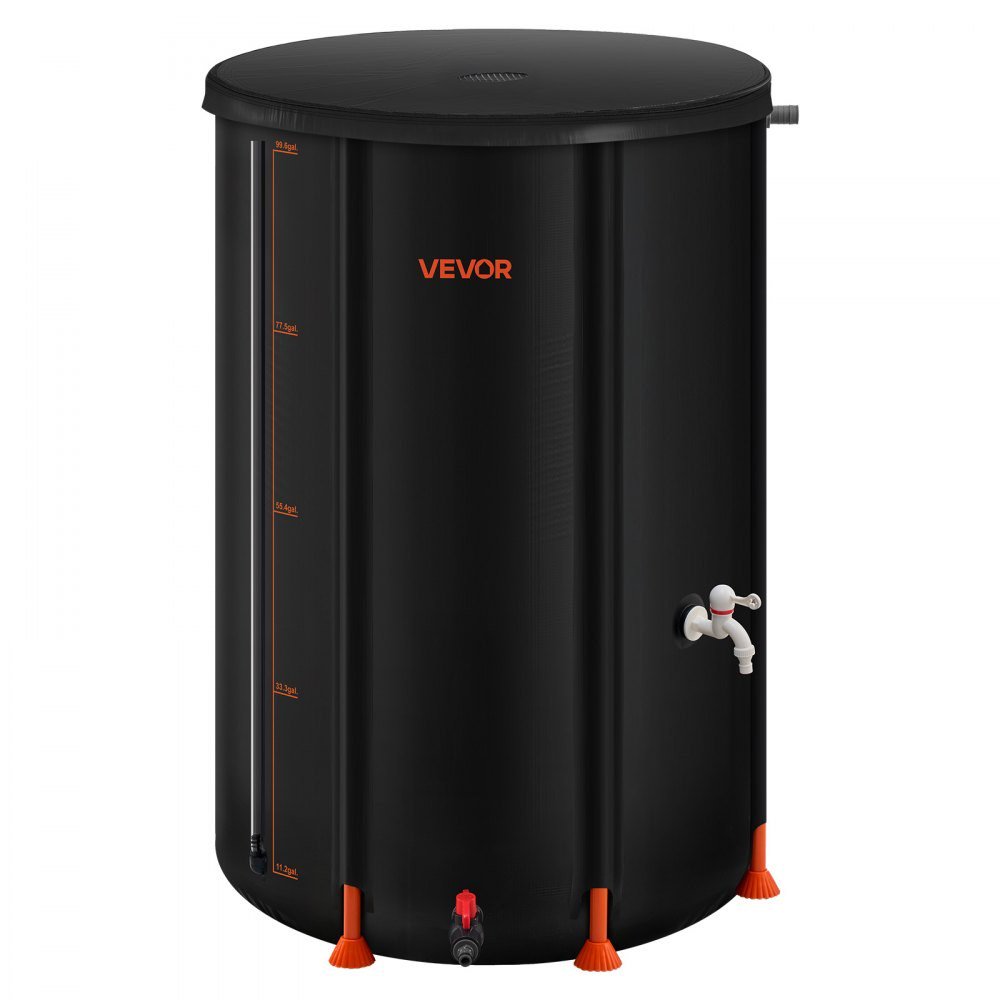
All three share the same basic design, according to VEVOR: a collapsible PVC body held up by 2 mm support rods and a "lotus" base of orange feet, a mesh top to keep out bugs and leaves, a pre-installed outlet, a 3/4-inch quick shut-off valve and tap, and a clear acrylic gauge with markings so you can check the water level without opening the lid. VEVOR rates them for a working temperature range of -30°C to +70°C and says they fold down small enough to store in a car trunk once drained. VEVOR's listings for the 53- and 100-gallon models mention a spigot and overflow kit in the product name.

VEVOR 53-gallon: for small spaces and patios
At 23.6 inches across and 28.7 inches tall, the 53-gallon barrel is the shortest of the three, which helps if your downspout ends low or you want it tucked beside a patio. It's made from the thicker 1000D PVC and weighs just 5.73 lbs empty. At $39.90 it's the cheapest, but in the moderate storms described above it will fill and overflow fastest.

VEVOR 66-gallon: same footprint, more water
The 66-gallon model has the same 23.6-inch diameter as the 53-gallon barrel but stands 35 inches tall, so you get 13 more gallons in the same floor space. The trade-off is material: VEVOR lists it in 500D PVC rather than the 1000D used on the other two. VEVOR still describes it as weatherproof and UV-resistant, but if durability is your priority, the 1000D models are the thicker option on paper. It costs $49.90.

VEVOR 100-gallon: the best value if you have room
When we checked, the 100-gallon barrel cost the same $49.90 as the 66-gallon model while holding about 50% more water and using thicker 1000D PVC. It's the biggest footprint, 27.6 inches across and 40.6 inches tall, and Nebraska Extension notes that containers larger than 100 gallons are usually treated as cisterns, so this is about as large as a simple barrel gets. For most homes with space beside a downspout, this is the one we'd pick.

Setup and safety tips
- Level, solid base. Wisconsin Horticulture Extension says rain barrels should sit only on level surfaces and be raised on concrete or cinder blocks or a sturdy wooden stand. Water weighs about 8.3 pounds per gallon, so a full 100-gallon barrel holds roughly 830 pounds of water.
- Raise it for better flow. Elevating the barrel increases water pressure when you open the tap, the same extension page notes.
- Seal the fittings. VEVOR says to use the included sealing tape when you install the faucet and outlet pipe to avoid leaks.
- Direct the overflow. Nebraska Extension advises sending overflow to additional barrels, a planted area or another permeable surface away from your home's foundation.
- Keep it closed. A screened or sealed top keeps out mosquitoes and debris; Colorado's rules require rain barrels to have sealable lids. VEVOR describes the top of these barrels as a mesh filter, so if you're in Colorado or another state with a similar rule, confirm the lid arrangement meets it before you buy.
- Don't drink it. Untreated roof water isn't safe to drink, and Wisconsin Extension doesn't recommend rain barrel water for vegetables because of possible leaching from roofing materials.
- Winter. Drain the barrel before hard freezes; since these models collapse, you can fold and store them for the off-season.
Bottom line
For most yards, the VEVOR 100-gallon collapsible rain barrel is the best buy: same price as the 66-gallon model, more capacity and thicker PVC. Choose the 53-gallon if you're short on space or height, and the 66-gallon only if you want more water in the 53-gallon footprint. For more ways to make your garden greener, see our guide to the best VEVOR compost bins, and for VEVOR shipping and returns, read how to buy from VEVOR.
References
- VEVOR, "Collapsible Rain Barrel 100 Gal Rain Catcher with Spigot and Overflow Kit": https://www.vevor.com/rain-barrel-c_12017/vevor-collapsible-rain-barrel-100-gal-rain-catcher-with-spigot-and-overflow-kit-p_010494767939
- VEVOR, "Collapsible Rain Barrel 66 Gallon": https://www.vevor.com/rain-barrel-c_12017/vevor-collapsible-rain-barrel-66-gallon-portable-rain-water-collection-barrel-500d-pvc-rainwater-collection-system-garden-water-catcher-tank-storage-container-with-spigot-overflow-kit-black-p_010289112670
- VEVOR, "Collapsible Rain Barrel 53 Gal Rain Catcher with Spigot and Overflow Kit": https://www.vevor.com/rain-barrel-c_12017/vevor-collapsible-rain-barrel-53-gal-rain-catcher-with-spigot-and-overflow-kit-p_010337152777
- University of Nebraska–Lincoln Extension, "Stormwater Management: Rainwater Harvesting with Rain Barrels" (G2220): https://extensionpubs.unl.edu/publication/g2220/na/html/view
- Clemson Home & Garden Information Center, "Designing for Rain Barrel Success": https://hgic.clemson.edu/factsheet/designing-for-rain-barrel-success/
- Mass.gov, "Rain Barrels and Other Water Conservation Tools": https://www.mass.gov/guides/rain-barrels-and-other-water-conservation-tools
- University of Tennessee, "Rain Barrels Make Good Sense" (W276): https://uthort.tennessee.edu/wp-content/uploads/sites/228/2023/11/W276%20rain%20barrel.pdf
- University of Wisconsin–Madison Extension, "Rain Barrels": https://hort.extension.wisc.edu/articles/rain-barrels/
- Colorado Division of Water Resources, "Rainwater, Storm Water & Graywater": https://dwr.colorado.gov/services/water-administration/rainwater-storm-water-graywater
- Colorado Revised Statutes § 37-96.5-103: https://colorado.public.law/statutes/crs_37-96.5-103
Meet your guide
Lipeiguan
author
What to read next
 Best Costway Patio Furniture (2026): Conversation Sets, Dining Sets and Loungers A research-based Costway patio furniture roundup as of November 18, 2026: official conversation, dining and folding lounge sets, current prices, weight capacities and box counts fr...
 How to Choose a VEVOR Jump Starter: Peak Amps, Start Current and Engine Size How to choose a VEVOR jump starter by official peak current, start current, watt-hours and gasoline or diesel engine limits, comparing the 1000A, 1500A, 3000A and 4000A models and...
 Best VEVOR Digital Pianos 2026: 88-Key Weighted vs Semi-Weighted vs Foldable vs 61-Key Six VEVOR digital pianos compared by who they suit, from the fully weighted 88-key furniture-stand models to the semi-weighted, foldable and 61-key beginner bundles, with keys, ton...