
How to Choose a VEVOR Walk-In Chicken Run: Size per Hen, Spire vs Dome Roof, Predator-Proofing
A step-by-step guide to VEVOR's walk-in metal chicken runs: why they are runs rather than full coops, how many hens each size really fits by extension space guidelines, spire vs dome roofs, predator-proofing and the add-ons that complete a setup.
Disclosure: This page may contain affiliate links. They do not influence our editorial conclusions. Read the disclosure.
Our pick
- See price at VEVOR
Top pick
VEVOR
Home improvement and equipment brand founded in 2007, selling tools, kitchen equipment and appliances on vevor.com and through online marketplaces.
Steps in this guide
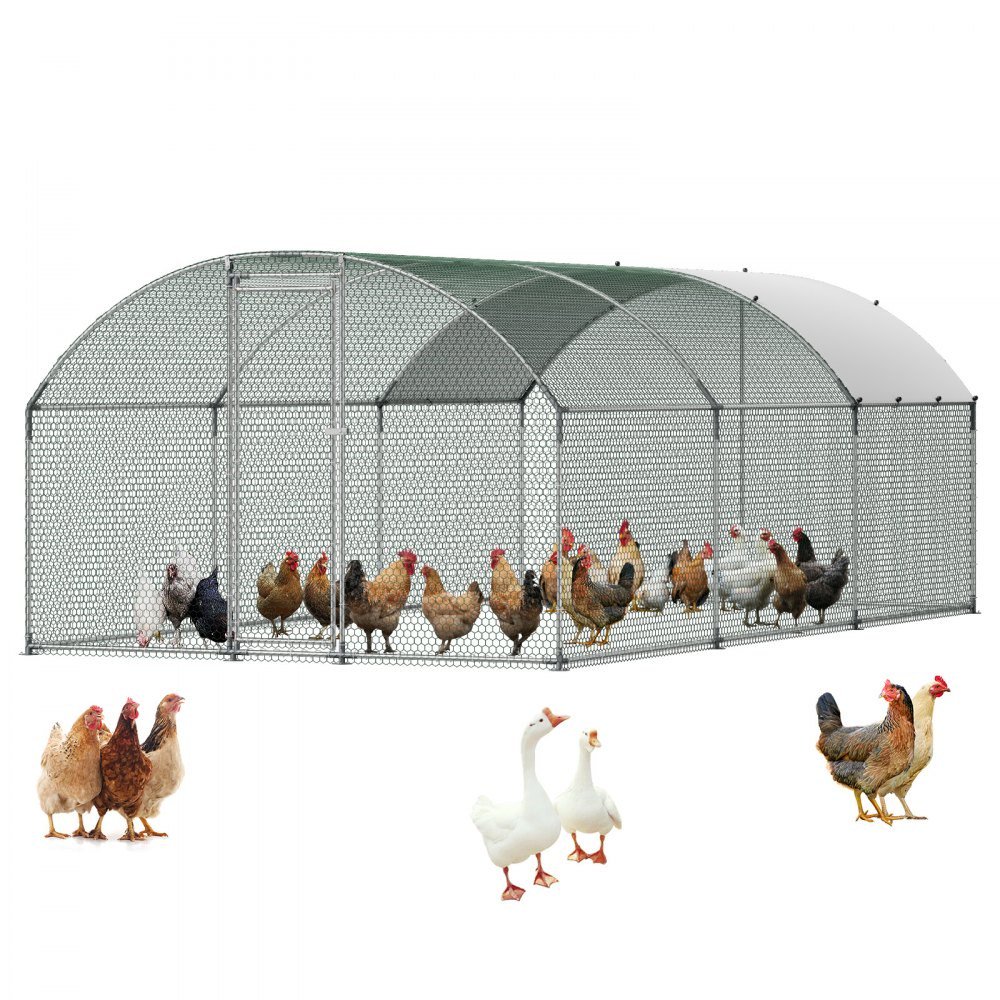
VEVOR's walk-in metal chicken runs are some of the most affordable large enclosures you can buy online, with sizes from a narrow 6.6 x 3.3 ft pen to a 9.8 x 19.7 ft dome run. They are listed as "chicken coops," but they are really covered runs: a galvanized steel frame, hexagonal wire mesh walls, a single walk-in door and a PE canopy on top. Picking the right one comes down to how many birds you keep, where the run will sit, and how much predator-proofing you are willing to add.
This how-to guide walks through those decisions using VEVOR's own product specs and listed prices (checked November 15, 2026) alongside space and predator guidance from university extension services. It is research-based; we have not installed these runs ourselves.

Step 1: Understand what you are buying
Every VEVOR walk-in run we looked at shares the same core design:
- Frame: galvanized steel pipe. On the 6.6 x 6.6, 9.8 x 6.6, 9.8 x 13.1 and 9.8 x 19.7 ft runs, VEVOR specifies 1-inch pipes and says the frame was salt-spray tested.
- Walls: hexagonal wire mesh, PVC-coated galvanized on the 6.6 x 6.6 ft model, attached with zip ties or bungee cords depending on size.
- Roof: a PE (polyethylene) canopy that VEVOR describes as waterproof, sun-blocking and tear-resistant. Depending on the model it covers the top or part of the top.
- Door: one walk-in door. On the 9.8-ft-wide runs the door frame is 6.17 x 2.12 ft.
- Floor: none. The run sits on the ground and is anchored with stakes.
What's missing matters as much as what's included. There is no enclosed, draft-free house, roost bar or nesting box. Oregon State University Extension recommends a coop that closes the flock inside at night, raised at least a foot off the ground with a solid floor. Treat a VEVOR run as the outdoor half of a setup: pair it with a wooden coop or henhouse, or put one inside a large run. VEVOR's poultry category even lists a low 3.3 x 6.6 x 3.3 ft run as "compatible with wooden coops," which says the same thing.
Step 2: Size the run by square feet per bird, not by the label
VEVOR's product images include flock-size labels, and they are generous. The University of Maryland Extension, citing Virginia Cooperative Extension, lists these minimum outdoor run areas per bird:
| Bird type | Inside coop (sq ft per bird) | Outside run (sq ft per bird) |
|---|---|---|
| Bantam chickens | 1 | 4 |
| Laying hens | 1.5 | 8 |
| Large chickens | 2 | 10 |
| Ducks | 3 | 15 |
Here is how VEVOR's runs compare once you do the math with those figures. Floor area is calculated from VEVOR's listed length and width.
| VEVOR run (L x W x H) | Roof | Floor area | VEVOR image label | Laying hens at 8 sq ft | Large breeds at 10 sq ft | Listed price |
|---|---|---|---|---|---|---|
| 6.6 x 3.3 x 6.6 ft | Spire | about 22 sq ft | 4–6 chickens | 2 | 2 | $89.90 |
| 6.6 x 6.6 x 6.6 ft | Spire | about 44 sq ft | 7–10 chickens | 5 | 4 | $109.90 |
| 9.8 x 6.6 x 6.6 ft | Spire | about 65 sq ft | not shown | 8 | 6 | $149.90 |
| 9.8 x 9.8 x 6.6 ft | Spire | about 96 sq ft | 16–20 chickens | 12 | 9 | $169.90 |
| 9.8 x 13.1 x 6.6 ft | Spire | about 128 sq ft | 18–24 chickens | 16 | 12 | $170.91 |
| 9.8 x 19.7 x 6.6 ft | Dome | about 193 sq ft | 20–27 chickens | 24 | 19 | $239.90 |
The pattern is clear: VEVOR's labels assume roughly 4 to 5 square feet per bird in the smaller sizes, which is the extension minimum for bantams. If you keep standard laying hens, plan on about half the number VEVOR suggests in the smaller runs. In the largest dome run, VEVOR's upper figure lines up with the 8 square feet per laying hen guideline.

Also check your local rules. Some cities set their own space minimums. Columbus, Ohio, for example, publishes the same 8 and 10 square foot run figures and requires rodent-proof material from the ground up to 36 inches on permanent runs.
Step 3: Choose spire roof or dome roof
VEVOR sells most sizes with a spire (peaked) roof and some with a dome (arched) roof.
- Spire roof: VEVOR says the peak lets rain and snow slide off rather than pool and leaves space at the top for hanging a light. Spire models have a squarer interior, so the full floor is usable at standing height near the walls.
- Dome roof: the arch also sheds water and suits long runs like the 9.8 x 19.7 ft model, but headroom drops toward the sides.

In snowy regions, the shape matters less than the canopy. A PE tarp is not a snow load roof. Brush heavy snow off and consider adding a solid roof section over the part of the run where birds shelter. If you want more cover, a section of corrugated panel over the coop end gives birds a dry spot in rain.
Step 4: Plan predator-proofing before you order
This is where a budget run needs the most help. VEVOR's listings point out spiral-wrapped wire at the bottom and extended latches on the smallest model, narrow door gaps on the 9.8 x 9.8 ft model, and on several sizes VEVOR itself recommends adding a galvanized wire fence for protection against raccoons and similar wildlife.
Extension advice goes further:
- Use hardware cloth low down. The University of Maryland recommends half-inch hardware cloth over openings, and Columbus requires no openings larger than half an inch in rodent-proof material. Hexagonal chicken wire keeps chickens in but is not considered predator-proof.
- Add an apron or buried skirt. UMD suggests burying hardware cloth 12 inches to 1.5 feet deep around the coop; OSU suggests 6 inches to 1 foot for run fencing. Either way, it stops digging predators like foxes and dogs.
- Cover the top. Both UMD and OSU recommend netting or wire over the run against hawks and owls. VEVOR's canopy covers part or all of the top depending on the model, so check the canopy dimensions; on the 6.6 x 6.6 ft run it is 6.4 x 7.3 ft.
- Weigh the base. VEVOR suggests adding wood or stones along the bottom to reinforce the run.
- Keep the area clear. UMD advises keeping grass mowed around the coop, cleaning up food scraps before dark and keeping your compost pile well away from the coop. If you compost, read our VEVOR compost bin guide and pick a closed tumbler placed at a distance.
Step 5: Add the pieces that make a run livable
VEVOR sells several add-ons that fill the gaps in a bare run:

- Nesting boxes. VEVOR's four-compartment roll-away nesting box ($88.90 when we checked) has 10.4-inch compartments, angled trays that roll eggs into a collection area, drainage holes and either wall-mount holes or four legs. VEVOR says each compartment serves up to five hens; OSU Extension's guideline is one nest box for about every four birds, so a four-hole box covers a flock of roughly 16.
- An automatic door. VEVOR's solar and battery automatic coop door ($60.90 in orange; the black version was out of stock) uses a 2,000 mAh lithium battery with solar charging, offers light-sensor, timer, remote and manual modes, and has an anti-pinch feature that stops the door and lifts it back within three seconds if it detects an obstacle. It mounts on the coop, not the run, so birds are closed into the house at night automatically.

- A tunnel for free-range time. VEVOR's 118.1 x 28 x 24.2 inch chicken tunnel ($66.51) is a portable steel-frame mesh tunnel with a sunshade fabric cover that can be staked out over grass and moved around the yard.
Step 6: Prepare the site and assemble
VEVOR says the 6.6 x 3.3 ft run is designed for two people and takes about one to two hours; budget more for the 9.8-ft-wide sizes. Before you start:
- Pick level, well-drained ground. UMD recommends a well-drained site with access to water and electricity.
- Mark the footprint and dig the trench for your hardware cloth apron.
- Assemble the frame, attach the mesh, then fit the canopy last.
- Stake the run and weigh down the base.
- Add the coop, perches, feeders, waterers and nesting boxes inside or alongside.
Bottom line
For most backyard flocks of four to six laying hens, VEVOR's 9.8 x 6.6 ft spire run ($149.90 when we checked) is the smallest size that meets the 8-square-foot extension guideline for six birds, while the 9.8 x 9.8 ft and 9.8 x 13.1 ft runs give room to grow. Whatever size you buy, budget for half-inch hardware cloth, a buried apron and an enclosed coop, because the run alone is not a complete predator-proof home.
Before ordering, read our guide to buying from VEVOR for shipping and return details, and our Costway vs VEVOR shipping, returns and warranty comparison. If you also keep dogs, our Costway dog playpen vs pet gate guide covers containment for them.
References
- VEVOR, Chicken Coops category: https://www.vevor.com/chicken-coops-c_44862
- VEVOR, Poultry supplies category: https://www.vevor.com/category-c_10929
- VEVOR, Large Metal Chicken Coop 6.6 x 3.3 x 6.6 ft: https://www.vevor.com/metal-chicken-coop-c_10940/vevor-large-metal-chicken-coop-6-6-x-3-3-x-6-6-ft-walk-in-chicken-run-house-with-waterproof-cover-sturdy-frame-spire-roof-poultry-cage-duck-pen-for-rabbit-hen-goose-outdoor-backyard-farm-use-p_010275651793
- VEVOR, Large Metal Chicken Coop 6.6 x 6.6 x 6.6 ft: https://www.vevor.com/metal-chicken-coop-c_44978/vevor-large-metal-chicken-coop-6-6x6-6x6-6-ft-walk-in-chicken-run-house-spire-roof-hen-house-enclosure-with-cover-and-security-lock-outdoor-duck-rabbit-cage-poultry-pen-for-backyard-farm-yard-p_010556300714
- VEVOR, Large Metal Chicken Coop 9.8 x 6.6 x 6.6 ft: https://www.vevor.com/metal-chicken-coop-c_44978/vevor-large-metal-chicken-coop-9-8-x-6-6-x-6-6-ft-walk-in-chicken-runs-with-waterproof-cover-spire-roof-hen-house-enclosure-with-lock-outdoor-duck-rabbit-cage-poultry-pen-for-backyard-farm-yard-p_010181936923
- VEVOR, Large Metal Chicken Coop 9.8 x 9.8 x 6.6 ft: https://www.vevor.com/metal-chicken-coop-c_44978/vevor-large-metal-chicken-coop-9-8-x-9-8-x-6-6-ft-walk-in-chicken-run-house-with-waterproof-cover-sturdy-frame-spire-roof-poultry-cage-duck-pen-for-rabbit-hen-goose-outdoor-backyard-farm-use-p_010843134792
- VEVOR, Large Metal Chicken Coop 9.8 x 13.1 x 6.6 ft: https://www.vevor.com/metal-chicken-coop-c_44978/vevor-large-metal-chicken-coop-9-8-x-13-1-x-6-6-ft-walk-in-chicken-runs-with-waterproof-cover-spire-roof-hen-house-enclosure-with-lock-outdoor-duck-rabbit-cage-poultry-pen-for-backyard-farm-yard-p_010796330525
- VEVOR, Large Metal Chicken Coop 9.8 x 19.7 x 6.6 ft dome roof: https://www.vevor.com/metal-chicken-coop-c_44978/vevor-large-metal-chicken-coop-9-8-x-19-7-x-6-6-ft-walk-in-chicken-runs-with-waterproof-cover-dome-roof-hen-house-enclosure-with-lock-outdoor-duck-rabbit-cage-poultry-pen-for-backyard-farm-yard-p_010719701970
- VEVOR, Chicken Nesting Boxes, 4 Compartments: https://www.vevor.com/chicken-nest-box-c_10937/vevor-chicken-nesting-boxes-4-compartments-with-support-legs-easy-egg-collection-galvanized-steel-and-high-strength-plastic-roll-away-nesting-boxes-for-chickens-and-hens-laying-eggs-orange-p_010890342499
- VEVOR, Automatic Chicken Coop Door (orange): https://www.vevor.com/chicken-coop-door-opener-c_10944/vevor-automatic-chicken-coop-door-solar-battery-powered-chicken-door-with-lcd-display-remote-control-light-sensor-timer-anti-pinch-security-aluminum-alloy-chick-run-gate-opener-orange-p_010485353665
- VEVOR, Chicken Tunnels 118.1 x 28 x 24.2 inch: https://www.vevor.com/metal-chicken-coop-c_10940/vevor-chicken-tunnels-118-1-x-28-x-24-2-inch-lxwxh-chicken-tunnels-for-yard-portable-chicken-tunnels-for-outside-easy-installation-chicken-coop-run-suitable-for-chickens-ducks-rabbits-p_010135080498
- University of Maryland Extension, Housing Requirements: https://www.extension.umd.edu/resource/housing-requirements
- University of Maryland Extension, Prevention of Predation: https://extension.umd.edu/resource/prevention-predation
- Oregon State University Extension, Backyard chicken coop design (EC 1644): https://extension.oregonstate.edu/pub/ec-1644
- City of Columbus Public Health, Guide for Starting a Chicken Coop: https://www.columbus.gov/files/sharedassets/city/v/1/public-health/animals/chickencoopguide_10.10.2025.pdf
Meet your guide
Lipeiguan
author
What to read next
 Best Costway Patio Furniture (2026): Conversation Sets, Dining Sets and Loungers A research-based Costway patio furniture roundup as of November 18, 2026: official conversation, dining and folding lounge sets, current prices, weight capacities and box counts fr...
 How to Choose a VEVOR Jump Starter: Peak Amps, Start Current and Engine Size How to choose a VEVOR jump starter by official peak current, start current, watt-hours and gasoline or diesel engine limits, comparing the 1000A, 1500A, 3000A and 4000A models and...
 Best VEVOR Digital Pianos 2026: 88-Key Weighted vs Semi-Weighted vs Foldable vs 61-Key Six VEVOR digital pianos compared by who they suit, from the fully weighted 88-key furniture-stand models to the semi-weighted, foldable and 61-key beginner bundles, with keys, ton...