
Jackery Explorer 100D Review: A 96Wh LiFePO4 Power Station for USB-C Gear (Research-Based)
A research-based look at the Jackery Explorer 100D: 96Wh LiFePO4 battery, 140W USB-C ports, 158W total output, recharging options, size, price and who it suits.
Disclosure: This page may contain affiliate links. They do not influence our editorial conclusions. Read the disclosure.
Our pick
- See price at Jackery
Top pick
Jackery
Maker of portable power stations, solar generators and foldable solar panels for camping, travel and home backup.
Our verdict
On paper the Explorer 100D is a long-life LiFePO4 USB-C battery that stays under the 100Wh airline threshold and charges laptops at 140W, but it has no AC outlet and its 3,000-cycle lifespan is Jackery's own rating.
The Explorer 100D is Jackery's smallest portable power station so far. It is a 96Wh unit about the size of a palm, built on lithium iron phosphate (LiFePO4) cells and designed around USB-C rather than wall outlets. Jackery announced it on October 28, 2026, in Canada, and listed it on its US store on November 2, 2026. It is pitched as something between a pocket power bank and a camping power station: small enough for a carry-on bag, but rated to last for years of daily charging.
This is a research-based review. We have not tested the Explorer 100D ourselves. Everything below comes from Jackery's US product page, Jackery's launch announcement and reporting from The Verge, and we point out where a figure is Jackery's own claim.

Key specs at a glance
| Spec | Jackery Explorer 100D |
|---|---|
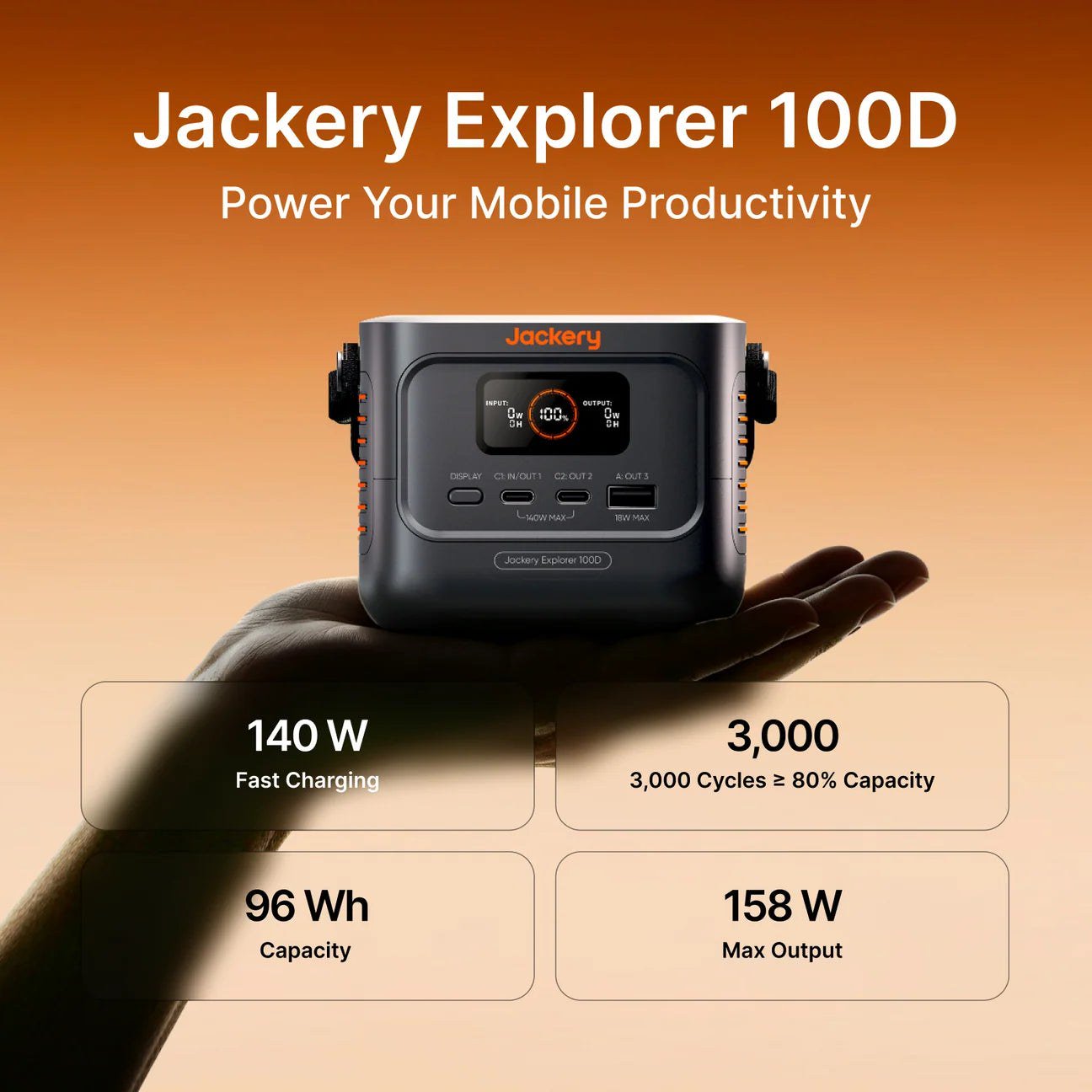
| Capacity | 96Wh (30,000mAh) |
| Battery chemistry | LiFePO4 |
| Rated lifespan | 3,000 cycles to at least 80% capacity; "up to 8 years" of use, per Jackery |
| Max total output | 158W |
| Ports | 2 × USB-C (140W each; C1 is input and output, C2 is output only), 1 × USB-A (18W) |
| Recharging | Up to 140W USB-C charger, up to 100W solar, up to 100W car charging |
| Size | 4.67 × 3.25 × 3.37 in (US product page) |
| Weight | 855 g (1.9 lb), per Jackery's launch release |
| Operating range | -4°F to 113°F, per Jackery's product graphics |
| Warranty | 2 years (Jackery US product page) |
| US price | $119.00 at jackery.com; $99 at Walmart from November 15 (The Verge) |
What it is (and what it is not)
Despite the "power station" name, the Explorer 100D has no AC outlet. You cannot plug in a lamp, a CPAP machine's AC adapter or a mini fridge. Everything runs through two USB-C ports and one USB-A port. In practice it is a very large, very durable USB power bank with a display and a carry handle.
That is a deliberate choice. Jackery's launch release frames the 100D as filling "that gap between pocket-size batteries and home-scale backup" for people who work on the move. If you need AC power, look at Jackery's larger Explorer models instead.
Battery: the headline feature
Most power banks use standard lithium-ion cells. The 100D uses LiFePO4, the chemistry Jackery and other brands already use in larger power stations. Jackery's claims for it are:
- 3,000 charge cycles while keeping at least 80% of the original capacity.
- Up to 8 years of regular use.
- A 50% longer lifespan than its predecessor, the Explorer 100 Plus, and than competing portable power stations, according to the launch release.
If those numbers hold, the 100D could outlive several ordinary power banks. The Verge makes the same point. You can find smaller and cheaper 30,000mAh chargers, but the LFP cells should "easily outlast" products built on more common lithium-ion cells. Note that the 3,000-cycle and 8-year figures are Jackery's own ratings, not independent results.
Jackery also lists a "10-layer battery cell protection" system and says the unit automatically reduces charging or discharging power when its internal temperature gets too high or too low. Its FAQ says this is normal behavior, not a fault, and that power returns once the temperature recovers.

Output: what it can charge
The 100D's ports are its whole interface, so they matter:
- USB-C1 and USB-C2 are each rated for up to 140W. That is enough for a 14-inch MacBook Pro or a USB-C gaming handheld.
- USB-A tops out at 18W, which suits a phone, earbuds case or small accessory.
- Total output is capped at 158W. You can run one laptop at full speed plus a phone, but not two 140W devices at full speed at the same time.
Jackery says the 100D supports AVS, PD and PPS charging protocols and markets it as "optimized for iOS". Its own charging claims, all to roughly 50%, are an iPhone 17 in 21 minutes, an iPhone 17 Pro Max in 23 minutes, an iPhone 18 Pro in 18 minutes and a DJI Pocket 3 in 10 minutes. On capacity, the US product page says the 96Wh battery delivers 4 or more charges for an iPhone 17 or Galaxy S26, or "about one full charge" for a 14-inch MacBook Pro. The Canadian release says "over 100%" of a MacBook Pro charge.
There is also a Low-Power Charging Mode. You turn it on by holding the DISPLAY button for 3 seconds, and it is meant for smartwatches and earbuds that can fail to charge from high-power ports.

Recharging: wall, sun and car
The 100D recharges through the USB-C1 port only. Jackery lists three ways to do it:
- USB-C charger: up to 140W input. The launch release says a 100W USB PD charger gets it to 80% in about 1.6 hours and to 100% in just over 2 hours. Jackery's FAQ notes that if you charge it and power other devices at the same time, input and output are each limited to 100W.
- Solar: up to 100W, with 0 to 80% in about 1.7 hours according to the US product page. Jackery lists its 40W and 100W panels as compatible, and you need a USB-C to DC8020 adapter.
- Car: works with 12V and 24V sockets through the same adapter. Jackery's release says 12V charging reaches 80% in slightly more than 3 hours, and 24V charging reaches a full charge in a little over 2 hours.
The "What's in the Box" list on Jackery's US page names only the power station and a charging cable, with no wall charger. Check whether you already own a USB-C charger of at least 100W before you order, because the fast-charging figures depend on one.
Size, display and carrying
Jackery puts the size at 4.67 × 3.25 × 3.37 inches on its US page, which it compares to an adult palm. The launch release says the 100D is lighter and smaller than the Explorer 100 Plus. It has a built-in soft-touch handle and an optional shoulder strap, sold separately.
The front has a TFT display showing input and output power, battery level, remaining runtime, battery health and temperature. A single DISPLAY button cycles through status screens: press once to switch screens, double-press to keep the screen on or off, and hold for 3 seconds for low-power mode.
Price and availability
On November 2, 2026, Jackery's US store listed the Explorer 100D at $119.00 with free shipping and a 2-year warranty, though the page showed it as sold out with a "Notify Me" option when we checked. The Verge reports that it arrives at Walmart for $99 on November 15 and that Costco already sells a two-pack for $179.99. In Canada it launched at CAD $159 against a CAD $179 MSRP.
Prices differ by channel, and so do the terms. See our Jackery shopping guide for the jackery.com return, warranty and points rules.
Who it suits
- Frequent flyers and commuters who want laptop-class USB-C power that stays under the common 100Wh airline limit. Our guide to flying with the Explorer 100D covers the FAA and TSA rules.
- People who replace power banks often. The LiFePO4 cycle rating is the main reason to pick this over a cheaper 30,000mAh charger.
- Light camping or van use, if you only need to charge phones, cameras and a laptop and already own a small solar panel.
It is a poor fit if you need AC outlets, want to run small appliances, or want the smallest possible charger for a pocket. At about 1.9 lb, it is much heavier than a typical 20,000mAh power bank.
What we would want to know
Because this review is based on published information, a few questions remain open until independent testing appears. How much of the 96Wh is usable at the ports? How quiet is it under load? How does the display hold up in sunlight? We will update this page if Jackery publishes more detailed specs.
Verdict
On paper the Explorer 100D is a long-life LiFePO4 USB-C battery that stays under the 100Wh airline threshold and can charge a laptop at 140W. However, it has no AC outlet, and its 3,000-cycle and 8-year lifespan figures are Jackery's own ratings.
References
- Jackery Explorer 100D Portable Power Station. Jackery US. https://www.jackery.com/products/jackery-explorer-100d-portable-power-station
- Introducing Jackery Explorer 100D: The long-term mobile productivity partner redefining portable power stations on the ground, over the road and in the air. Jackery via GlobeNewswire, October 28, 2026. https://www.globenewswire.com/news-release/2026/10/28/3390553/0/en/introducing-jackery-explorer-100d-the-long-term-mobile-productivity-partner-redefining-portable-power-stations-on-the-ground-over-the-road-and-in-the-air.html
- Jackery made its portable power stations even smaller. The Verge, November 2, 2026. https://www.theverge.com/tech/1023173/jackery-explorer-100d-portable-power-station-battery-lithium-iron-phosphate
Meet your guide
Lipeiguan
author
What to read next
 Apple TV Will Be the Exclusive U.S. Home of F1 Academy Beginning in 2027 On November 19, 2026, Apple said F1 Academy will stream on Apple TV in the United States beginning in 2027, with every qualifying session and race included for U.S. Apple TV subscr... How to Watch F1 Academy on Apple TV in 2027: Official Calendar and Subscription Note Apple said U.S. Apple TV subscribers will get every F1 Academy qualifying session and race beginning in 2027. This guide records the official seven-round 2027 calendar graphic and...
 Google Adds Computer Use to the Gemini App for Mac in the U.S. On November 19, 2026, Google said computer use is available in the Gemini app for Mac, in English in the U.S. Official requirements include an Apple Silicon Mac on macOS Sequoia 15...