
Can You Fly With the Jackery Explorer 100D? FAA and TSA Carry-On Rules Explained
How the Jackery Explorer 100D's 96Wh battery fits FAA and TSA rules for power banks: carry-on only, the 100Wh limit, airline restrictions, packing and in-flight use.
Disclosure: This page may contain affiliate links. They do not influence our editorial conclusions. Read the disclosure.
Our pick
- See price at Jackery
Top pick
Jackery
Maker of portable power stations, solar generators and foldable solar panels for camping, travel and home backup.
What this guide covers
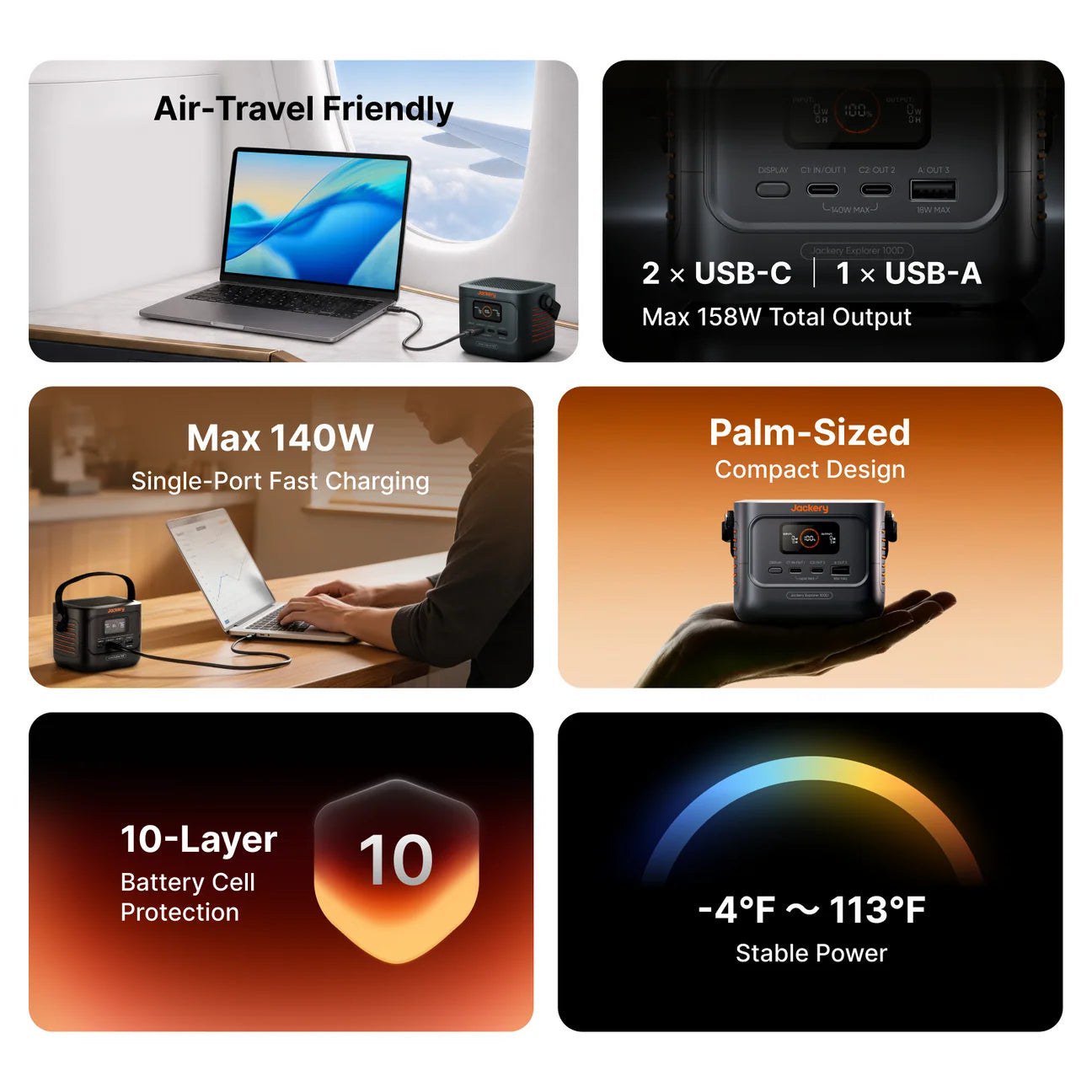
Jackery markets the new Explorer 100D as "air-travel friendly", and its 96Wh battery is the reason. Most US travelers will run into one number at the airport: 100 watt-hours. Below it, a spare lithium-ion battery or power bank can go in your carry-on without special approval. Above it, things get complicated. This guide explains what the FAA and TSA rules say, how the Explorer 100D fits under them, and what to check with your airline before you fly with it.
One caveat first. This is a summary of published US rules as of November 2026, not legal advice. Airlines can set stricter rules than the FAA, and the TSA officer at the checkpoint has the final say. Jackery's own product page includes the same warning.

The short answer
Yes, you can generally bring a Jackery Explorer 100D on a US flight, as long as you follow three rules:
- Carry-on only. It must travel in the cabin with you, never in checked baggage.
- It is under 100Wh, so the FAA does not require airline approval for its size.
- Your airline may still limit it. Check your carrier's power bank policy, especially for international flights.
The details behind each rule follow.
Rule 1: power banks never go in checked bags
The FAA's PackSafe guidance on lithium batteries is clear. Spare (uninstalled) lithium-ion and lithium metal batteries, "including power banks and cell phone battery charging cases, must be carried in carry-on baggage only". The guidance explicitly covers "external battery chargers (portable rechargers) containing a lithium ion battery". The Explorer 100D is exactly that, a standalone battery that charges other devices.
The TSA says the same thing. Its "What Can I Bring?" entry for power banks lists Carry On Bags: Yes and Checked Bags: No, and adds that spare lithium batteries, including power banks and phone chargers, are prohibited in checked luggage.
There is one situation that catches people out: gate-checked bags. The FAA says that when a carry-on bag is checked at the gate or at planeside, all spare lithium batteries and power banks must be removed from the bag and kept with you in the cabin. If you pack the 100D in a roller bag that might get gate-checked on a full flight, keep it in your personal item instead.
Rule 2: the 100Wh line
The FAA limits lithium-ion batteries to 100 watt-hours (Wh) per battery for passengers. With airline approval, you may also carry up to two spare larger batteries between 101 and 160Wh. Anything above 160Wh is not allowed as a passenger spare.
Jackery rates the Explorer 100D at 96Wh. That puts it under the 100Wh limit, which means no airline approval is needed on size grounds. That is the whole point of its design. Jackery's launch release describes the 96Wh capacity as "suitable for domestic and international flights", and the US product page calls it "under the typical 100Wh airline carry-on limit".
Why 30,000mAh can mean different watt-hours
Power banks are usually sold by milliamp-hours (mAh), but airlines care about watt-hours. The FAA's tip is to multiply the battery voltage by the amp-hours (Ah).
The Explorer 100D is listed as both 30,000mAh and 96Wh. That works out to 3.2 volts × 30Ah = 96Wh. A nominal 3.2V is typical of LiFePO4 cells. Ordinary lithium-ion power banks are often rated at a higher nominal voltage, around 3.6V to 3.7V. At 3.7V, the same 30,000mAh would come to 111Wh, which is over the line.
So do not assume two "30,000mAh" power banks are treated the same at the airport. Look for the Wh rating, which the FAA notes is marked on newer lithium-ion batteries.

Rule 3: your airline may be stricter
The FAA rules are a floor, not a ceiling. Its PackSafe page warns that "many airlines, both domestic and international, may have stricter quantity and Wh limits", including how many power banks each passenger may bring, regardless of capacity. It tells passengers to check with their carrier before traveling.
That matters more on international trips, where the foreign airline's rules and the departure country's rules both apply. Jackery says the same on its product page: "Airline policies and regulations may vary by carrier and region and are subject to change. Always check with your airline before traveling."
A practical approach:
- Look up your airline's "lithium batteries" or "power banks" page a few days before departure, not just the FAA page.
- Check whether the airline limits how many power banks you can carry. If you also carry a phone power bank, it counts too.
- Check whether the airline restricts using or charging power banks during the flight. These rules are set by carriers and can change.
- Print or screenshot the 100D's spec label or product page showing 96Wh in case a gate agent asks.
How to pack it
The FAA requires spare batteries to be protected from damage and short circuit, meaning the terminals should not touch metal. It suggests keeping batteries in their retail packaging, taping over terminals, using a battery case or sleeve, or putting them snugly in a plastic bag or protective pouch.
The Explorer 100D's USB ports are recessed in the front panel, but it is still sensible to:
- Pack it in a padded pouch or sleeve inside your personal item.
- Keep keys, coins and loose cables away from the ports.
- Unplug all cables before you go through security, so the unit and cables can be screened separately if needed.
The FAA also says damaged or recalled batteries must not be carried aboard an aircraft at all. If your 100D has been dropped hard, is swollen or shows warning messages, leave it at home and contact Jackery support.
Using it on the plane
If your airline allows power bank use in flight, the 100D's two 140W USB-C ports can charge a laptop and phone at the same time, within its 158W total output. Jackery says a single USB-C port can charge an iPhone 17 to 50% in about 21 minutes, and the 96Wh battery holds roughly one full charge for a 14-inch MacBook Pro.
The FAA notes that all lithium-ion batteries can overheat and go into thermal runaway, and flight crews are trained to respond. Its advice is to notify the flight crew immediately if a battery or device is overheating, expanding, smoking or burning. Keep the 100D where you can see it while it is charging something, not buried in a bag in the overhead bin.
Is the Explorer 100D a good travel battery?
That depends on what you carry. At 855 g (1.9 lb) according to Jackery, it is heavier than a pocket power bank. In return you get laptop-level 140W USB-C output, a display that shows battery level and remaining runtime, and LiFePO4 cells rated by Jackery for 3,000 cycles. That trade makes the most sense for people who work from airports and hotels with a laptop. Our research-based Explorer 100D review goes through the specs in detail.
If you are buying one before a trip, note that Jackery ships by ground only, with no expedited option. See our Jackery shopping guide for delivery times and return rules. The Explorer 100D launch report has US and Canadian pricing.
Quick checklist
- The Explorer 100D is rated 96Wh, under the FAA's 100Wh per-battery limit.
- Carry-on only; never checked, and take it out of any bag that gets gate-checked.
- Protect the ports from short circuits with a pouch or case.
- Check your airline's limits on the number of power banks and on in-flight use.
- Leave it at home if it is damaged or swollen.
References
- PackSafe: Lithium Batteries. Federal Aviation Administration. https://www.faa.gov/hazmat/packsafe/lithium-batteries
- What Can I Bring? Power Banks. Transportation Security Administration. https://www.tsa.gov/travel/security-screening/whatcanibring/items/power-banks
- Jackery Explorer 100D Portable Power Station. Jackery US. https://www.jackery.com/products/jackery-explorer-100d-portable-power-station
- Introducing Jackery Explorer 100D. Jackery via GlobeNewswire, October 28, 2026. https://www.globenewswire.com/news-release/2026/10/28/3390553/0/en/introducing-jackery-explorer-100d-the-long-term-mobile-productivity-partner-redefining-portable-power-stations-on-the-ground-over-the-road-and-in-the-air.html
Meet your guide
Lipeiguan
author
What to read next
 Google Adds Computer Use to the Gemini App for Mac in the U.S. On November 19, 2026, Google said computer use is available in the Gemini app for Mac, in English in the U.S. Official requirements include an Apple Silicon Mac on macOS Sequoia 15... How to Use Gemini Computer Use on a Mac: Official Requirements, Permissions and Examples Official Google requirements for computer use in the Gemini app for Mac: an Apple Silicon Mac on macOS Sequoia 15.0 or later, a personal Google account for people 18 or older, a Go...
 How to Choose a SwitchBot Lock: Lock Pro vs Lock Ultra vs Lock Vision and Vision Pro A research-based guide to official SwitchBot Lock Pro, Lock Ultra, Lock Vision and Lock Vision Pro specs and November 20, 2026 U.S. prices, including batteries, hubs, keypads, comp...