XREAL One vs One Pro vs 1S: Which XREAL Glasses Should You Buy?
A spec-based buyer's FAQ comparing the XREAL One, XREAL 1S and XREAL One Pro: field of view, brightness, refresh rate, fit sizes, prices and who each model suits.
Disclosure: This page may contain affiliate links. They do not influence our editorial conclusions. Read the disclosure.
Our pick
- See price at XREAL
Top pick
XREAL
Maker of AR and XR display glasses, including the Android XR-based XREAL AURA.
XREAL now sells several pairs of display glasses that look almost identical in photos but differ in price, optics and features. On its US store on November 2, 2026, the XREAL One and the newer XREAL 1S were both listed at $399, the XREAL One Pro at $539 and the XREAL 1 Pro+ at $599. If you are trying to work out which one is worth your money, this buyer's FAQ compares the three models XREAL publishes detailed specs for, using only XREAL's own product pages and tutorials. We have not used these glasses ourselves, so the comparisons below are about published specifications and features rather than personal impressions.

The short answer
- Choose the XREAL One Pro if a wider, brighter picture matters most and you are willing to pay more. XREAL lists a 57-degree field of view and 700 nits for the One Pro, against 50 degrees and 600 nits for the One.
- Choose the XREAL 1S if you want XREAL's newer features at the lower price point: XREAL highlights its on-glasses Real 3D conversion, a 120Hz refresh rate in 3DoF mode, Bose-tuned audio and TÜV Rheinland eye-comfort certification.
- Consider the XREAL One if you find it at a good price and simply want a large private screen for a phone, laptop or handheld; it shares the X1 chip and device compatibility with its siblings.
Spec comparison at a glance
| XREAL One | XREAL 1S | XREAL One Pro | |
|---|---|---|---|
| US store price (Nov 2, 2026) | $399 | $399 | $539 |
| Chip | XREAL X1 | XREAL X1 | XREAL X1 |
| Display | Sony 0.68-inch Micro-OLED | Not specified on the store page | Sony 0.55-inch Micro-OLED |
| Field of view | 50° | Not specified on the store page | 57° |
| Brightness (as listed) | 600 nits | Not specified on the store page | 700 nits |
| Refresh rate | Not specified on the store page | 120Hz in 3DoF mode, 90Hz global | 120Hz |
| Virtual screen claim | Ultrawide mode up to 310 inches | Up to 500 inches | 171 inches at 4 meters; Ultrawide up to 310 inches |
| Frame sizes | One size, three nose pads | Not specified on the store page | M (IPD 57–66mm) and L (IPD 66–75mm) |
| Prescription lens frame | $49.90 | $49.90 (One/1S frame) | $59.90 |
"Not specified" means XREAL's US store page did not list that figure when we checked, not that the feature is missing. XREAL measures virtual screen sizes at a set viewing distance, so they are best read as a rough sense of scale rather than a direct comparison between models.
What all three share
The X1 chip. XREAL describes the X1 as its self-developed spatial computing chip. On the One Pro and 1S pages it is credited with native 3DoF tracking and a 3ms motion-to-photon latency, which XREAL says keeps the screen stable as you move your head. The chip also powers on-glasses controls, so you can change screen size, distance, brightness and color temperature from buttons on the frame rather than through a phone app.
Plug-and-play connection. All three connect to devices whose USB-C port outputs video over DisplayPort, including iPhone 15 and newer, many Android phones, laptops, Steam Deck and ROG Ally. Consoles with HDMI need adapters. Our guide on how to connect XREAL glasses covers each device type, including Switch and Switch 2.
No battery. XREAL's tutorials note that One series glasses are powered by the device they are plugged into.
Optional 6DoF. Each model can be paired with the XREAL Eye camera accessory ($99 on the US store), which XREAL says unlocks 6DoF spatial anchoring so a screen stays pinned in place as you move, and lets you take photos and video from the glasses.
XREAL One Pro: the bigger, brighter picture

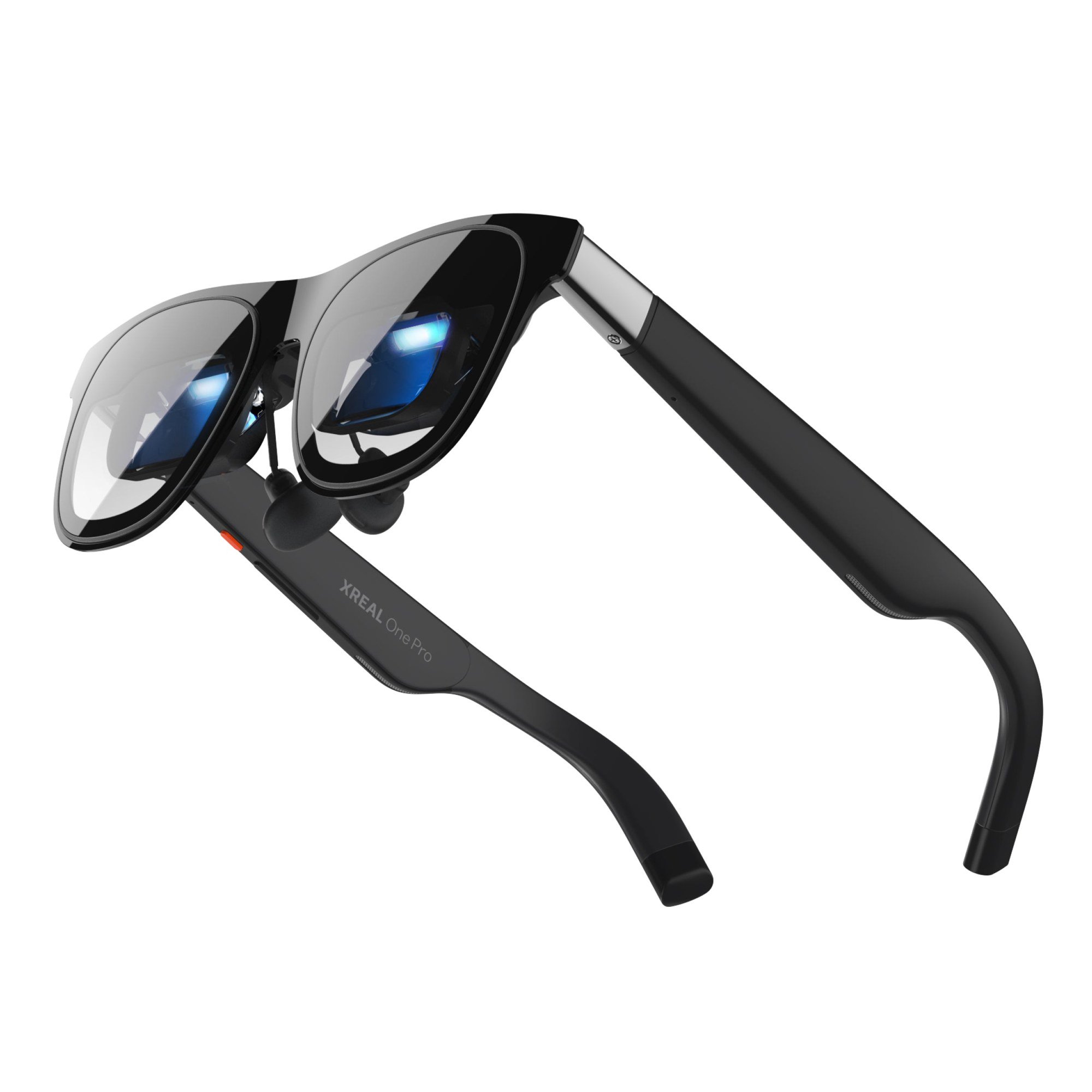
XREAL positions the One Pro as the step up. Its product page lists:
- a 57-degree field of view from what XREAL calls Optic Engine 4.0 with "X-Prism" optics, which it says takes up 40% less space;
- Sony 0.55-inch Micro-OLED panels at up to 120Hz and 700 nits;
- a virtual screen equivalent to 171 inches at 4 meters, with an Ultrawide mode that XREAL says reaches 310 inches;
- an anti-glare coating to reduce reflections.
XREAL's own comparison on the page says that, compared with the One, the One Pro has a larger field of view and a "marginally brighter" screen, a display system that reduces outside light interference and the image reflections sometimes visible on the front of the glasses, and a thinner, lighter front frame.
Fit is the other difference. The One Pro comes in two sizes based on interpupillary distance (IPD), the distance between your pupils: M for 57–66mm and L for 66–75mm. XREAL says the two sizes fit over 95% of users and that built-in software helps fine-tune IPD. If you do not know your IPD, an optician's prescription often lists it, and it is worth checking before you order.
XREAL 1S: the newer model at $399

The 1S is the newest of the three on XREAL's store. Its page focuses on features rather than optical figures:
- Refresh rate: 120Hz in 3DoF mode and a 90Hz global refresh that XREAL says eliminates flicker and blur.
- Screen size: a virtual screen of up to 500 inches.
- Clarity: a redesigned optical engine that XREAL says improves clarity by 9%, with each unit individually color-tuned and distortion-tuned.
- Viewing modes: 0DoF follow, 3DoF anchor, Ultrawide (32:9 or 21:9), Real 3D and Side-View.
- Real 3D: XREAL calls this the first on-glasses technology that converts 2D games, movies, apps and photos into 3D with one switch, at up to 30fps with 90–100ms latency.
- Audio: a sound system co-developed with Bose.
- Eye comfort: TÜV Rheinland certification for low blue light and flicker-free viewing, plus 100% UV protection.
Because the 1S page does not list field of view or brightness, it is hard to say on paper how its picture compares with the One Pro. If a wide field of view is your priority, the One Pro is the model with the clearest published advantage.
XREAL One: still a capable entry point
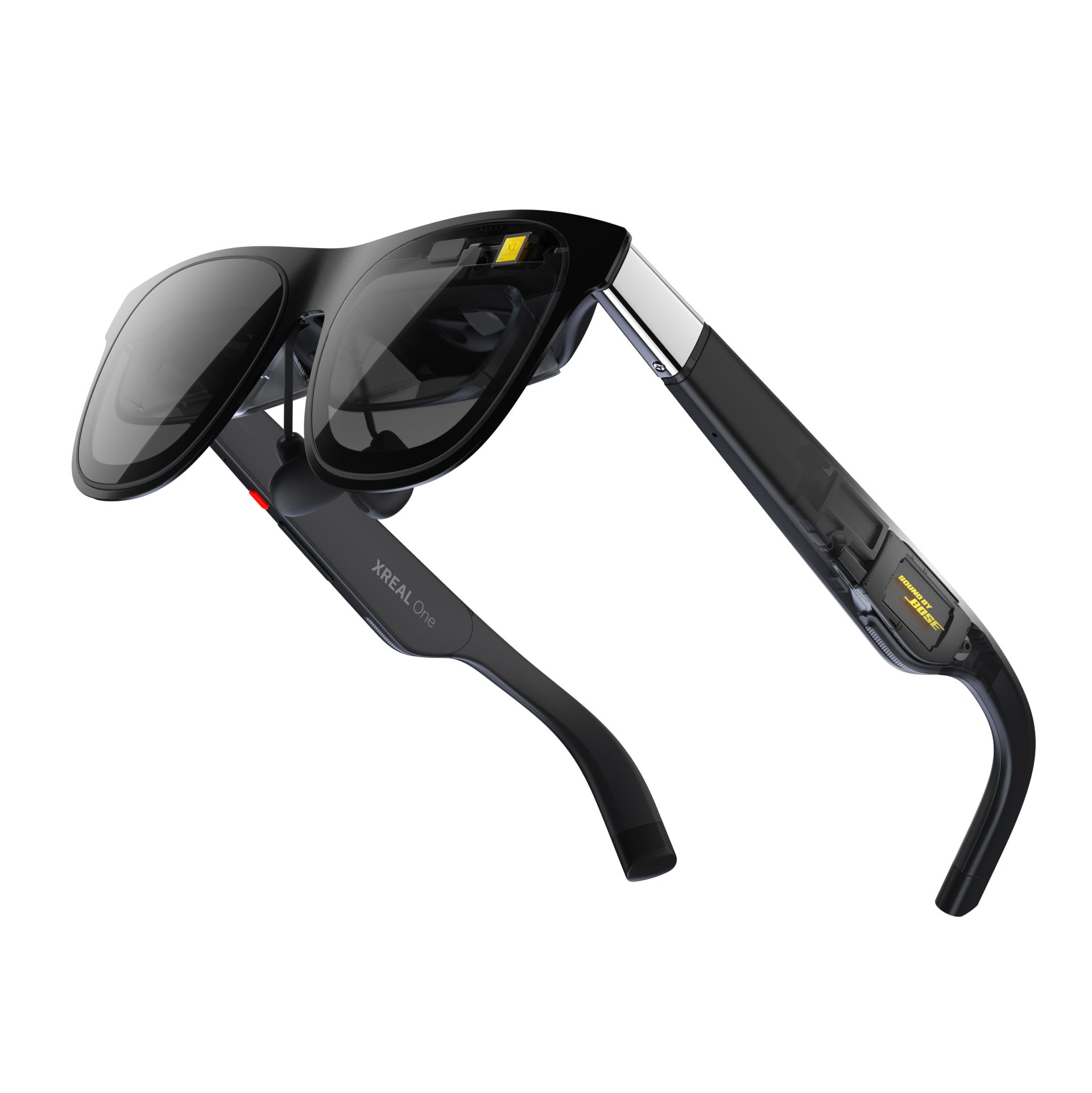
The One shares the X1 chip, the on-glasses controls and the same device compatibility. XREAL lists a 50-degree field of view, Sony 0.68-inch Micro-OLED panels and 600 nits. In the box, according to XREAL, you get the glasses, a prescription lens frame (without lenses), a detachable USB-C cable, three sizes of nose pads, a protective case, a cleaning cloth and a user manual. With the 1S at the same $399 list price on XREAL's store, the One is mostly worth considering when it is discounted.
Buyer's FAQ
Which XREAL glasses are best for gaming? For handheld PCs like Steam Deck, all three plug in directly. XREAL markets the One Pro as its gaming-focused model because of its wider field of view and 120Hz display. The 1S also lists 120Hz in 3DoF mode.
Which is best for working on a laptop? Ultrawide mode, which XREAL supports on laptops and other devices with desktop-style output, is available on all three. A wider field of view (One Pro) means less head movement to see the edges of a large virtual monitor.
Can I wear them with glasses? Not over your regular glasses. XREAL sells prescription lens frames for each model: $49.90 for One/1S and $59.90 for One Pro on its US store.
Do I need the XREAL Eye? Only if you want 6DoF anchoring or want to take photos and videos from the glasses. For watching and gaming, 3DoF is built in.
What about the XREAL 1 Pro+? It is listed at $599 on XREAL's US store, including in a bundle with a discounted XREAL Eye. XREAL's store page did not publish a detailed spec table for it when we checked, so compare it on XREAL's site before deciding.
What about XREAL AURA? AURA is a different class of product built on Android XR, priced from $1,099. See our XREAL AURA launch coverage and our AURA vs portable monitor guide.
The bottom line
For most buyers the choice comes down to two models. The One Pro costs $140 more but has the clearest published optical advantages: a 57-degree field of view, 700 nits and two IPD sizes. The 1S matches the One's price and adds newer software and comfort features such as Real 3D conversion, Bose-tuned audio and TÜV Rheinland certification. Check your device's video output, your IPD and current prices on XREAL's store before ordering.
References
- XREAL US Shop. "XREAL One Pro" product page. https://us.shop.xreal.com/products/xreal-one-pro
- XREAL US Shop. "XREAL One" product page. https://us.shop.xreal.com/products/xreal-one
- XREAL US Shop. "XREAL 1S" product page. https://us.shop.xreal.com/products/xreal-1s
- XREAL US Shop. "XREAL Eye" product page. https://us.shop.xreal.com/products/xreal-eye
- XREAL US Shop. "XREAL 1 Pro+" product page. https://us.shop.xreal.com/products/xreal-1-pro
- XREAL. "XREAL One Pro." https://www.xreal.com/one-pro
- XREAL Tutorials. "Connect Devices" (XREAL One series). https://tutorials.xreal.com/docs/glasses/one-series/first-use/connect-device/
Meet your guide
Lipeiguan
author
What to read next
 How to Connect XREAL Glasses to iPhone, Android, Laptops, Steam Deck, Switch and PS5 A device-by-device guide to connecting XREAL One series glasses: the DisplayPort rule, direct connections, Switch and Switch 2 workarounds, HDMI consoles and troubleshooting.
 Google Health Premium Review (Formerly Fitbit Premium): Price, Coach and What Changed A research-based review of Google Health Premium, the renamed Fitbit Premium: pricing, trial terms, what the coach adds over the free app, and what was removed.
 EasySMX Controller Shopping Guide: Which Model Fits Switch 2, PC or Your Phone A platform-first guide to the current EasySMX controller lineup with prices from easysmx.com, plus the store's shipping, return and warranty rules.