
Best Jackery Power Stations (2026): Which to Buy for Camping, RVs and Home Backup
A research-based guide to Jackery's current power stations: how to size one, the best pick for camping, RVs, rough conditions and home backup, with official specs and listed prices.
Disclosure: This page may contain affiliate links. They do not influence our editorial conclusions. Read the disclosure.
Our pick
- See price at Jackery
Top pick
Jackery
Maker of portable power stations, solar generators and foldable solar panels for camping, travel and home backup.
Jackery sells more than a dozen power stations, and the names do not make the choice easy: Explorer, HomePower, Plus, Pro, Ultra, v2. The useful way to cut through it is to start with what you want to power and for how long, then pick the smallest unit that covers it. A bigger battery costs more, weighs more and takes longer to recharge.
This guide picks the Jackery models that make the most sense for common jobs, from a weekend of camping to keeping a refrigerator running through an outage. It is research-based: the specs, claims and prices come from Jackery's own product pages as listed on jackery.com on November 3, 2026, and we have not run these units ourselves. Jackery's prices change often, sometimes daily during sale periods, so check the product page before you buy.

Quick picks
| Model | Capacity | Rated AC output | Listed price (Nov 3, 2026) | Best for |
|---|---|---|---|---|
| Explorer 300 | 292Wh | 300W | $289 | Camping, phones, cameras and weekend trips |
| HomePower 1000 v2 | 1,024Wh | 1,500W | $549 (white), $559 (black) | Home office backup, small appliances |
| Explorer 1000 v2 | 1,024Wh | 1,500W | $559 (black), $589 (white) | Car camping and RV trips |
| Explorer 1500 Ultra | 1,536Wh | 1,800W | $1,199 | Rough conditions, job sites, rain |
| HomePower 2000 Plus v2 | 2,048Wh (expandable to 12kWh) | 2,400W | $1,549 with extra battery | Whole-day home backup |
| HomePower 3600 Plus | 3,584Wh (expandable to 21kWh) | 3,600W | bundles from $2,549 | Multi-day outages, 240V appliances |
How to size a power station
Two numbers matter. Capacity in watt-hours (Wh) is how much energy the battery holds. Rated output in watts (W) is how much it can deliver at once. A 1,024Wh unit could, in theory, run a 100W load for about 10 hours, but real runtime is lower because of conversion losses, so treat any simple division as an upper limit.
Add up the wattage of everything you want to run at the same time and make sure the rated output is comfortably above it. Then multiply each device's watts by the hours you need it and add those up to estimate capacity. Appliances with motors, such as refrigerators and power tools, can draw a short surge on startup, which is why Jackery lists peak or surge figures as well.
Best for camping and day trips: Explorer 300

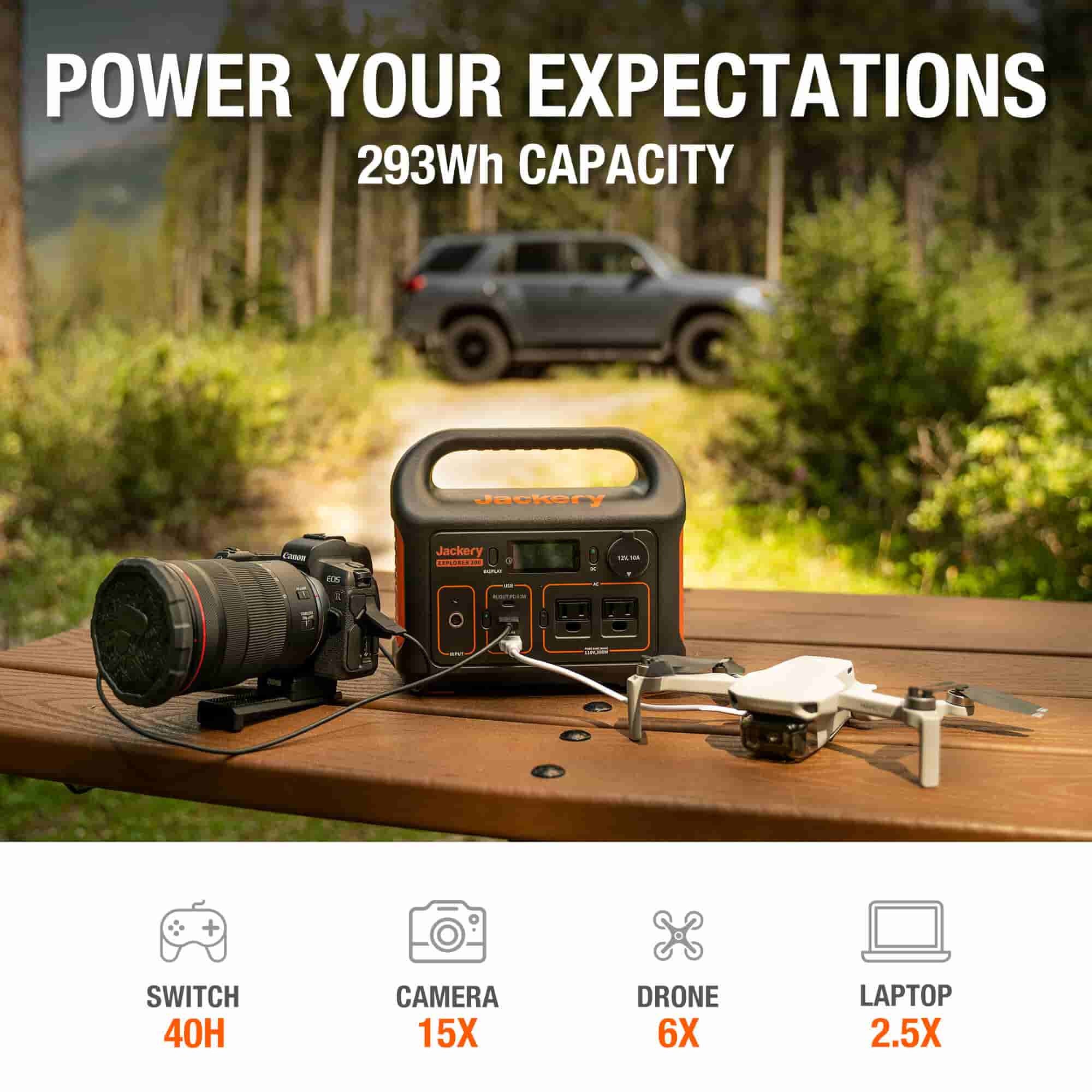
The Explorer 300 is Jackery's current small all-rounder. Jackery lists it at 7.5 pounds with 292Wh of capacity and 300W rated output, and says it can power six devices at once through two AC outlets, a 100W USB-C PD port, two USB-A ports and a 120W car port. It uses LiFePO4 cells that Jackery rates for 4,000+ charge cycles to 70% capacity, and the brand says it reaches 80% in about 2.8 hours from a compatible 100W solar panel. Jackery lists it at $289 with a 5-year warranty.
Note that the similarly named Explorer 300 v2 was marked sold out on jackery.com, with the store pointing shoppers to the Explorer 300 instead.
If you only need to charge phones, laptops and cameras and want something that fits in a carry-on, the much smaller 96Wh Explorer 100D is the other option. It has no AC outlet, though, and it showed as unavailable on jackery.com when we checked. We cover it in our Explorer 100D review and our guide to flying with the Explorer 100D.
Best value for home backup: HomePower 1000 v2

The HomePower 1000 v2 has the same 1,024Wh capacity and 1,500W output as the Explorer 1000 v2 below, but it is listed for less ($549 in white at the time of writing) and Jackery aims it at the home. The brand highlights a sub-10ms switchover, so it can act like an uninterruptible power supply for a PC or router during a blackout. It also lists built-in lightning protection, 3kV surge resistance, a full recharge in 50 minutes, operation under 30dB, and a rating of 6,000+ cycles.
Its "Priority Routing" feature lets you pick which devices stay on. Jackery says that when the battery drops to a level you set, the unit shuts off less critical devices so essentials such as a refrigerator, router and lights keep running longer.
Best for car camping and RVs: Explorer 1000 v2

The Explorer 1000 v2 is the travel version of the 1kWh class. Jackery lists 1,024Wh, 1,500W output, dual 100W USB-C ports, an "Emergency Super Charge" mode that takes it from 0 to 100% in 50 minutes, and LiFePO4 cells rated for 4,000 cycles, backed by a 5-year warranty at jackery.com. It is sold alone or bundled with a SolarSaga 200W panel ($879 black, $909 white).
Jackery's own page for this model now says "Looking for a newer, more affordable option? Explore HomePower 1000 v2." If you mostly want home backup, take that hint. Pick the Explorer if you specifically want the Explorer design for the road and the solar bundle.
Best for tough conditions: Explorer 1500 Ultra

The Explorer 1500 Ultra is the rugged pick. Jackery says it is IP65-rated against dust and water, "one-meter drop-resistant," and designed with a drainage base for rain or dusty job sites. Its 1,536Wh LiFePO4 battery delivers 1,800W continuous, and Jackery lists a 3,600W peak for 5 seconds and 2,000W for up to 15 minutes, which helps with tools and pumps that surge on startup.
Charging is quick by Jackery's figures: a full AC charge in 1.5 hours, solar in 2.5 hours at up to 800W, or vehicle alternator charging in about 3 hours. It is rated for 4,000+ cycles to 70% capacity and comes with a 5-year warranty (3 years standard plus a 2-year extension). The price is $1,199 alone or $1,659 with two SolarSaga 200W panels.
Best for whole-day home backup: HomePower 2000 Plus v2

If you want to keep more of the house running through a day-long outage, the HomePower 2000 Plus v2 steps up to 2,400W output and 2,048Wh of capacity, expandable to 12kWh with extra batteries. Jackery says it is the lightest expandable 2kWh system on the market, 34% lighter than the previous generation, and rates it for 6,000+ cycles. It has a 140W USB-C port and Jackery lists operation at 30dB.
One compatibility trap: Jackery states that it works only with the Battery Pack 2000 Plus v2, not the older Battery Pack 2000 Plus. On November 3, the standalone unit ($1,199 listed) showed as unavailable, while the bundle with a Battery Pack 2000 Plus v2 was available at $1,549.
Best for long outages: HomePower 3600 Plus

The HomePower 3600 Plus is the big one in this guide: 3,600W output and 3,584Wh of capacity, expandable to 21kWh. Jackery claims it can keep a fridge running for up to 14 days, and says it supports 120V and 240V dual voltage in parallel for appliances such as a well pump or dryer. To feed your home's circuits directly, Jackery says you add a manual transfer switch; that kind of connection to household wiring should be installed by a licensed electrician.
Availability was tight on November 3. The product page said the unit was sold out due to demand and available for pre-order shipping November 16, with the standalone listing ($1,899) unavailable and solar or battery bundles from $2,549.
Buyer's FAQ
Explorer or HomePower: what is the difference?
Based on how Jackery describes them, the Explorer line is built around portability and outdoor use, while the HomePower line is aimed at home backup, with features like UPS-style switchover, Priority Routing and expansion batteries.
Do I need solar panels?
Only if you will be away from wall power for more than a day or want to recharge during a long outage. Jackery sells many of these units in bundles with its SolarSaga panels. Real solar charging times depend on sun, angle and weather, so treat Jackery's charge-time figures as best-case.
What warranty and return policy do I get?
Most of the models above list a 5-year warranty when bought at jackery.com. Returns, cancellations and membership points are covered in our Jackery shopping guide.
Is the Explorer 100D cheaper somewhere else?
Jackery announced the Explorer 100D at $119 on its own site and said it would be $99 at Walmart from November 15. See our Explorer 100D launch story.
Bottom line
For camping and light use, the Explorer 300 is the sensible starting point. For home backup on a budget, the HomePower 1000 v2 gives you the same 1kWh capacity as the Explorer 1000 v2 for less. Step up to the Explorer 1500 Ultra if your power station will live outdoors, and to the HomePower 2000 Plus v2 or 3600 Plus only if you have measured your loads and need to run a refrigerator or bigger appliances for a day or more.
References
- Jackery, "Jackery Explorer 300 Portable Power Station," product page, jackery.com/products/explorer-300-portable-power-station (accessed Nov 3, 2026).
- Jackery, "Jackery HomePower 1000 v2," product page, jackery.com/products/jackery-homepower-1000-v2 (accessed Nov 3, 2026).
- Jackery, "Jackery Portable Power Station Explorer 1000 v2," product page, jackery.com/products/jackery-explorer-1000-v2 (accessed Nov 3, 2026).
- Jackery, "Jackery Portable Power Station Explorer 1500 Ultra," product page, jackery.com/products/jackery-explorer-1500-ultra-portable-power-station (accessed Nov 3, 2026).
- Jackery, "Jackery HomePower 2000 Plus v2," product page, jackery.com/products/jackery-homepower-2000-plus-v2 (accessed Nov 3, 2026).
- Jackery, "HomePower 3600 Plus," product page, jackery.com/products/homepower-3600-plus (accessed Nov 3, 2026).
- Jackery, "Jackery Portable Power Station Explorer 300 v2," product page, jackery.com/products/jackery-explorer-300-v2-portable-power-station (accessed Nov 3, 2026).
- Jackery, "Jackery Explorer 100D Portable Power Station," product page, jackery.com/products/jackery-explorer-100d-portable-power-station (accessed Nov 3, 2026).
Meet your guide
Lipeiguan
author
What to read next
 Apple TV Will Be the Exclusive U.S. Home of F1 Academy Beginning in 2027 On November 19, 2026, Apple said F1 Academy will stream on Apple TV in the United States beginning in 2027, with every qualifying session and race included for U.S. Apple TV subscr... How to Watch F1 Academy on Apple TV in 2027: Official Calendar and Subscription Note Apple said U.S. Apple TV subscribers will get every F1 Academy qualifying session and race beginning in 2027. This guide records the official seven-round 2027 calendar graphic and...
 Google Adds Computer Use to the Gemini App for Mac in the U.S. On November 19, 2026, Google said computer use is available in the Gemini app for Mac, in English in the U.S. Official requirements include an Apple Silicon Mac on macOS Sequoia 15...