
How to Choose a FOGATTI RV Furnace: BTU Size, Four Heat Levels and the InstaHeat 35K
A step-by-step way to choose among FOGATTI's InstaHeat 20K, 25K, 30K and Ultra 35K furnaces using official output, airflow and fit guidance, plus how the 35K's 17,000, 25,000, 30,000 and 35,000 BTU settings are meant to be used.
Disclosure: This page may contain affiliate links. They do not influence our editorial conclusions. Read the disclosure.
Our pick
- See price at FOGATTI
Top pick
FOGATTI
FOGATTI is an RV comfort brand that sells InstaHeat propane furnaces, InstaShower water heaters, InstaCool rooftop air conditioners and RV kitchen appliances on...
Steps in this guide
Choosing an RV furnace is less about picking the biggest BTU number and more about matching output, airflow and cabinet fit to the coach you already have. FOGATTI makes that point directly on its InstaHeat Ultra 35K page: "More BTU is useful only when the installation and calculated heat load support it." This guide walks through FOGATTI's official lineup — the InstaHeat 20K, 25K, 30K and Ultra 35K — and explains how the 35K's four heating levels are meant to be used. It is based on FOGATTI's product, collection and policy pages, plus FOGATTI's November 15, 2026 product update, and does not include hands-on testing.

Start with heat load and fit, not the badge
FOGATTI's 35K product page opens its fit section with three checks:
- Match calculated heat load — not BTU alone — to the RV.
- Confirm cabinet, duct, return-air and exhaust fit.
- Verify propane supply, 12V power and installation clearances.
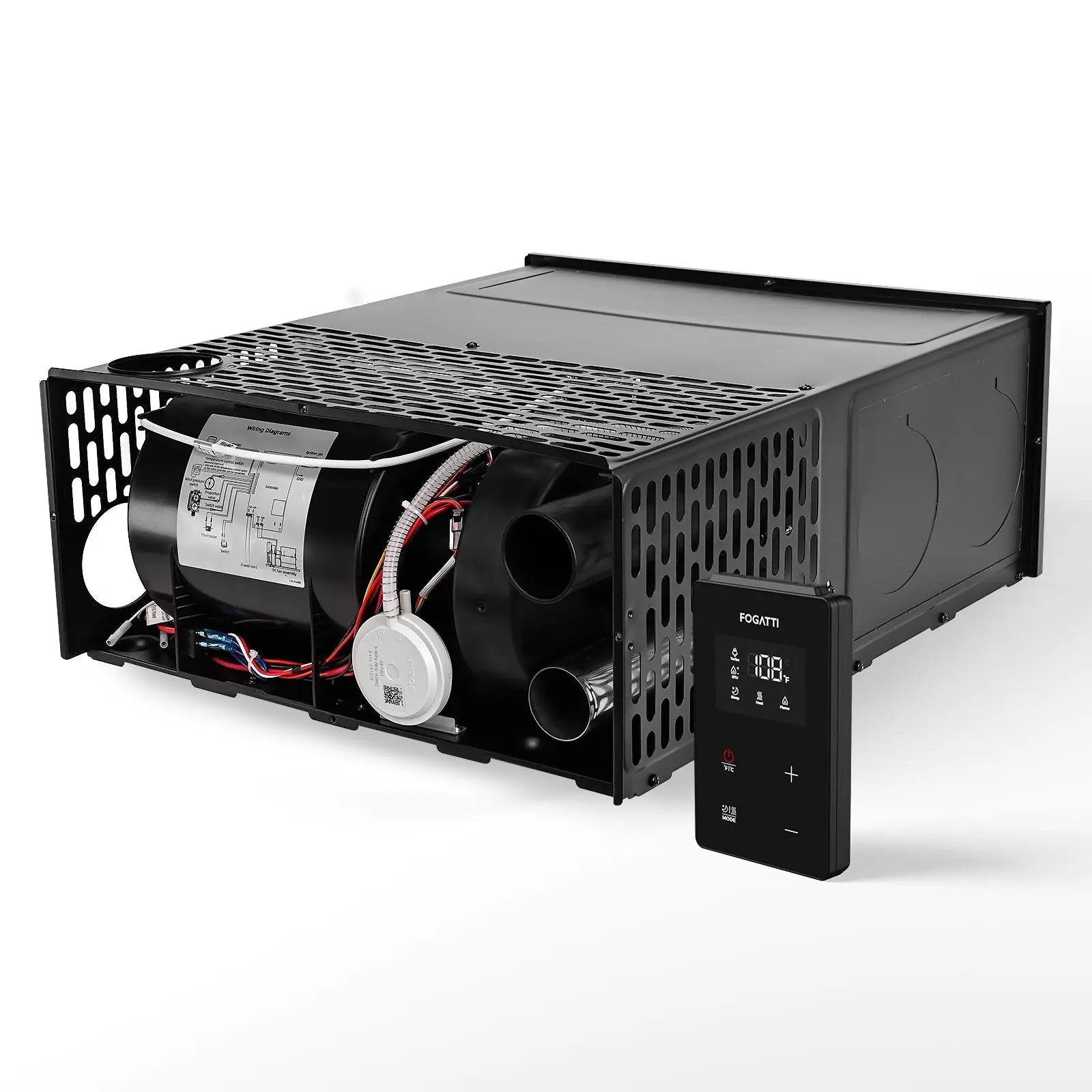
Those checks come before the model comparison for a reason. A 35,000 BTU furnace in a cabinet that cannot take its 17.7 × 7.8 × 20.1 in size, or on a duct system that cannot support its 320 CFM airflow and 0.10 in WC static pressure, will not deliver the recovery FOGATTI describes. The same page warns that a restricted duct system can undermine performance and create avoidable furnace problems.
The RV furnace collection adds a practical checklist before you buy: confirm the existing furnace's complete model number, BTU rating, front gas-inlet configuration and installation requirements, and contact FOGATTI support if the compatibility is unclear. FOGATTI also publishes a replacement-orientation guide on the collection page for common Suburban SF-xxFQ and Furrion FFG xx FA front-gas-inlet setups, and tells shoppers to view the full replacement guide rather than assume a drop-in fit.
FOGATTI's own RV furnace buying guide, published on fogatti.com, offers a size starting point after those fit checks: 25K for a small RV or compact trailer, 30K for a travel trailer or mid-size fifth wheel, and the 35K Ultra for a larger fifth wheel, deeper winter use or full-time comfort. Treat that as official guidance from FOGATTI, not a substitute for a heat-load calculation or a tape measure in the existing cabinet.
The official InstaHeat lineup
On the InstaHeat Ultra 35K product page, FOGATTI compares the three larger ducted models like this:
| Model | Maximum heat | Airflow | Heat levels or output | Official best-for note on the 35K page |
|---|---|---|---|---|
| InstaHeat 25K | 25,000 BTU | 240 CFM | Standard output | Lighter heat loads and smaller ducted interiors |
| InstaHeat 30K | 30,000 BTU | 260 CFM | Standard output | A balanced option for moderate heat loads and lower duct airflow |
| InstaHeat Ultra 35K | 35,000 BTU | 320 CFM | Four levels: 17K / 25K / 30K / 35K | Larger rigs, colder travel, and owners who need fast recovery plus lower overnight levels |
The collection page also lists a compact InstaHeat 20K: 20,000 BTU, 245 CFM, a wired rotary thermostat, and a design aimed at Suburban NT-SEQ series replacements and space-limited installs.

Prices change, so always re-check the product page. On November 16, 2026, the official No Door / Front prices — the standard complete-furnace configuration on each page — were:
| Model | Official product page | No Door / Front price | Compare-at price shown |
|---|---|---|---|
| InstaHeat 20K Compact | 20K product page | From $799.99 (85 mm and 115 mm options) | $999.99 |
| InstaHeat 25K | 25K product page | $629.99 | $1,099.99 |
| InstaHeat 30K | 30K product page | $649.99 | $1,199.99 |
| InstaHeat Ultra 35K | 35K product page | $639.99 | $1,299.99 |
The 30K and 35K pages also list a furnace-core-only option: $545.99 (compare-at $749.99) for the 30K core, and $594.99 (compare-at $799.99) for the 35K core. Adding a black or white door raises the 35K front-intake price to $739.99. Those door and core choices are about the existing opening and whether you already have a compatible door, not about heating output.
One pricing detail is worth a second look: on November 16, 2026, the 35K No Door / Front configuration was listed at $639.99, $10 below the 30K No Door / Front price of $649.99. That is the pair of figures shown on FOGATTI's own product pages that day; it is not a reason to skip the heat-load and duct checks. The 35K still moves 320 CFM through seven 4-inch ducts and needs a compatible 35K cabinet. The 30K remains FOGATTI's "balanced" mid-size recommendation when the heat load and duct airflow do not support the larger unit.

How the 35K's four heat levels work
The Ultra 35K is the model FOGATTI equips with four selectable outputs: 17,000, 25,000, 30,000 and 35,000 BTU. The product page describes the point of those steps as "step down instead of always running high," so the system can match changing cabin demand more closely. Rapid, Standard and Sleep modes sit on top of that range. Sleep mode is rated at 40 dB, which FOGATTI presents as a way to maintain comfort overnight without repeatedly calling for maximum recovery.
FOGATTI's November 15, 2026 press release explains why those lower settings exist. Heating can draw heavily on a propane supply that also serves the cooktop and water heater, and a refill may mean breaking camp. The 35,000 BTU and 320 CFM combination is for warming a cabin that has been sitting in the cold; once the RV is warm, full power may no longer be needed. "On a winter trip, people notice how quickly the RV warms up. They also notice how much propane is left a few days later," said Legend Todd, Technical Director at FOGATTI. "We wanted owners to have useful choices between those two points. The thermostat update helps them control cabin temperature more accurately, while the four heat settings let them choose how much heating power to use."
In practice, FOGATTI's official story is a sequence: use the higher output (and Rapid mode) to recover, then use a lower BTU level and Sleep mode to hold the cabin. This site has not tested how much propane each level uses, or how quickly a given RV reaches a setpoint, so those figures are not estimated here. The official facts stop at the four listed outputs, the 320 CFM airflow, the three modes and FOGATTI's statement that the updated thermostat is meant to control cabin temperature more accurately.
The 25K and 30K, in the 35K page comparison, are listed with a single output each (25,000 and 30,000 BTU) and lower airflow (240 and 260 CFM). They can still be the right furnace if the cabinet, duct capacity and heat load point there. The 20K is a different, more compact replacement path, with 20,000 BTU, 245 CFM and a rotary thermostat, when the existing unit is a Suburban NT-SEQ or the space is limited.

A simple decision path
Use this order, which follows FOGATTI's own checks:
- Identify the existing furnace. Record the model number, BTU rating, cabinet opening, duct count and size, exhaust location, return-air opening, and whether the gas inlet is at the front or the back.
- Check physical fit first. For the 35K, FOGATTI lists a 17.7 × 7.8 × 20.1 in cabinet, seven 4-inch duct openings, 12V DC at 120W / 10A, LP propane, and horizontal or vertical mounting with the approved bracket for vertical installs. If those do not match, look at the 30K, 25K or 20K product pages instead of forcing the 35K.
- Match output to heat load and climate. FOGATTI points the 25K at smaller ducted interiors, the 30K at moderate mid-size loads, and the 35K at larger compatible ducted RVs and colder trips. Its buying guide uses a similar small / mid-size / larger-or-full-time split. If you are unsure, FOGATTI tells you to contact support rather than guess.
- Use the 35K's four levels as intended if you buy it. The official design is to recover at up to 35,000 BTU and 320 CFM, then step down to 30,000, 25,000 or 17,000 BTU and use Sleep mode overnight, especially when the same propane tanks also feed the cooktop and water heater.
- Read the purchase rules before you order. Shipping is free in the contiguous United States and Canada. Returns are limited to 30 days and are not accepted on installed or trial-used products. RV furnaces carry a 12-month limited warranty that does not cover installation labor. Those details are in the FOGATTI shopping guide. For the 35K's full specification table, configurations and current prices, see the InstaHeat Ultra 35K review.

If the cabinet, ducts and heat load line up, the Ultra 35K is FOGATTI's highest-output, four-level option, listed at $639.99 for the in-stock No Door / Front configuration on November 16, 2026. If they do not line up, the official 25K and 30K pages are the next place to look, not a larger badge on a furnace that will not fit.
References
- FOGATTI, "Fogatti 35,000 BTU Quiet LP Gas Propane RV Furnace" (InstaHeat Ultra 35K): https://fogatti.com/products/fogatti-35-000-btu-quiet-lp-gas-rv-furnace-smart-triple-explosion-proof-easy-install
- FOGATTI, "Fogatti InstaHeat 30K BTU RV Furnace": https://fogatti.com/products/fogatti-instaheat-30k-btu-rv-furnace-lp-gas
- FOGATTI, "Fogatti InstaHeat 25K BTU RV Propane Furnace": https://fogatti.com/products/fogatti-25-000-btu-rv-furnace-smart-triple-explosion-proof-easy-install
- FOGATTI, "Fogatti InstaHeat 20K Compact RV Furnace": https://fogatti.com/products/fogatti-instaheat-20k-compact-rv-furnace
- FOGATTI, "RV Furnaces": https://fogatti.com/collections/rv-furnace
- FOGATTI, "RV Furnace Buying Guide: How to Choose the Right BTU for Your Camper": https://fogatti.com/blogs/news/rv-furnace-buying-guide-how-to-choose-the-right-btu-for-your-camper
- FOGATTI, via PR Newswire, "FOGATTI Updates InstaHeat 35K for More Precise Heating on Winter RV Trips" (Nov. 15, 2026): https://www.prnewswire.com/news-releases/fogatti-updates-instaheat-35k-for-more-precise-heating-on-winter-rv-trips-302936357.html
- FOGATTI, "Shipping policy": https://fogatti.com/policies/shipping-policy
- FOGATTI, "Refund policy": https://fogatti.com/policies/refund-policy
- FOGATTI, "Warranty Policy": https://fogatti.com/pages/warranty
Meet your guide
Lipeiguan
author
What to read next
 Best DREO Humidifiers (2026): 713S, 717S, 735S, 747S and Evaporative 774S Compared A research-based 2026 comparison of official DREO humidifier specs and November 19, 2026 listed prices for the 713S, 717S cartridge bundle, 735S, 747S, and evaporative 774S, includ...
 Pep Boys Review (2026): Services, Warranties, Mavis Ownership and Customer Scores A research-based 2026 review of Pep Boys, covering official service and warranty terms, the August 2026 Mavis acquisition, and Pep Boys' March 2026 claim that 80% of locations were...
 How to Set Up, Use and Maintain the Papablic SafeguardPlus Bottle Washer A research-based SafeguardPlus how-to as of November 18, 2026: assembly, cycles, loading, the 30-cycle filter reminder, filter odor notes and official descaling steps.