
How to Test Your Home for Radon With an X-Sense Detector
A research-based X-Sense XR0B-SR how-to as of November 18, 2026: where to place the detector, how long to wait, how to read pCi/L and Bq/m³, and what X-Sense and EPA documents say to do with the results.
Disclosure: This page may contain affiliate links. They do not influence our editorial conclusions. Read the disclosure.
Our pick
- See price at X-Sense
Top pick
X-Sense
X-Sense makes home safety devices, including smoke, carbon monoxide and combination alarms, heat alarms, water leak sensors and digital radon detectors, and sel...
Steps in this guide
X-Sense's XR0B-SR is a battery-powered indoor radon detector that continuously measures radon in pCi/L or Bq/m³, shows short- and long-term averages, and sounds a built-in alarm when its threshold is crossed. This how-to is a research-based reading of the official XR0B-SR user manual (F800004000330 V1.0), the XR0B-SR and XR0A-SR product pages and on-page FAQ, and U.S. Environmental Protection Agency radon guidance, all as of November 18, 2026. It is not a hands-on test, and it is not a substitute for advice from your state radon office or a qualified radon professional. For which model to buy, see the XR0A-SR vs XR0B-SR comparison and the XR0B-SR review. Shipping, returns and the five-year warranty are in the X-Sense shopping guide.

What you are measuring, and why the wait matters
Radon is a colorless, odorless radioactive gas. The XR0B-SR manual and the EPA both describe it as a leading cause of lung cancer after smoking, and the EPA's Health Risk of Radon page and action-level FAQ are explicit that there is no known safe level of exposure. The EPA recommends that homes be fixed if the radon level is 4 pCi/L (150 Bq/m³) or more, and that Americans consider fixing levels between 2 pCi/L and 4 pCi/L (75–150 Bq/m³). The same EPA FAQ puts the average indoor concentration in U.S. homes at about 1.3 pCi/L (50 Bq/m³) and outdoor air at about 0.4 pCi/L (15 Bq/m³).
A continuous detector like the XR0B-SR is not the same device as a two- to 90-day charcoal test kit in EPA's Citizen's Guide to Radon. The guide still matters for what official results mean, including EPA's advice to test all homes below the third floor. X-Sense's own placement rules, quoted below, are the ones to follow for this detector; where the two documents differ, do not invent a hybrid rule.
X-Sense's product FAQ and the manual both say reliable early data can appear within 4 to 24 hours, with higher concentrations producing a first reading sooner. The manual adds that in most household environments the first reliable reading comes in 24 hours, and that a single monitoring period of more than seven days is recommended because radon levels are unstable. Listed accuracy is less than ±10% at 5.4 pCi/L (200 Bq/m³) after seven days. The long-term average — the manual's main figure for deciding whether further action is needed — is "meaningful only after at least 7 days of monitoring, and its accuracy improves over time."
Power on, wait, then read the averages
The XR0B-SR manual's "How to Use" chapter is three steps: power on, wait patiently (recommended over seven days), and check for abnormal readings. The box includes the detector with three pre-installed removable AA alkaline batteries, a user manual, five date stickers you fill in with the start time of detection, and an indicator label for the side air-intake area.
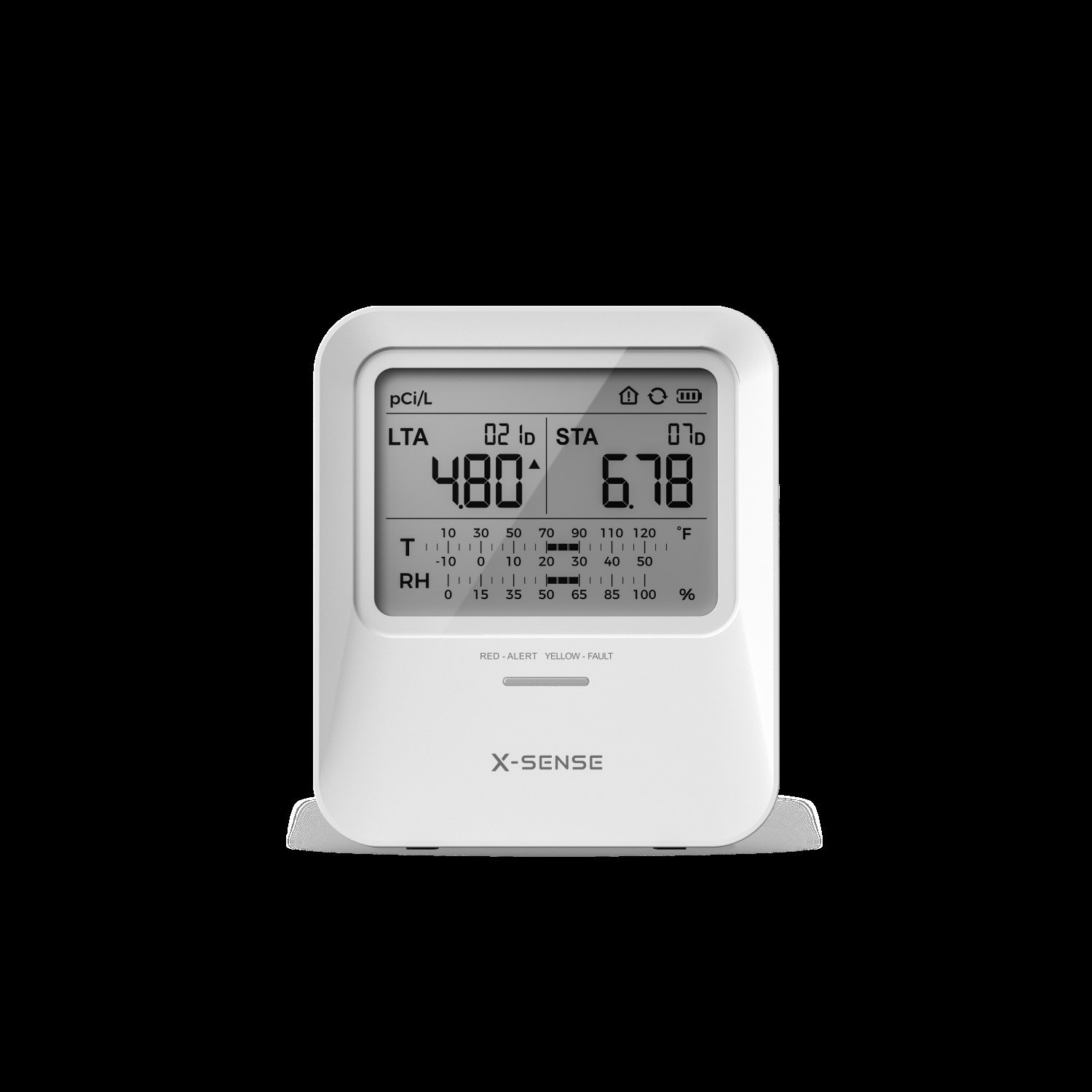
Power on by pulling the insulating film after the batteries are installed. The device powers on automatically, the LCD briefly shows all segments, the indicator flashes red and yellow, and a self-check displays "CAL" with an increasing value. If a fault is found, an error code appears (see the manual's troubleshooting section). If the check passes, the detector starts monitoring. After the first power-on or a data reset, both averages display "run" while the device collects initial stable data, then the first reading appears within 4 to 24 hours.
The manual recommends against powering the unit off for more than four hours, because detection data may become distorted and a retest is then required. Records are temporarily saved if the battery is removed or depleted; after power is restored and the self-test finishes, recording resumes from the last saved data. The only way to clear all monitoring data is to press and hold Reset for at least three seconds (built-in reports are retained). Use that reset before you start a new monitoring cycle in another room. The product page lists one-button reset as the way to use one detector in more than one space, one cycle at a time.
Do not use rechargeable batteries, mix battery types or mix new and used cells. The manual says rechargeable batteries may negatively impact operation, and that an incorrect type can defeat the safeguard and create a fire or explosion risk. The official specification is three replaceable 1.5 V AA alkaline batteries, with an estimated two-year battery life and a five-year warranty. The FAQ states that the XR0B-SR is a standalone unit and is not compatible with the X-Sense app or the SBS50 base station.

Where to place the detector
The official FAQ says to place the detector "in the lowest regularly occupied level, away from windows, doors, vents, exterior walls, direct sunlight, and humid areas." The user manual is more specific. Measurements are recommended in the basement or on the lowest livable floor, "where radon most commonly enters and accumulates." Other frequently used areas may also be tested, including spaces under construction that are intended for future use, such as a workspace, game room or bedroom. For best accuracy, perform the test while the heating system is running; if it is not operating, results may be inaccurate. Place the detector at least 3 ft (90 cm) from the nearest door, window or air vent.
The manual says not to use the detector inside closets, cabinets, sumps, crawl spaces, or foundation nooks; near heat sources such as appliances, radiators, fireplaces, or in direct sunlight; near drafts from fans or heating and air-conditioning vents, or in enclosed high-velocity areas such as mechanical or furnace closets; within enclosed areas of humidity exceeding 85%, such as bathrooms, laundry rooms, and kitchens isolated from large open areas; or outdoors. It is intended for ordinary indoor locations of family living units. Also avoid placing it on or near materials that may produce radiation, with examples such as rock collections, granite countertops, hearths or slate pool tables. During testing, do not block the side air-intake areas, and keep the device stationary.
Those side vents are visible on the official size diagram, which labels the cabinet 95 mm (3.74 in) tall, 82 mm (3.23 in) wide and 77 mm (3.03 in) deep.
How to read pCi/L and Bq/m³ on the XR0B-SR
The recommended unit for use in the United States is pCi/L. Double-press the Peak Level/Silence button to switch between pCi/L and Bq/m³; the manual says you may switch to Bq/m³ for use in Europe or Canada. The detection range is 0–500 pCi/L or 0–9,999 Bq/m³.
The long-term average is the main reading: the average of all radon monitoring data since power-on or data reset, updated every 24 hours, with a maximum duration of 999 days. The short-term average is auxiliary data — four rolling intervals for the past 1, 7, 30 and 90 days — and the FAQ says it updates every hour.
A single press of Peak Level/Silence shows the maximum radon concentration in the current interval, plus that interval's average temperature and humidity, for five seconds. Press and hold at least three seconds while the peak is shown to clear only the current peak. Double-press Report/Settings to switch temperature units between °C and °F, or press it once to save a data report (up to 99 reports). Yellow on the LED indicates a fault or low battery; red indicates an alarm.
The official XR0A-SR product page was also live on November 18, 2026. X-Sense's XR0B-SR FAQ says both models display short- and long-term averages, and that the XR0B-SR additionally provides sound and light alerts and enhanced accuracy using temperature and humidity compensation. This how-to follows the XR0B-SR manual. An older XR0A-iR product URL on X-Sense's site returned 404 the same day, so this article does not treat that page as a current official listing.
What the numbers mean, and what official documents say to do
When the "Maintenance Recommended" icon appears, the LCD flashes, the LED flashes red once every 10 seconds and the detector beeps, the manual says the radon concentration has exceeded the threshold and the built-in alarm is triggered. "You can consult local professionals or authorities to reduce indoor radon levels." The flashing screen and icon deactivate automatically once radon levels drop. Each radon warning lasts for 24 hours; during that warning you can press Peak Level/Silence once to mute the device until the current warning ends.
If the icon does not appear but you still have concerns, the manual tells you to check the long-term average after at least seven days and compare it with this table:

- Long-term average of 4 pCi/L (150 Bq/m³) or higher: "It is recommended to consult a professional to assess the next steps."
- 2–4 pCi/L (75–150 Bq/m³): "Ventilation and monitoring."
- 2 pCi/L (75 Bq/m³) or below: "No obvious problems found."
The same table's note matches EPA language: any exposure carries some risk, there is no completely safe level, and health risks still exist even below 4 pCi/L (150 Bq/m³).
EPA's action-level page is the official U.S. benchmark those X-Sense bands sit against: fix the home at 4 pCi/L or more, and consider fixing between 2 and 4 pCi/L. The Citizen's Guide also describes a kit-based follow-up sequence — a second short-term test or a long-term test after a first short-term result of 4 pCi/L or higher — that is easy to confuse with a continuous monitor. Closed-house conditions in that guide (windows and outside doors closed, no fans that bring in outdoor air) apply to those short-term kit tests, especially 2- or 3-day tests. They are not a substitute for the XR0B-SR's own seven-day-plus, heating-system-on, stay-stationary instructions. The guide's kit-placement details, including a lowest lived-in level, a regularly used room rather than a kitchen or bathroom, and a height of at least 20 inches above the floor, apply to those kits; follow the X-Sense list above for this detector.
If you confirm an elevated long-term average, the next official step is a qualified professional, not a guess at a do-it-yourself fix. EPA's page on finding a radon test kit or measurement and mitigation professional is the starting point, along with your state radon contact. The Citizen's Guide also says you should test again after a home is mitigated. The XR0B-SR is a continuous monitor, not a mitigation system. Use the long-term average after a recommended cycle, compare it with the manual's table and with EPA's 4 pCi/L action level, and call a qualified radon professional if the result stays at or above that level — or if you want a second official measurement before you decide.
References
- X-Sense, "XR0B-SR Indoor Radon Detector" product page and on-page FAQ (placement, 4–24 hour first reading, seven-day testing, alerts, EPA 4.0 pCi/L action language, no app or SBS50 support, accessed November 18, 2026). https://www.x-sense.com/products/xr0b-sr-radon-detector
- X-Sense, XR0B-SR User Manual, F800004000330 V1.0 (power-on, "run" status, placement, units, long- and short-term averages, warning table, specifications). https://cdn.shopify.com/s/files/1/0115/9223/7122/files/xr0b-sr-manual.pdf?v=1776858718
- X-Sense, "XR0A-SR Digital Radon Detector for Home Monitoring" (live official page as of November 18, 2026). https://www.x-sense.com/products/xr0a-sr-radon-detector
- X-Sense, User Manuals page. https://www.x-sense.com/pages/user-manuals
- U.S. Environmental Protection Agency, "What is EPA's Action Level for Radon and What Does it Mean?" (fix at 4 pCi/L or more; consider fixing 2–4 pCi/L; average indoor 1.3 pCi/L and outdoor 0.4 pCi/L). https://www.epa.gov/radon/what-epas-action-level-radon-and-what-does-it-mean
- U.S. Environmental Protection Agency, A Citizen's Guide to Radon (EPA 402/K-12/002; testing steps, lowest lived-in level, kit placement, short-term and long-term tests). https://www.epa.gov/sites/default/files/2016-12/documents/2016_a_citizens_guide_to_radon.pdf
- U.S. Environmental Protection Agency, "Health Risk of Radon." https://www.epa.gov/radon/health-risk-radon
- U.S. Environmental Protection Agency, "Find a Radon Test Kit or Measurement and Mitigation Professional." https://www.epa.gov/radon/find-radon-test-kit-or-measurement-and-mitigation-professional
- U.S. Environmental Protection Agency, Radon home page. https://www.epa.gov/radon
Meet your guide
Lipeiguan
author
What to read next
 How to Choose a SwitchBot Lock: Lock Pro vs Lock Ultra vs Lock Vision and Vision Pro A research-based guide to official SwitchBot Lock Pro, Lock Ultra, Lock Vision and Lock Vision Pro specs and November 20, 2026 U.S. prices, including batteries, hubs, keypads, comp...
 How to Choose a Sharper Image Massager: Guns, Neck Wraps and Heat or Cold A research-based 2026 guide to official Sharper Image massager specs, including the PowerBoost Pro Plus, Powerboost Move Aero, 5D neck wrap, and cordless wand, plus November 19, 20...
 How to Install and Use SwitchBot Curtain 3 A research-based SwitchBot Curtain 3 how-to as of November 18, 2026: official Rod 3 package contents, 15–40 mm track fit, app pairing before hanging, magnet stops, calibration, Tou...