Apple Launches Health AI Usage Study With OpenEvidence for iPhone 15 Pro and Later
Apple's new US research study lets up to 200,000 adults 21+ ask health questions in an AI app built on OpenEvidence, with cited clinical sources and optional HealthKit data. It needs iPhone 15 Pro or later on iOS 26+, and data won't train AI models.
Disclosure: This page may contain affiliate links. They do not influence our editorial conclusions. Read the disclosure.
Key facts
- Announced
- November 2026, United States
- Partner
- OpenEvidence clinical AI platform
- Who can join
- Up to 200,000 eligible adults aged 21+
- Requirements
- iPhone 15 Pro or later (Apple Intelligence) on iOS 26 or later
- Cost
- Free study app from Apple
- Privacy
- HealthKit sharing optional; study data not used to train AI models
- Limits
- Not for diagnosis or treatment
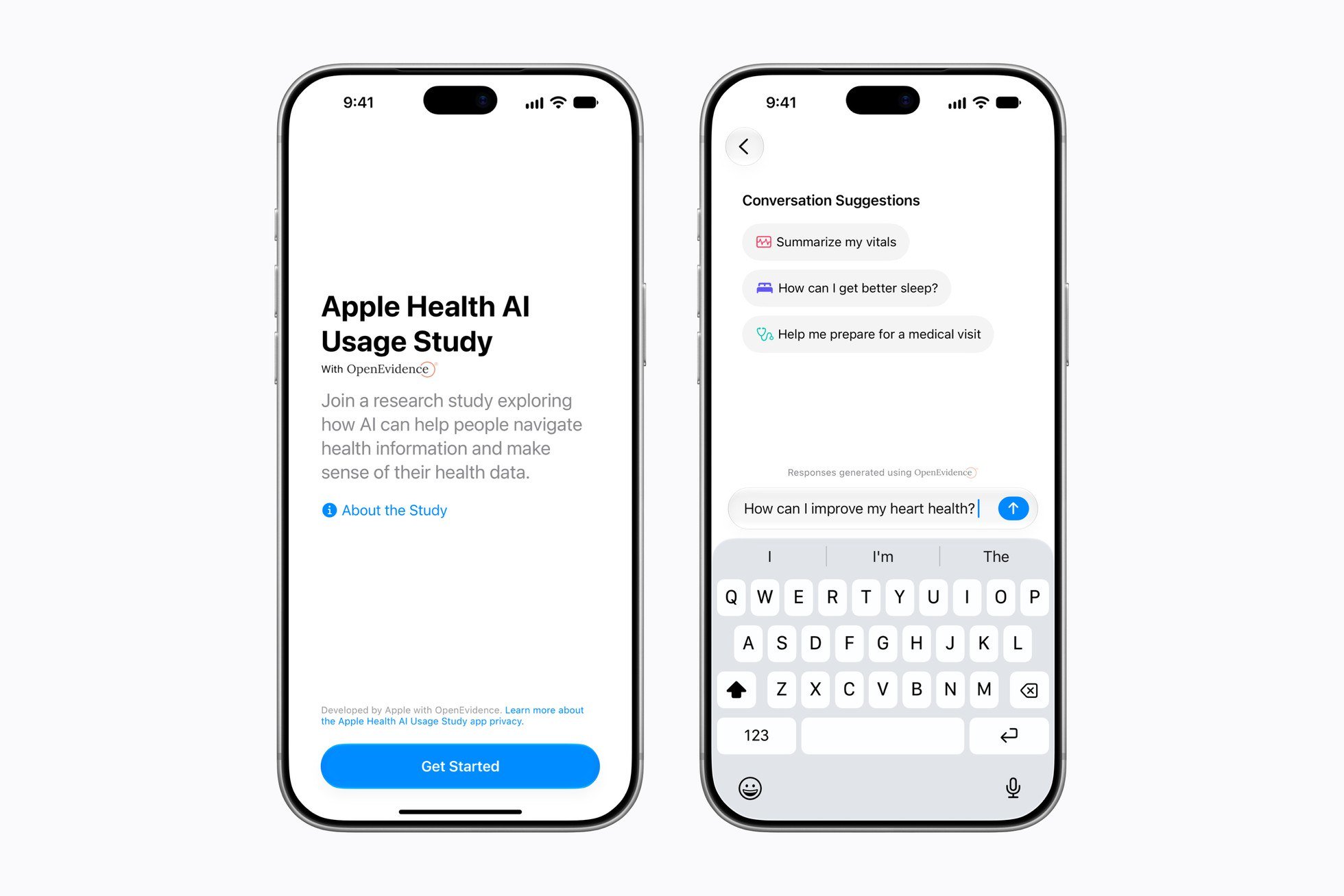
Apple has launched the Apple Health AI Usage Study, a virtual research study in the US built around a new iPhone app where participants can ask everyday health questions and get answers from AI. The answers come from OpenEvidence's medically grounded technology and include links to peer-reviewed clinical sources. The study is open to up to 200,000 eligible adults aged 21 and over. You need an Apple Intelligence-capable iPhone, meaning iPhone 15 Pro or later, running iOS 26 or later.

What Apple announced
Apple announced the study in its Newsroom on November 15, 2026. It's meant to find out how people use conversational health AI tools. Apple says it will look at what makes users trust the answers, how good the answers are, how well people understand them and what health actions people take afterwards. Apple says the findings are meant to guide the responsible design of health AI for Apple and the wider industry.
The study runs in collaboration with OpenEvidence, a clinical AI platform widely used by healthcare professionals. Apple says OpenEvidence builds its answers from established medical sources such as the Journal of the American Medical Association. In the study app, participants can:
- ask everyday health questions
- read complex medical information explained in plain language
- see links to the peer-reviewed clinical sources behind each answer
- choose to share HealthKit data, such as resting heart rate, activity, sleep or lab results, to get more personalized answers
- get help preparing for appointments with their own doctors
The App Store listing for the free Apple Health AI Study App adds a few uses: understanding symptoms or conditions, putting your Health data in context, and building a personalized exercise or meal plan.

Who can join
| Requirement | Detail |
|---|---|
| Location | United States |
| Age | 21 or older |
| iPhone | Apple Intelligence-enabled model (iPhone 15 Pro or later) |
| Software | iOS 26 or later |
| Enrollment cap | Up to 200,000 eligible participants |
| Cost | Free app from Apple |
Privacy and safety
Apple says the study was designed with privacy protections, transparency and clinical guardrails from the start, and study data won't be used to train AI models. Participants decide whether to share any HealthKit data or survey answers. The app also has safety guardrails that try to spot certain worrying questions and suggest following up with a doctor or other resources.
Apple is clear that the app doesn't diagnose or treat any condition and doesn't replace medical advice. The App Store listing says neither the app nor the study provides medical advice, diagnosis or treatment. Apple also acknowledges that health tools powered by large language models can sometimes give incomplete or unclear answers, and says that's why it's running the research.
Why it matters
This is Apple's most direct move yet into conversational health AI. It builds on recent Health features like the redesigned Health app, which we cover in our Apple Health app redesign explainer, and Apple Watch's hypertension notifications. For iPhone owners, the study is an early, opt-in way to try health AI that cites medical sources and can use your own Health data, with clear limits on what it's for. Our step-by-step guide covers how to join the Apple Health AI Usage Study, including eligibility checks and the privacy choices you'll make.

References
- Apple Newsroom, "Apple launches research study to explore the use of AI for health," November 2026: https://www.apple.com/newsroom/2026/11/apple-launches-research-study-to-explore-the-use-of-ai-for-health/
- App Store, "Apple Health AI Study App": https://apps.apple.com/us/app/apple-health-ai-study-app/id6800060365
Launch
Where to go next
Meet your guide
SurfGirl
author
What to read next
 Apple TV Will Be the Exclusive U.S. Home of F1 Academy Beginning in 2027 On November 19, 2026, Apple said F1 Academy will stream on Apple TV in the United States beginning in 2027, with every qualifying session and race included for U.S. Apple TV subscr... How to Watch F1 Academy on Apple TV in 2027: Official Calendar and Subscription Note Apple said U.S. Apple TV subscribers will get every F1 Academy qualifying session and race beginning in 2027. This guide records the official seven-round 2027 calendar graphic and...
 Google Brings the Gemini App to Eligible Android Go and Lower-Memory Phones On November 18, 2026, Google said the Gemini app is available on eligible Android (Go edition) devices after a re-architecture for lower-memory phones. Official help adds a 2GB RAM...