Apple's Redesigned Health App Explained: Insights, Health Age, Longevity and Requirements
What Apple's redesigned Health app includes, from the Insights tab and Health Age score to at-home movement evaluations, plus the new languages, device requirements and release timing.
Disclosure: This page may contain affiliate links. They do not influence our editorial conclusions. Read the disclosure.
Our pick
- See price at Apple
Top pick
Apple
Maker of iPhone, iPad, Mac, Apple Watch and related services, sold through its online and retail stores.
What this guide covers
Apple's redesigned Health app is expanding beyond its first languages. In a November 3, 2026 Newsroom post, Apple said the app, "built with Apple Intelligence at its core," now supports global English, Chinese (Simplified and Traditional), French, Japanese, Korean, Norwegian, Portuguese, Spanish, Turkish and Vietnamese. It is in the iOS 27.3 developer beta now and will reach everyone as a free software update later this year. This explainer walks through each part of the redesign Apple describes, the devices you need, and the limits Apple spells out in its footnotes, so you know what to expect before the update lands.

The short version
- What it is: a redesigned Health app for iPhone and iPad that uses Apple Intelligence to summarize your health data and suggest actions.
- New areas: an Insights tab, a For You section, a Longevity tab with a Health Age score, and at-home movement evaluations.
- New languages: global English, Chinese (Simplified and Traditional), French, Japanese, Korean, Norwegian, Portuguese, Spanish, Turkish and Vietnamese.
- When: iOS 27.3 developer beta now; a free public update "later this year," according to Apple.
- What you need: an Apple Intelligence-enabled iPhone or iPad with the latest software. Health Age needs an Apple Watch, and some features are iPhone-only or limited to users 18 and older.
Insights tab: summaries through the day
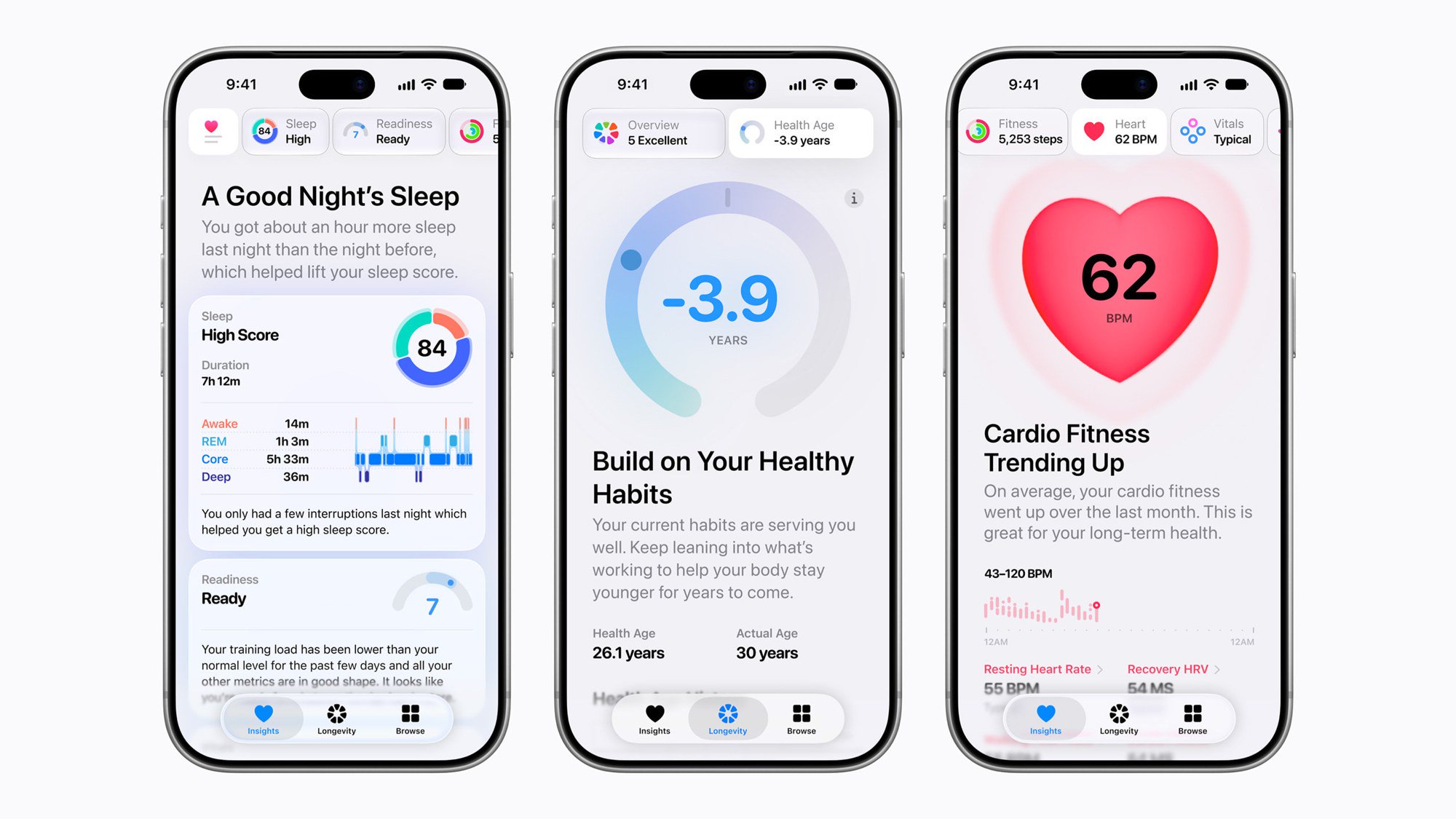
Apple describes the new Insights tab as surfacing "timely, holistic summaries" across heart, sleep, readiness, fitness, vitals and cycle tracking data throughout the day. Instead of opening separate categories to find a number, the idea is that the app pulls the relevant data together and explains it in context.
Apple's product images show what that looks like: a sleep card with a score, duration and time spent in each sleep stage, a readiness card, and a cardio fitness card noting a month-long trend alongside resting heart rate and recovery heart rate variability. Those screens are Apple's examples, and the cards you see will depend on which devices you use and which data you record.
For You: recommendations based on your habits
Inside the experience, a dedicated For You section delivers what Apple calls "intelligent recommendations tailored to a user's daily habits." Apple's example is practical: after several nights of interrupted sleep, the app might suggest adjusting your wind-down routine.
Apple says the app also pairs your data with health content, including educational videos and articles featuring Health app clinical experts. That makes the redesign part dashboard and part guide. As with any wellness software, recommendations are general guidance, not a diagnosis, and anyone managing a medical condition should keep working with their clinician.
Longevity tab and Health Age
The biggest new idea is the Longevity tab. Apple says it analyzes long-term metrics across heart health, sleep, mental wellbeing, movement, metabolic health, hearing and nutrition, to help people understand their "health trajectory."
At the center of the tab is Health Age. Apple says Health Age takes Apple Watch data, including:
- VO2 max (cardio fitness)
- Resting heart rate
- Sleep
- Heart rate variability
and translates it into a single metric "that reflects how a user's body is tracking relative to their chronological age." In Apple's sample screen, a 30-year-old user sees a Health Age of 26.1 years, shown as -3.9 years, with the message "Build on Your Healthy Habits."

Two details matter here. First, Health Age requires an Apple Watch, according to Apple's footnotes, so iPhone-only users will not get it. Second, you can add clinical lab results such as A1c and LDL cholesterol to "enrich" the long-term picture. Apple does not say in the announcement exactly how lab values change the Health Age calculation, so treat the score as a trend signal rather than a medical measurement.
At-home movement evaluations
Apple is also adding at-home movement evaluations designed to work without specialized equipment. Using an iPhone camera and an Apple Watch, you can measure:
- Flexibility
- Strength
- Balance
- Movement mechanics
- VO2 max
Apple says the evaluations give real-time audio and visual feedback and were developed with clinical experts. They use on-device, vision-based AI models, and Apple states the experience "runs entirely on device; no video is ever recorded, stored, or shared."
The footnotes add a device detail: the test that estimates VO2 max requires an Apple Watch, AirPods Pro 3, or a third-party heart rate sensing device.
Privacy
Apple says the Health app "has been built to securely and privately protect a user's data at every step." The clearest concrete privacy claim in the announcement concerns the movement evaluations: processing happens on device and no video is kept. Apple's footnotes also note that some Apple Intelligence features that rely on server-side models are subject to daily usage limits; the announcement does not list which Health features, if any, use server-side processing.
Which devices and languages qualify
From Apple's footnotes:
- The redesigned Health app is available on Apple Intelligence-enabled iPhone and iPad models with the latest software.
- Select features are iPhone-only.
- Health Age requires Apple Watch.
- The VO2 max test requires Apple Watch, AirPods Pro 3, or a third-party heart rate sensor.
- Some features require users to be 18 or older.
- Some features may not be available in all regions or languages.
Apple Intelligence itself works when Siri and device language are set to Chinese (Simplified or Traditional), Danish, Dutch, English, French, German, Italian, Japanese, Korean, Norwegian, Portuguese, Spanish, Swedish, Turkish or Vietnamese. Note that the redesigned Health app's language list is shorter: Danish, Dutch, German, Italian and Swedish appear in the Apple Intelligence list but not in the Health app expansion announced on November 3. Apple says it "will continue to expand support for the redesigned Health app in new languages."
If you need to change your iPhone's language to one Apple Intelligence supports, our guide to getting Siri AI in your language walks through the settings.

When you can get it
Apple says the redesigned Health app is in the iOS 27.3 developer beta now and will roll out "as a free software update later this year." Apple did not give a specific public release date. Developer betas are meant for testing apps, so most people should wait for the public release instead of installing beta software on the phone that holds their health records.
When the update arrives, it should appear in Settings, then General, then Software Update on a compatible iPhone or iPad.
How to prepare now
You do not need to buy anything to get the redesign on a compatible iPhone, but a few steps can make the new features more useful on day one:
- Check Apple Intelligence support. The app requires an Apple Intelligence-enabled iPhone or iPad. Apple keeps its list of supported devices and regions at support.apple.com.
- Wear your Apple Watch to sleep if you want Health Age, since it uses sleep and heart rate variability along with VO2 max and resting heart rate.
- Record cardio fitness. VO2 max feeds Health Age, and the new VO2 max test needs an Apple Watch, AirPods Pro 3 or a third-party heart rate sensor.
- Gather lab results such as A1c and LDL cholesterol if you want to add them; Apple says you can incorporate clinical lab data.
- Set your language. If your language is in the November 3 list, you can use the redesign in it once the update arrives.
How this fits Apple's other recent updates
The Health language expansion follows Apple's recent push to bring Apple Intelligence features to more languages. Our earlier coverage of Siri AI in French, Spanish, Japanese, Korean and Portuguese in iOS 27.2 explains that part of the rollout. For the latest Health app announcement in brief, read our news story on the Health app language expansion.
Bottom line
The redesigned Health app turns raw readings into summaries, recommendations and a single long-term Health Age figure, and Apple is now offering it in many more languages. The fine print matters: you need an Apple Intelligence-capable iPhone or iPad, Health Age needs an Apple Watch, some features are iPhone-only or 18+, and the public release is "later this year" rather than today.
References
- Apple Newsroom, "Redesigned Health app expands language support," November 3, 2026, apple.com/newsroom.
- Apple Support, Apple Intelligence availability page referenced in the Newsroom footnotes, support.apple.com/en-us/121115.
Meet your guide
Lipeiguan
author
What to read next
 Best Bose Earbuds 2026: QuietComfort Ultra vs QuietComfort vs Ultra Open vs Sport Open vs Wired All five Bose earbuds compared on Bose's published specs and prices, from the $299 QuietComfort Ultra Earbuds (2nd Gen) and Ultra Open Earbuds (2nd Gen) to the $99 Noise Cancelling...
 How to Set Up Bose QuietComfort Ultra Earbuds (2nd Gen): Pairing, Fit, Multipoint and Reset Step-by-step setup for Bose QuietComfort Ultra Earbuds (2nd Gen) from Bose's owner's guide: app and Bluetooth pairing, Fast Pair, eartip and band fit, touch controls, multipoint, c...
 Google Store Cuts Pixel 11 Pro to $799 and Pixel 11 to $699 Through November 8 The U.S. Google Store has the unlocked Pixel 11 Pro at $799 (was $1,099), the Pixel 11 at $699 (was $899) and $350 off the Pixel 11 Pro XL until November 8, 2026 at 11:59 PM PST, p...