
How to Charge a Jackery in Your Car: 12V Car Port vs the 600W DC-DC Alternator Charger
Jackery's two ways to charge a power station while driving compared: the $29.90 12V car charging cable and the $269 600W DC-DC Alternator Charger, with Jackery's charging times by model, installation advice and the 12V car battery charging cable.
Disclosure: This page may contain affiliate links. They do not influence our editorial conclusions. Read the disclosure.
Our pick
- See price at Jackery
Top pick
Jackery
Maker of portable power stations, solar generators and foldable solar panels for camping, travel and home backup.
Steps in this guide
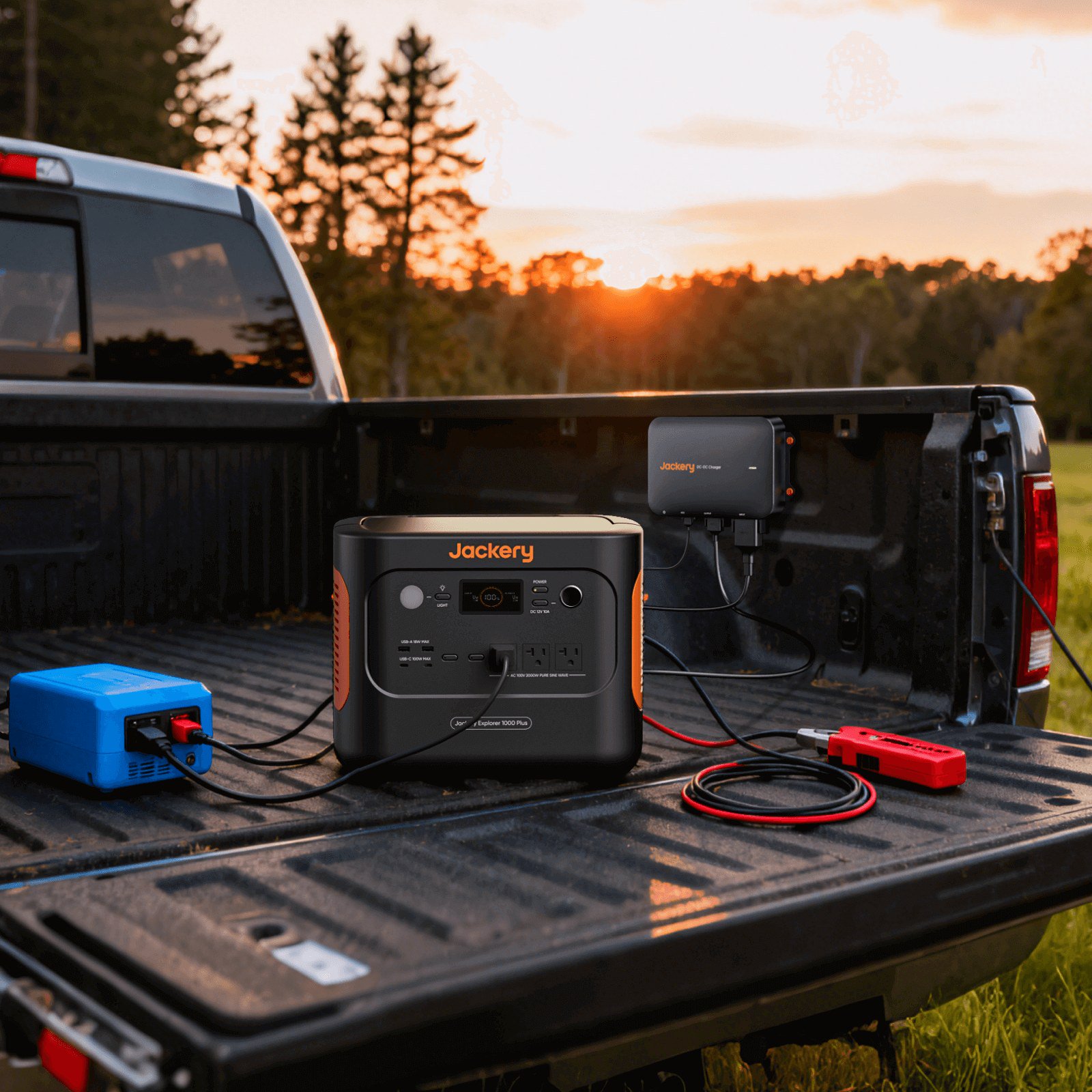
A portable power station is most useful on the road when it can recharge while you drive. Jackery gives you two ways to do that. The first is the car charging cable that plugs into a 12V socket (the old cigarette-lighter port). The second is the $269 Jackery DC-DC Alternator Charger, which is wired to the vehicle's battery and charges at up to 600W. The difference in speed is large: on an Explorer 2000 v2, Jackery lists 24 hours for a full charge from the car adapter and about 5.6 hours from the alternator charger.
This guide compares both methods using Jackery's own product pages and spec tables as of November 14, 2026. It is research-based rather than a hands-on test, and every charging time below is Jackery's estimate. Real times depend on your vehicle, the starting charge level and how hard you drive.

Option 1: The 12V car port and Jackery car charging cable
Most Jackery Explorer models can charge from a vehicle's 12V accessory socket. Jackery sells a Car Charging Cable for $29.90: 6.56 feet (2 m) long, rated for 10A maximum current and 12V maximum voltage, with a DC8020 plug on the power station end. Jackery lists it as compatible with the Explorer E3000 Pro, E2000 Pro, E1500 Pro, E1000 Pro, E880 Pro, E800 Pro, E2000 Plus, E1000 Plus, E700 Plus, E600 Plus, E1500, E1000 v2 and E300D. The Explorer 300 Plus and 240 v2 also work but need Jackery's DC8020-to-USB-C adapter.
A 12V socket can only supply a limited amount of current, and that keeps charging slow. Jackery's own spec tables show how slow:
| Power station | Capacity | Car charging (12V) per Jackery |
|---|---|---|
| Explorer 300 v2 | 288Wh | About 4 hours (242 minutes) |
| Explorer 1000 Plus | 1,264Wh | 7 hours |
| Explorer 2000 v2 | 2,042Wh | 24 hours |
Note that on the Explorer 300 v2, Jackery says the car charging cable is not included in the box and is sold separately. Check what is included with any model you buy.

Who it suits: owners of smaller power stations (roughly 300Wh) who drive a few hours a day, or anyone who just wants to top up phones, lights and a small fridge between campsites. For a 1kWh-plus unit, a single day's drive usually won't fill it from a 12V socket.
Watch out for: some vehicles turn the 12V socket off when the ignition is off, and others keep it live. If yours stays live, charging a power station while parked can drain the starter battery. Unplug it when the engine is off unless you know how your socket behaves.
Option 2: Jackery DC-DC Alternator Charger (600W)
The Jackery DC-DC Alternator Charger (model JA-AD600A, $269 on jackery.com) is a box you mount in the vehicle and wire to the main battery. It draws from the alternator while the engine runs and sends up to 600W to the power station's DC8020 input. Jackery calls 600W its "golden power" level, chosen for fast charging without stressing the alternator or starter battery. Its marketing headline is that two hours of driving delivers 1kWh, and that it is "6× faster than cigarette lighter ports."
Key specs from Jackery's listing:
- Input: 11.8–32V DC, 60A, so it works with 12V and 24V vehicles. Jackery says that covers more than 90% of fuel vehicles and even small boats.
- Output: 50V DC, 12A maximum, 600W maximum
- Size and weight: 10.2 x 6.1 x 1.5 inches, about 3.5 lb
- Protection: IP40 dustproof, working temperature -4°F to 140°F, fanless with noise below 40 dB
- In the box: the charger, a 6 m input cable, a fuse, a 1.5 m output cable, a 6 m ACC cable, screws, bolts and nuts, and a user manual

Charging times with the alternator charger
Jackery publishes a 0–100% charging table for models that work with it. Not every model takes the full 600W:
| Power station | Capacity | Charging power | Time (0–100%) |
|---|---|---|---|
| Explorer 1000 v2 | 1,070Wh | Around 400W | Around 3.0 hours |
| Explorer 1000 Plus | 1,265Wh | Around 400W | Around 3.5 hours |
| Explorer 2000 Plus | 2,042Wh | Around 600W | Around 3.7 hours |
| Explorer 2000 v2 | 2,042Wh | Around 400W | Around 5.6 hours |
| Explorer 3000 Pro | 3,024Wh | Around 600W | Around 5.5 hours |
| HomePower 3000 | 3,072Wh | Around 600W | Around 5.6 hours |
The Explorer 1500 Ultra's listing also mentions "vehicle alternator charging in ~3 hours." On the Explorer 1000 Plus, compare 3.5 hours to 7 hours from the 12V socket; on the 2000 v2, 5.6 hours versus 24.
How it protects the starter battery
The charger uses two safeguards. It reads the ACC (accessory) signal so it knows when the engine is running, and it monitors battery voltage. Charging starts when you drive and stops when you park. If the battery voltage drops below the startup threshold, it stops. When the vehicle isn't running, it goes into standby and shuts down after 24 hours. Jackery also lists over-voltage, under-voltage, over-current, overload, short-circuit and temperature protection. Jackery says it uses excess alternator power and doesn't increase fuel consumption. It adds that charging power varies with driving and road conditions, so a fluctuating reading is normal.
Installation: Jackery recommends a professional
Jackery's five installation steps: connect the fuse cable and input cable to the vehicle's main battery, connect the ACC cable to the vehicle's ACC line, route the wiring, plug the input and ACC cables into the charger, then connect the output cable to the power station's DC input. Jackery's FAQ is direct: "it is recommended to have the installation performed by a professional modification shop. Non-professionals should not attempt to install it themselves." Budget for installation on top of the $269 price. Jackery also suggests a monthly check of the connectors, wiring, screws and fuses.

Jackery notes that some older vehicles run at lower voltages that may not match the charger's operating range. If it won't work after installation, Jackery asks you to contact customer service.
Option 3: Solar at camp (and why not both at once)
Many road-trippers mix methods: car charging on driving days, solar while parked. Jackery's FAQ warns that "most models do not support car charging and solar charging at the same time," although most support AC and solar together. Plan to switch sources rather than stack them. For panel choices, see our guide to which Jackery solar panel to buy.
Bonus: Using a Jackery to top up a car battery
Jackery's 12V Automobile Battery Charging Cable ($35.99) works in the other direction. It runs from the power station's 12V/10A car port to alligator clips on a car battery. Jackery says it is compatible with all Jackery portable power stations and is meant only for 12V lead-acid batteries, not electric cars. Jackery's estimates are 15–20 minutes for a 40–60Ah battery and 30–40 minutes for a 60–100Ah battery. Jackery describes it as slower than a traditional jump starter, because it charges the battery rather than delivering a cranking surge.

Which method should you choose?
- Weekend camping with a small unit (around 300Wh): the $29.90 car charging cable is enough. At about 4 hours to fill an Explorer 300 v2, a normal drive does most of the work.
- Regular road trips with a 1–2kWh unit running a fridge: the alternator charger is the upgrade that matters. It cuts an Explorer 1000 Plus from 7 hours to about 3.5, and an Explorer 2000 v2 from 24 hours to about 5.6.
- RVs, vans and overlanding rigs with 3kWh-class stations: the alternator charger is close to essential, since Jackery says it can fully recharge a 3kWh unit during a single 5–6 hour drive.
To work out how much capacity your devices need, use our Jackery sizing guide. To compare models, see the best Jackery power stations for camping and home backup. Shipping, returns and warranty details for jackery.com are in our Jackery shopping guide.
Bottom line
A 12V socket is cheap and simple but limited: fine for a 300Wh unit, too slow for anything over 1kWh. The Jackery DC-DC Alternator Charger costs more and needs a professional install. In return, Jackery's figures show it charging large power stations roughly two to four times faster than the car port, depending on the model, with automatic start and stop to protect your starter battery.
References
- Jackery, DC-DC Alternator Charger (specs, charging table, FAQ): https://www.jackery.com/products/jackery-dc-dc-alternator-charger
- Jackery, Car Charging Cable: https://www.jackery.com/products/car-charging-cable
- Jackery, 12V Automobile Battery Charging Cable: https://www.jackery.com/products/12v-automobile-battery-charging-cable
- Jackery, Explorer 1000 Plus Portable Power Station (tech specs): https://www.jackery.com/products/jackery-explorer-1000-plus-portable-power-station
- Jackery, Explorer 2000 v2 Portable Power Station (tech specs): https://www.jackery.com/products/jackery-explorer-2000-v2-portable-power-station
- Jackery, Explorer 300 v2 Portable Power Station (specs and FAQ): https://www.jackery.com/products/jackery-explorer-300-v2-portable-power-station
- Jackery, Explorer 300D Portable Power Station (FAQ on charging inputs): https://www.jackery.com/products/jackery-explorer-300d-portable-power-station
- Jackery, Explorer 1500 Ultra Portable Power Station: https://www.jackery.com/products/jackery-explorer-1500-ultra-portable-power-station
Meet your guide
Lipeiguan
author
What to read next
 Apple TV Will Be the Exclusive U.S. Home of F1 Academy Beginning in 2027 On November 19, 2026, Apple said F1 Academy will stream on Apple TV in the United States beginning in 2027, with every qualifying session and race included for U.S. Apple TV subscr... How to Watch F1 Academy on Apple TV in 2027: Official Calendar and Subscription Note Apple said U.S. Apple TV subscribers will get every F1 Academy qualifying session and race beginning in 2027. This guide records the official seven-round 2027 calendar graphic and...
 Best Gymshark Hoodies and Sweatshirts (2026): Crest, Power, Training and Cosy Luxe A research-based 2026 guide to official Gymshark hoodies and sweatshirts on the U.S. store, including Crest, Power, Training and Cosy Luxe prices we verified on November 20, 2026,...