
What Size Jackery Do I Need? How to Size a Power Station by Watts, Watt-Hours and Runtime
A step-by-step way to size a Jackery: total your running watts, check surge for motor loads, estimate runtime with Jackery's own capacity x 0.85 / watts formula, then match the result to current models from the 292Wh Explorer 300 to the 3,584Wh HomePower 3600 Plus.
Disclosure: This page may contain affiliate links. They do not influence our editorial conclusions. Read the disclosure.
Our pick
- See price at Jackery
Top pick
Jackery
Maker of portable power stations, solar generators and foldable solar panels for camping, travel and home backup.
Steps in this guide
"What size Jackery do I need?" is really two questions. The first is output: can the power station start and run your device at all? The second is capacity: once it's running, how many hours will it last? Jackery's lineup now runs from 292Wh camping units to 3.5kWh home backup systems, and picking the wrong one usually means either a unit that shuts off when a fridge compressor kicks in or paying for capacity you never use.
This guide walks through the sizing math Jackery itself publishes, applies it to current models on Jackery's US store (prices checked November 12, 2026), and points out the limits of the estimates. It is research-based, built from Jackery's product listings and buying-advice pages, not from our own runtime testing.

Step 1: List your devices and their watts
Start with every device you want to power at the same time and its running wattage. The number is usually printed on the device label, power brick or manual. Jackery's own examples use figures like these:
- Wi-Fi router: 10W
- Desk fan: 10W
- Camping lights: 10W
- Tablet: 20W
- Portable printer: 30W
- Portable camping refrigerator: 60W
- Laptop: 80W
Your own devices may draw more or less, so always use the label value for your device rather than a generic chart.
Add up everything that will run at once. That total is the continuous output you need.
Step 2: Check surge for anything with a motor
Refrigerators, pumps, compressors and many power tools draw a spike of power for a moment when they start. Jackery's battery capacity explainer notes that motors can draw two to three times their rated wattage at startup, and that you should "always check the surge rating of the unit against your largest motor load."
Every Jackery listing gives two output figures, a rated (continuous) output and a surge or peak output. Your running total must stay under the rated output, and the startup spike of your largest motor must stay under the surge figure.
Step 3: Estimate runtime with Jackery's 0.85 formula
Jackery's buying-advice pages use the same formula for every model:
Working hours = capacity in Wh x 0.85 / device operating watts
The 0.85 factor accounts for roughly 15% of the energy lost during conversion, mostly in the inverter. Jackery's battery explainer puts it this way: a "1,000 Wh" power station "often delivers 850–900 Wh to your devices."
Two of Jackery's own worked examples:
- Explorer 1000 Plus (1264Wh) running a 40W device: 1264 x 0.85 / 40 = about 26.8 hours.
- Explorer 600 Plus (632.3Wh) running 10W camping lights plus a 60W camping fridge (70W total): 632.3 x 0.85 / 70 = about 7.5 hours.
Jackery adds a disclaimer to all of these: the runtime figures are for reference only and assume a fully charged unit, and real-world results vary.
A note on refrigerators
A household fridge doesn't run its compressor nonstop, so its average draw over a day is lower than the wattage on its label. That makes the formula conservative for fridges if you plug in the label value. If you want a more realistic figure, check the fridge's annual energy use (in kWh, often on its EnergyGuide label) and divide by 365 to get daily watt-hours.
Step 4: Match your numbers to a Jackery tier
Here is how Jackery's current US lineup breaks down, using the specs and prices on jackery.com as of November 12, 2026.
| Model | Capacity | Rated output (surge) | Price on jackery.com | Notes |
|---|---|---|---|---|
| Explorer 300 | 292Wh | 300W | $289 | 7.5 lb; 2 AC outlets, 100W USB-C, 120W car port |
| Explorer 1000 Plus | 1264Wh | 2000W | $619 | Expandable to 5kWh with up to 3 battery packs |
| Explorer 1500 v2 | 1536Wh | 2000W (4000W surge) | $849 | 31.97 lb; 0–100% in 64 minutes in fast-charge mode |
| Explorer 2000 v2 | 2042Wh | 2200W (4400W surge) | $999 | Listed as sold out; pre-order shipping Nov 16 |
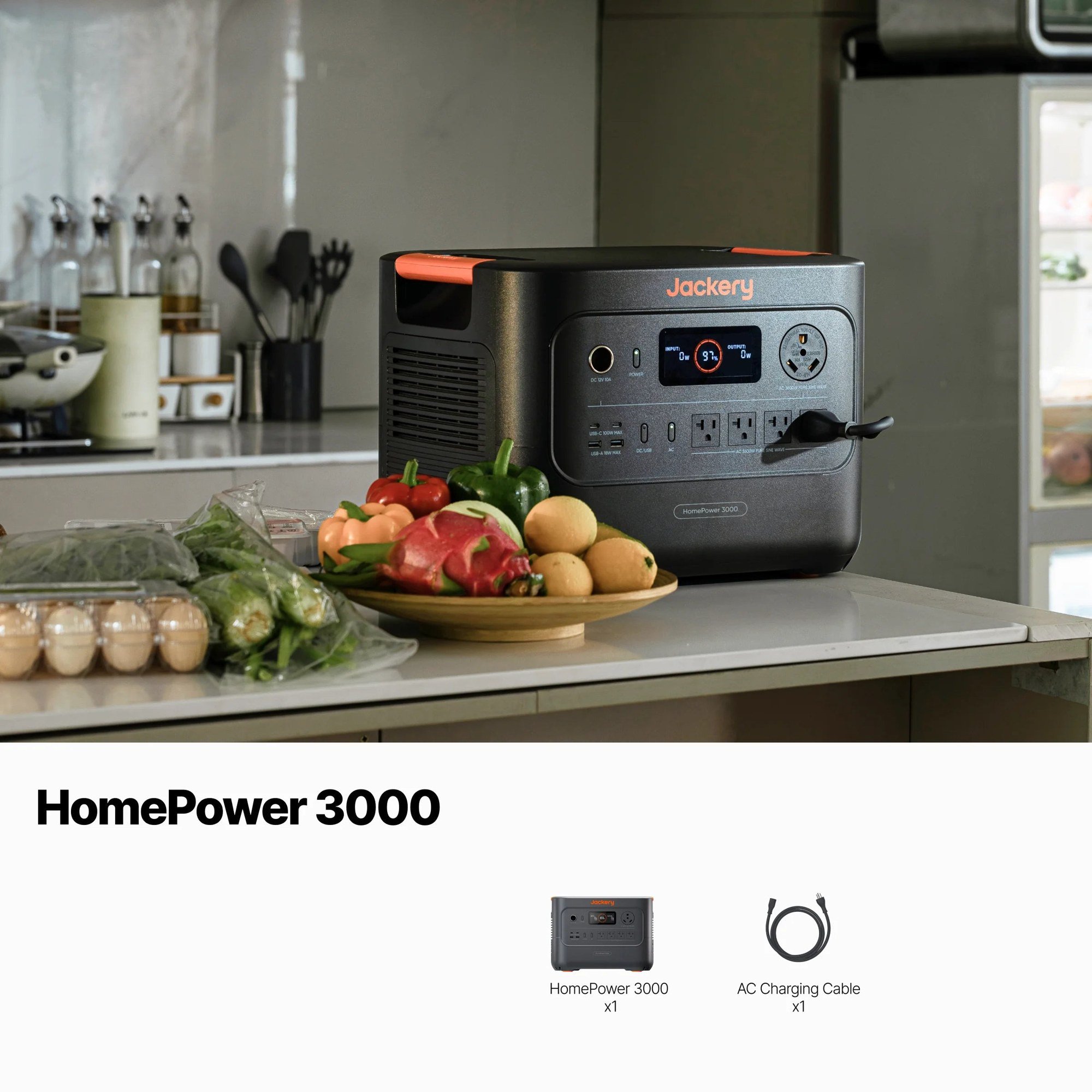
| HomePower 3000 | 3072Wh | 3600W (7200W surge) | $1,499 | Listed to ship starting Nov 28 |
| HomePower 3600 Plus | 3584Wh, expandable to 21kWh | 3600W | $3,999 | 120V per unit; two units for 240V; 5-year warranty |
Prices and stock change often on Jackery's store, so check the live listing before you buy.
Under 300Wh: phones, laptops, cameras and lights
At 292Wh and 300W, the Explorer 300 covers small electronics. Using Jackery's formula, a single 80W laptop would run about 3.1 hours (292 x 0.85 / 80), and a 10W router about 24.8 hours. It isn't built for anything that heats or cools.
1–1.5kWh: weekend camping, car fridges and short outages
The Explorer 1000 Plus (1264Wh, 2000W) and Explorer 1500 v2 (1536Wh, 2000W with 4000W surge) are the middle tier. Jackery says the 1000 Plus can expand to 5kWh with up to three battery packs, which Jackery says can keep a home running for one to three days. The 1500 v2 has three AC outlets and dual USB-C ports and is, according to Jackery, the smallest and lightest 1.5kWh LiFePO4 power station.

2–3kWh: a day or two of home essentials
The Explorer 2000 v2 (2042Wh, 2200W) is pitched for a full-day outage covering a fridge, Wi-Fi and lights, with a switchover under 20ms so a router or computer stays online. The HomePower 3000 (3072Wh, 3600W continuous, 7200W surge) is pitched at one to two days of essentials, including a fridge, Wi-Fi, fans and lighting.
3.5kWh and up: whole-room or whole-home backup
The HomePower 3600 Plus (3584Wh, 3600W) is Jackery's expandable home system. Jackery says it expands to 21kWh, runs 120V appliances on one unit, and needs two units connected for 240V appliances such as well pumps and dryers. It carries a 5-year warranty.

Step 5: Plan how you'll recharge it
A power station is only as useful as its next recharge. If you plan to rely on solar, look at the solar input figure for the model and how long Jackery says a recharge takes with its panels. For example, Jackery says the Explorer 300 reaches 80% in about 2.8 hours with a compatible 100W panel or about 7.5 hours with a 40W panel. Bigger stations need more panel wattage to refill in a single day of sun.
For help matching panels to a station, see our guide to which Jackery solar panel to buy.

A worked example
Say you want to keep a 10W router, a 20W tablet and a 60W camping fridge running during a weekend trip, for a 90W total:
- Output: 90W is far below the 300W rating of the smallest model, but a compressor fridge's startup spike is the thing to check against the surge rating.
- Runtime on the Explorer 300: 292 x 0.85 / 90 = about 2.8 hours.
- Runtime on the Explorer 1000 Plus: 1264 x 0.85 / 90 = about 11.9 hours.
- Runtime on the Explorer 1500 v2: 1536 x 0.85 / 90 = about 14.5 hours.
If you need that load to last a full 24 hours without recharging, you'd need roughly 90 x 24 / 0.85 = about 2,541Wh, which points to the HomePower 3000 tier or to a mid-size unit plus solar recharging during the day.
Common sizing mistakes
- Sizing only by capacity. A big battery with too little output will still shut off when you plug in a high-watt appliance.
- Forgetting startup surge. Motor loads need surge headroom, not just running watts.
- Using the full Wh figure. Plan on about 85% of the rated capacity, as Jackery does.
- Ignoring weight. Jackery lists the Explorer 300 at 7.5 lb and the 1500 v2 at 31.97 lb. If you'll carry it to a campsite, weight matters as much as capacity.
Where to go next
- Compare complete models in our best Jackery power stations guide.
- Weighing Jackery against a rival for home backup? See Jackery HomePower 1000 v2 vs EcoFlow DELTA 3 Classic.
- Before ordering, read our Jackery shopping guide for shipping, returns and warranty terms.
References
- Jackery, "What Can Jackery 1000 Plus Run?": https://www.jackery.com/blogs/buying-advice/what-can-jackery-1000-plus-run
- Jackery, "What Can Jackery 600 Plus Run?": https://www.jackery.com/blogs/buying-advice/what-can-jackery-600-plus-run
- Jackery, "What Can Jackery 160 Run?": https://www.jackery.com/blogs/buying-advice/what-can-jackery-160-run
- Jackery, "Battery Capacity Explained: mAh, Wh & Amp Hours Decoded": https://www.jackery.com/blogs/knowledge/battery-capacity-explained-mah-wh-amp-hours-decoded
- Jackery Explorer 300 product page: https://www.jackery.com/products/explorer-300-portable-power-station
- Jackery Explorer 1000 Plus product page: https://www.jackery.com/products/jackery-explorer-1000-plus-portable-power-station
- Jackery Explorer 1500 v2 product page: https://www.jackery.com/products/jackery-explorer-1500-v2-portable-power-station
- Jackery Explorer 2000 v2 product page: https://www.jackery.com/products/jackery-explorer-2000-v2-portable-power-station
- Jackery HomePower 3000 product page: https://www.jackery.com/products/jackery-homepower-3000
- Jackery HomePower 3600 Plus product page: https://www.jackery.com/products/jackery-homepower-3600-plus
Meet your guide
Lipeiguan
author
What to read next
 Google Adds Computer Use to the Gemini App for Mac in the U.S. On November 19, 2026, Google said computer use is available in the Gemini app for Mac, in English in the U.S. Official requirements include an Apple Silicon Mac on macOS Sequoia 15... How to Use Gemini Computer Use on a Mac: Official Requirements, Permissions and Examples Official Google requirements for computer use in the Gemini app for Mac: an Apple Silicon Mac on macOS Sequoia 15.0 or later, a personal Google account for people 18 or older, a Go...
 How to Choose a SwitchBot Lock: Lock Pro vs Lock Ultra vs Lock Vision and Vision Pro A research-based guide to official SwitchBot Lock Pro, Lock Ultra, Lock Vision and Lock Vision Pro specs and November 20, 2026 U.S. prices, including batteries, hubs, keypads, comp...