
Which Jackery Solar Panel to Buy: SolarSaga 100 Air vs 100 Light vs 100 Prime vs 200W vs 500 X
Jackery's SolarSaga solar panels compared: 40 Air, 100 Light, 100 Prime, 100 Air, 200W and 500 X prices, weights, efficiency, connectors and power-station compatibility, plus how to match panels to your station's solar input.
Disclosure: This page may contain affiliate links. They do not influence our editorial conclusions. Read the disclosure.
Our pick
- See price at Jackery
Top pick
Jackery
Maker of portable power stations, solar generators and foldable solar panels for camping, travel and home backup.
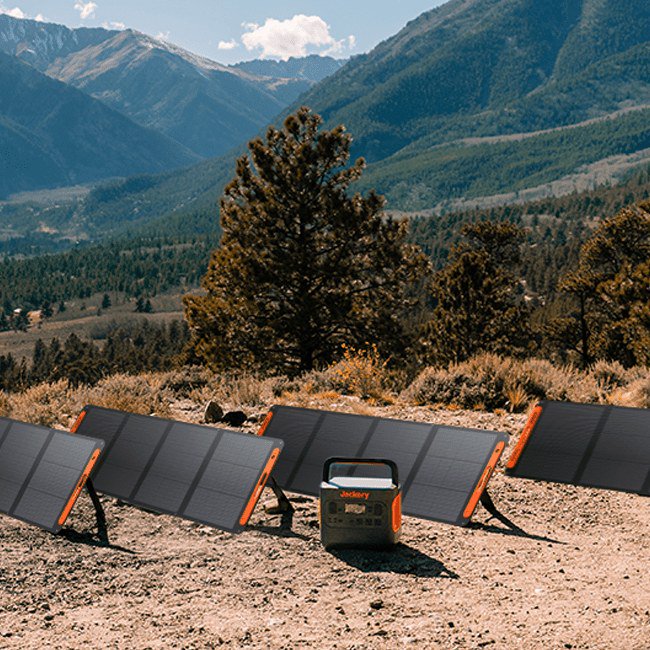
A Jackery power station becomes a true off-grid setup once you pair it with solar panels. It can recharge from sunlight during a camping trip, an RV stay or a long power outage, without a gas generator running. Jackery now sells at least six SolarSaga panels, though, and they differ more than the names suggest: rigid versus flexible, 100 watts versus 500, and three different connector styles.
This guide compares Jackery's current SolarSaga lineup using the specs, prices and compatibility notes on jackery.com as of November 12, 2026. It also covers how to match a panel to your power station's solar input. It is a research-based guide built from published specs, not a hands-on test. Jackery prices change often, especially around Black Friday.

Quick comparison
| Panel | Jackery price | Weight | Cell type and rated efficiency | Best for |
|---|---|---|---|---|
| SolarSaga 40 Air | $129 | 0.9 kg (about 2 lb) | Bifacial, 23% | Phones and the smallest power stations |
| SolarSaga 100 Light | $179 (listed down from $299) | 2.05 kg (about 4.5 lb) | IBC, 25% | RV roofs, balconies, boats (flexible) |
| SolarSaga 100 Prime | $199 (listed down from $249) | Not listed | Bifacial, 25% | Semi-fixed mounting with its bracket kit |
| SolarSaga 100 Air | $299 | 7.1 lb | Bifacial PERC, 23% | Light, foldable, carry-anywhere camping |
| SolarSaga 200W | $429 | 14.33 lb | Bifacial TOPCon, 25% | Faster charging of mid-size stations |
| SolarSaga 500 X | $999 | 22.05 lb | Bifacial TOPCon, 25% (six 85W panels) | Large home-backup stations |
All of these panels are rated IP68 for dust and water. Efficiency percentages are Jackery's own figures.
Start with your power station, not the panel
The most common mistake is buying more panel than your power station can use. Every station has a maximum solar input, and any extra wattage is wasted. Three specs matter:
- Maximum solar input in watts. For example, the Explorer 1000 v2 has two DC8020 inputs that together accept up to 400W, and the Explorer 2000 v2 lists the same 400W combined limit. Two SolarSaga 200W panels fill that input exactly.
- Voltage range. The Explorer 1000 v2 accepts 12–60V on its DC inputs. The SolarSaga 200W has an open-circuit voltage of about 22V, which sits inside that range.
- Connector type. Most current Explorer and HomePower models use DC8020. Older Explorer models (E1000, E550, E500, E300, E240 and E160) need a DC8020-to-DC7909 adapter. The Explorer 240 v2 and Explorer 100 Plus need a separate DC8020-to-USB-C adapter, which Jackery says is not included.
Small stations have small limits. Jackery's FAQ for the Explorer 300 v2 says it takes about 9.5 hours to charge with a SolarSaga 40W panel in ideal full sun, and suggests panels up to 100W for faster charging. Jackery also says the SolarSaga 100 Air is not compatible with the Explorer 300 v2, Explorer 300, 300D or 240D, so check the compatibility list before pairing a small station with a new panel.
SolarSaga 100 Air ($299): the easy-carry folding panel

The 100 Air is Jackery's lightweight folding 100W panel. Jackery says it weighs 7.1 lb, which it calls 27 percent lighter than typical 100W panels, and folds in a W shape to fit a car trunk. It uses bifacial PERC cells with 23 percent rated efficiency and has an integrated aluminum stand with stake holes. Jackery says it sets up in about 60 seconds. Built-in USB ports let it charge up to three devices at once, using the 100W output plus USB-A and USB-C. It is rated to work from -4°F to 149°F.
The box includes a storage bag, a 3 m (9.84 ft) multifunctional charging cable and a DC8020-to-DC7909 adapter. Choose it if you carry the panel to a picnic table or campsite and pack it away again each day.
SolarSaga 100 Light ($179): the flexible panel for RVs and balconies

The 100 Light is a thin, bendable panel rather than a folding one. Jackery lists 2.05 kg (about 4.5 lb), a bend of up to 221 degrees and IBC cells with 25 percent rated efficiency. It is designed to conform to RV roofs, boat decks and balcony railings without drilling. It is rated for -40°F to 185°F, carries IEC TS 63163 certification and comes with a 5-year warranty. It has a built-in 3 m flat cable and ships with Anderson-to-DC8020 and Anderson-to-DC7909 adapters.
At its current $179 listing it is the cheapest 100W option in the lineup. The trade-off is that it is not built to be folded up and carried around like the 100 Air. It suits surfaces where it can stay in place.
SolarSaga 100 Prime ($199): rigid panel with an Anderson connector

The 100 Prime is a rigid single-panel design that Jackery positions for RVs, camping and emergency power. Jackery's product images list 25 percent efficiency with a bifacial design, 12 mounting holes and an operating range of -40°C to 85°C. It uses an Anderson connector, and the package includes an Anderson-to-DC8020 adaptor, a 9.58 ft panel cable and a Z-bracket kit. For older Explorer models it also needs a DC8020-to-DC7909 adapter. Jackery's FAQ gives a 3+2-year warranty: three years standard, plus a two-year extension applied automatically to orders from Jackery's website.
Pick it over the 100 Light if you want a rigid panel you can bracket to a roof, rack or shed.
SolarSaga 200W ($429): the default pairing for mid-size stations

The 200W is the panel Jackery bundles with many of its Solar Generator kits. Jackery lists:
- Output: 200W ±5% rated under standard test conditions. Jackery also quotes up to 225W when reflected light reaches the rear side under its bifacial test condition.
- Electrical: about 22V open-circuit voltage, 18V operating voltage and 11.5A operating current.
- Build: TOPCon monocrystalline cells with 25 percent rated efficiency, IP68, a -4°F to 149°F operating range and 14.33 lb.
- Size: 23.62 × 23.50 × 1.57 in folded and 89.76 in long unfolded.
- Extras: USB-A (5V/2.4A) and USB-C (5V/3A) ports for charging small devices, plus Jackery's SolarTarget aid for angling the panel toward the sun.
- Warranty: 3+2 years.
For an Explorer 1000 v2 or 2000 v2, two 200W panels match the 400W input limit. The Explorer 1000 v2 page lists a solar charging time of 7.5 hours, but it does not spell out the panel setup, so treat it as a rough guide. Jackery also sells a Solar Panel Connector accessory for combining its 200W and 100W panels.
SolarSaga 500 X ($999): big output for home backup

The 500 X is a set of six 85W panels that fold into one unit. Each panel works on its own, so you can deploy as many as you have room or sun for. Jackery lists 25 percent rated efficiency from bifacial TOPCon cells, IP68, an operating range of -40°F to 185°F, 22.05 lb and a 5-year warranty. Jackery says it is compatible with the Explorer 5000 Plus, 3000 Pro, 2000 Plus, 2000 v2, 1000 Plus and 1000 v2.
There are important limits. Jackery says the system supports parallel connection only: do not connect panels in series, and do not connect more than six panels to one DC8020 input. It is not intended for permanent installation. Also note that the Explorer 1000 v2 and 2000 v2 cap combined solar input at 400W, so on those models you cannot use the full 500W. It fits best with larger stations. At the time of writing, Jackery's page said the 500 X was sold out and available for pre-order, shipping November 28.
How many panels do you need?
Jackery's site has a "How many solar panels do I need" calculator on each panel page, and that is the best way to estimate charge times for a specific pairing. A few rules of thumb from Jackery's own specs:
- Match the input, don't exceed it. Add panels until you reach your station's maximum solar input, and no further.
- Expect less than the rating. Rated wattage is measured under lab test conditions. Jackery's own review summaries show the gap: 100 Air owners report 100–109W on sunny days, while 500 X owners report anywhere from 165W to 475W depending on location and angle.
- Angle and placement matter. Jackery recommends angling panels toward the sun and keeping the power station itself out of direct sun and heat while it charges.
For a weekend of phone, light and fan charging with a small station, one 100W panel is usually the practical choice. For a 1 kWh-class station such as the Explorer 1000 v2, two 200W panels reach the 400W input limit, which is the fastest solar charging that station supports.
Which Jackery solar panel should you buy?
- Most campers: SolarSaga 100 Air, for its weight and quick setup.
- RV roofs, boats and balconies: SolarSaga 100 Light, for the flexible mount and price.
- A rigid, bracketed setup: SolarSaga 100 Prime.
- Explorer 1000 v2, 2000 v2 or a HomePower station: two SolarSaga 200W panels.
- Large home-backup systems: SolarSaga 500 X, paired with a station that can use more than 400W of solar input.
If you are still choosing the power station, see our best Jackery power stations guide, our HomePower 1000 v2 vs EcoFlow Delta 3 Classic comparison and our Explorer 100D review, along with the Explorer 100D launch news. For warranty and return details, see our Jackery shopping guide.
References
- Jackery, SolarSaga 100 Air product page (specs, box contents, compatibility): https://www.jackery.com/products/jackery-solarsaga-100-air
- Jackery, SolarSaga 100 Light product page: https://www.jackery.com/products/jackery-solarsaga-100-light
- Jackery, SolarSaga 100 Prime product page and FAQ: https://www.jackery.com/products/jackery-solarsaga-100-prime-solar-panel
- Jackery, SolarSaga 200W product page and tech specs: https://www.jackery.com/products/solarsaga-200w-solar-panel
- Jackery, SolarSaga 500 X product page, tech specs and FAQ: https://www.jackery.com/products/jackery-solarsaga-500-x
- Jackery, Explorer 1000 v2 tech specs (DC input and charging times): https://www.jackery.com/products/jackery-explorer-1000-v2
- Jackery, Explorer 2000 v2 tech specs: https://www.jackery.com/products/jackery-explorer-2000-v2-portable-power-station
- Jackery, Explorer 300 v2 product page and FAQ: https://www.jackery.com/products/jackery-explorer-300-v2-portable-power-station
- Jackery, Explorer 240 v2 product page (solar adapter note): https://www.jackery.com/products/jackery-explorer-240-v2-portable-power-station
Meet your guide
Lipeiguan
author
What to read next
 Google Adds Computer Use to the Gemini App for Mac in the U.S. On November 19, 2026, Google said computer use is available in the Gemini app for Mac, in English in the U.S. Official requirements include an Apple Silicon Mac on macOS Sequoia 15... How to Use Gemini Computer Use on a Mac: Official Requirements, Permissions and Examples Official Google requirements for computer use in the Gemini app for Mac: an Apple Silicon Mac on macOS Sequoia 15.0 or later, a personal Google account for people 18 or older, a Go...
 How to Choose a SwitchBot Lock: Lock Pro vs Lock Ultra vs Lock Vision and Vision Pro A research-based guide to official SwitchBot Lock Pro, Lock Ultra, Lock Vision and Lock Vision Pro specs and November 20, 2026 U.S. prices, including batteries, hubs, keypads, comp...