
How to Thaw and Cook Omaha Steaks: Storage, Thawing Times and Searing Methods
Omaha Steaks' own instructions in one place: how long frozen steaks keep, refrigerator and cold-water thawing times, pan-sear, reverse-sear, grill and sear-roast methods, doneness temperatures and the USDA's 145°F safety guidance.
Disclosure: This page may contain affiliate links. They do not influence our editorial conclusions. Read the disclosure.
Our pick
- See price at Omaha Steaks
Top pick
Omaha Steaks
Nebraska-based seller of frozen steaks, meats, meals and food gift boxes shipped to US homes.
Steps in this guide
Omaha Steaks ships its beef flash-frozen and vacuum-sealed, so every order raises the same three questions: how long can it stay in the freezer, how do you thaw it safely, and how do you cook it without overshooting. Omaha Steaks answers all three on its own blog and in the cooking chart it packs in the box. This guide pulls those instructions together in one place, with the company's thawing times, cooking methods and target temperatures, plus the USDA safety guidance you should know. It is based on published instructions, not our own kitchen tests.

Why Omaha Steaks arrive frozen
Omaha Steaks says it ages its steaks at least 28 days, then flash-freezes and vacuum-seals them. Its reasoning is that freezing stops the aging at the point it wants, and that flash freezing does less damage to the meat than freezing at home. Whatever you make of the marketing, the practical result is that you need to plan a day ahead, or use the quick-thaw method below.
Step 1: Store it in the freezer
Unpack the box as soon as it arrives and move everything into the freezer. Omaha Steaks says its frozen beef is safe to eat indefinitely, but recommends eating it within these windows for best quality:
| Item | Best-quality window (frozen) |
|---|---|
| Uncooked steaks, roasts and chops | 4 to 12 months |
| Uncooked ground beef | 4 months |
| Cooked beef | 2 to 3 months |
Safe and best are different things here. A steak at month 14 is still safe if it stayed frozen, but Omaha Steaks suggests it won't taste as good. Keep the vacuum seal intact; a torn package lets air in.
Step 2: Thaw it safely
Omaha Steaks gives two methods and one firm rule: never thaw at room temperature. The company says room-temperature thawing encourages bacteria growth.

Refrigerator thawing (recommended)
This is the method Omaha Steaks recommends for the best and safest result, because it says the meat keeps more of its natural juices.
- Take the meat out of the shipping box.
- Lay it in a single layer on a tray in the refrigerator. Don't stack steaks; stacking greatly increases thawing time.
- Leave the vacuum seal on.
- Keep the fridge between 36°F and 40°F.
Omaha Steaks publishes two slightly different figures for a steak. Its storage guide says a 1-inch or thicker steak takes 12 to 24 hours. Its thawing chart lists 12 to 14 hours for a 1-inch steak. The safe reading is to move steaks to the fridge the night before, and a full day ahead for thick cuts.
Omaha Steaks' refrigerator thawing chart for other items:
| Item | Time in the refrigerator (36–40°F) |
|---|---|
| 1-inch steak | 12 to 14 hours |
| Small roast | 3 to 5 hours per pound |
| Large roast | 4 to 7 hours per pound |
| Poultry | 24 hours per 1 to 2 pounds |
| Whole turkey | 24 hours per 4 to 5 pounds |
Quick thaw in cold water
Forgot to plan? Omaha Steaks says vacuum-sealed steaks can be thawed in cold water while still in their packaging.
- Check that the package is not punctured or damaged.
- Submerge the sealed steak in a bowl or sink of cold water. The storage guide describes thawing under cold running water.
- Keep steaks separate, not stacked.
Omaha Steaks says a steak 1 inch thick or less takes 30 to 40 minutes, and its thawing article gives a range of 15 to 40 minutes depending on size. The company recommends this method for small and medium cuts. For large items, especially bone-in cuts, it says to use the refrigerator instead.
Step 3: Prepare the steak
Omaha Steaks' instructions agree on the basics, with small differences in timing:
- Rest at room temperature before cooking. The storage guide says to set steaks out one hour before cooking, while its filet mignon recipe says at least 30 minutes. The goal is more even cooking from edge to center.
- Pat dry and season. Salt and pepper, or Omaha Steaks Seasoning, on both sides and the edges.
- Optional dry brine. For a crisper crust, salt the steak generously, set it on a rack over a pan and refrigerate for at least an hour or overnight, then bring it to room temperature.
Step 4: Choose a cooking method
Omaha Steaks includes a Steak Cooking Chart in the box and offers a mobile app with a built-in cooking timer. Times vary with thickness, so use the chart for timing and a thermometer for doneness. Here are the company's four main methods.
Pan sear
Omaha Steaks' 10-step filet mignon method:
- Preheat the skillet over high heat for at least 5 minutes, or at least 10 minutes for cast iron.
- Add 1 to 3 tablespoons of a high-smoke-point oil or fat, such as grapeseed oil, canola oil, ghee or duck fat, and let it get hot.
- Add the steaks, leaving at least an inch between them.
- Cook both sides, using the chart or app for timing.
- Add butter and fresh herbs such as rosemary, thyme or garlic, tilt the pan and spoon the butter over the steaks for about a minute, until it smells nutty and starts to brown.
- Rest the steaks. The recipe suggests 5 minutes per inch of thickness or 10 minutes per pound.

Reverse sear (best for thick cuts)
Omaha Steaks recommends this method for thick steaks such as filet mignon because it gives more control and makes overcooking less likely.
- Cook low and slow. Heat the oven to 250°F and put the seasoned steak on an elevated rack. Cook 20 to 25 minutes, then check the temperature every 5 to 7 minutes. On a grill, set up two zones, hold the grill at 225°F to 250°F, and cook over indirect heat with the lid closed, flipping often.
- Pull it early. Take the steak off when it is 10°F below your target. For medium rare at 130°F, that means 120°F.
- Sear hot. In a very hot cast-iron or stainless pan with a little high-smoke-point oil, sear about 2 minutes per side, flipping every 30 seconds. On the grill, sear over direct heat, flipping about every 30 seconds.
- Rest at least five minutes.
Grill
For a gas grill, Omaha Steaks says to preheat to 450°F, then reduce to medium heat before cooking. On charcoal, sear both sides over red-hot coals, and finish steaks thicker than 1¼ inches over indirect heat. Keep the lid on to speed cooking and reduce flare-ups. Bone-in cuts take longer than boneless ones, and weather and grill placement change cooking times.
Sear roast
Preheat the oven to 300°F. Sear the meat in a little oil in an oven-safe pan, ideally cast iron, over high heat for 2 to 3 minutes until well browned. Flip it, then move the pan to the oven and cook to your target doneness.
Step 5: Cook to temperature, not time
Omaha Steaks says the most reliable way to judge doneness is an accurate thermometer. Insert an instant-read probe through the side into the thickest part of the steak, without touching bone or fat. Its doneness guide gives these targets:
| Doneness | Omaha Steaks target | What to expect |
|---|---|---|
| Rare | 120°F | Cool-to-warm red center |
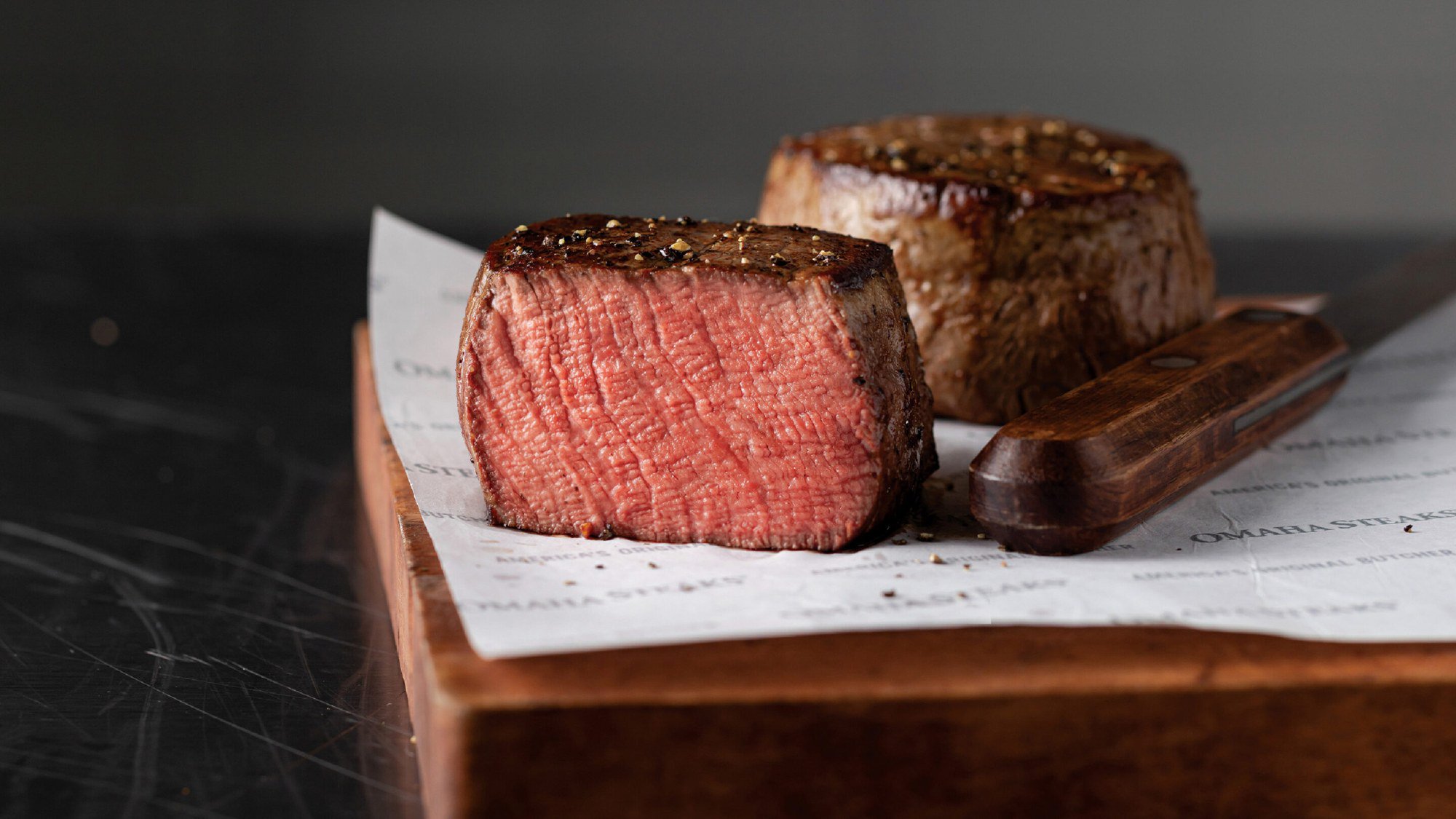
| Medium rare | 130°F | Warm red center; the company's recommendation for most steaks |
| Medium | 140°F | Hot pink center, firmer texture |
| Medium well | 150°F | Mostly brown center |
| Well done | 160°F+ | No pink, much drier |
The temperature keeps rising as the steak rests, by up to about 5 degrees according to the doneness guide. That is why Omaha Steaks says to take steaks off the heat 5 to 10 degrees before your target.

What the USDA says
Omaha Steaks' targets are about taste. The USDA Food Safety and Inspection Service sets a different benchmark for safety: it lists 145°F for beef steaks, chops and roasts, followed by a rest of at least 3 minutes, measured with a food thermometer before you remove the meat from the heat. That is above Omaha Steaks' medium target, and it does not allow for pulling the steak early. Ground beef, such as burgers, has a higher USDA minimum of 160°F. Following the company's medium-rare target is a personal choice; following the USDA figure is the food-safety standard.
Step 6: Rest and serve
Resting lets the juices redistribute. The doneness guide says 3 to 5 minutes, the storage guide 5 to 10 minutes, and the pan-sear recipe 5 minutes per inch of thickness. For a 1½-inch filet, about 5 to 8 minutes covers all three.
Quick checklist
- Freeze on arrival; eat uncooked steaks within 4 to 12 months for best quality.
- Thaw in the fridge overnight, single layer, still sealed.
- In a hurry, thaw sealed steaks in cold water for 15 to 40 minutes.
- Never thaw on the counter.
- Rest steaks at room temperature 30 to 60 minutes before cooking.
- Use a thermometer and pull 5 to 10 degrees early.
- Rest before slicing.
Choosing what to order? Our Omaha Steaks review covers quality, delivery and the guarantee, and our guide to USDA Certified Tender explains the tenderness labels. For a thermometer, see our ThermoWorks thermometer buyer's FAQ. Sending steaks as a gift? Check Omaha Steaks' 2026 holiday delivery dates.
References
- Omaha Steaks, "Storing, Thawing & Cooking Your Omaha Steaks": https://www.omahasteaks.com/blog/storing-thawing-and-cooking-your-omaha-steaks/
- Omaha Steaks, "What's the Best Way to Thaw Steaks?" (updated July 2, 2025): https://www.omahasteaks.com/blog/whats-the-best-way-to-thaw-steaks/
- Omaha Steaks, "Steak Doneness Guide & Temperature Charts" (updated October 9, 2025): https://www.omahasteaks.com/blog/steak-doneness-guide/
- Omaha Steaks, "How to Reverse Sear a Filet Mignon" (updated July 2, 2025): https://www.omahasteaks.com/blog/how-to-reverse-sear-a-filet-mignon/
- Omaha Steaks, "10 Steps to Perfect Pan-Seared Filet Mignon" (updated July 31, 2025): https://www.omahasteaks.com/blog/recipes/10-steps-to-perfect-pan-seared-filet-mignon/
- USDA Food Safety and Inspection Service, Safe Minimum Internal Temperature Chart: https://www.fsis.usda.gov/food-safety/safe-food-handling-and-preparation/food-safety-basics/safe-temperature-chart
Meet your guide
Lipeiguan
author
What to read next
 How to Choose Kitchen Cabinets at Menards: KLEARVUE, Concepts, Quality One and Cardell A research-based guide to choosing kitchen cabinets at Menards, covering the official KLEARVUE, Cardell, Concepts Cabinetry and Quality One Woodwork lines, door styles, unfinished...
 Oats Overnight vs Mylk Labs: Protein Pouches or Oatmeal Cups? A research-based comparison of official Oats Overnight pouches and Mylk Labs oatmeal cups, covering protein and fiber labels, how each is prepared, vegan and allergen details, subs...
 Once Upon a Farm Review: Organic Pouches, Ratings, Certifications and the Tractor Wheels Recall A research-based review of Once Upon a Farm's refrigerated organic pouches and meals, including Clean Label Project certifications, official 4.9-star Baby Starter Box ratings, and...