
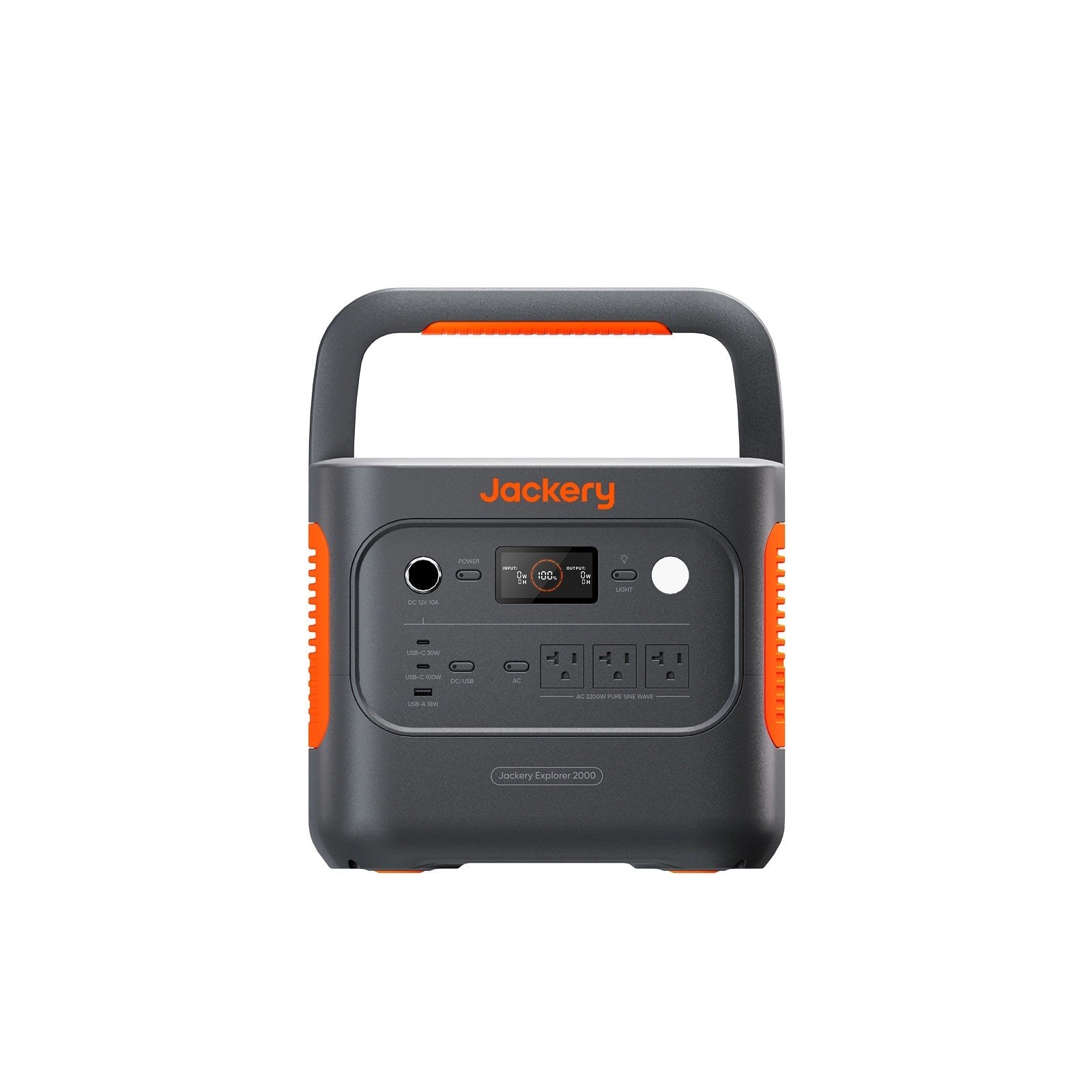
Solar Generator vs Gas Generator for Home Backup: Safety, Noise, Runtime and Cost (Jackery Explorer 2000 v2)
Solar generator vs gas generator for power outages, using Jackery Explorer 2000 v2 specs and CPSC carbon monoxide guidance: indoor safety, noise, runtime, solar recharge, output, cost and which to buy.
Disclosure: This page may contain affiliate links. They do not influence our editorial conclusions. Read the disclosure.
Our pick
- See price at Jackery
Top pick
Jackery
Maker of portable power stations, solar generators and foldable solar panels for camping, travel and home backup.
When the power goes out, most people reach for one of two machines: a gasoline portable generator or a battery "solar generator" such as Jackery's Explorer 2000 v2. They solve the same problem in very different ways. A gas generator makes electricity as long as you keep feeding it fuel. A solar generator stores electricity in a battery and refills it from the wall, a car or solar panels.
This guide compares the two for home backup using Jackery's published specs for the Explorer 2000 v2 and Solar Generator 2000 v2 bundles, plus U.S. Consumer Product Safety Commission (CPSC) guidance on portable generators, checked November 14, 2026. It is research-based, not a hands-on test. We do not quote figures for any specific gas generator model; check the spec sheet of any model you are considering.

The short answer
- Choose a solar generator if you want something you can safely run indoors, that is quiet enough for a bedroom, and that covers essentials (fridge, Wi-Fi, lights, phones, a CPAP or a laptop) through a typical outage.
- Choose a gas generator if you need to run heavy loads for many days with no sun, and you have a safe outdoor spot at least 20 feet from the house to run it.
- Many households end up with a battery for the first day or two, because it is safe, silent and ready instantly, and reserve gas for long, multi-day outages.
Side by side
| Jackery Explorer 2000 v2 (solar generator) | Gasoline portable generator | |
|---|---|---|
| Where it can run | Indoors; Jackery calls it "safe for indoor use" | Outdoors only, at least 20 feet from the house (CPSC) |
| Exhaust | None | Carbon monoxide; CPSC says one generator produces as much CO as hundreds of cars |
| Noise | Under 30 dB in Quiet Mode, 45 dB at full load (measured at 1 meter) | Varies by model; check the spec sheet |
| Energy stored | 2,042Wh LiFePO4 battery | Limited only by the fuel you have on hand |
| Output | 2,200W continuous, 4,400W surge | Varies by model |
| Refill | AC wall charge in about 1.7 hours; solar charging listed at 7.5 hours; 12V car charging 24 hours | Refuel with gasoline |
| Outage switchover | Under 20ms UPS-style switchover when plugged in | Manual start after the power goes out |
| Battery life | 4,000 cycles to 70%+ capacity | N/A |
| Warranty | 3+2 years | Varies by brand |
| Weight | About 39.5 lb | Varies by model |
Safety: the biggest difference
This is not a close call. The CPSC estimates that more than 200 people in the United States die every year from accidental non-fire carbon monoxide poisoning linked to consumer products, and that more than 100 of those deaths are tied to portable generators. In a 2022 report, the agency found most generator CO deaths (81%) happen at home, and that weather-related power outages were among the top reasons people were running a generator.
CPSC's rules for gas generators are blunt:
- Never run one inside a home, garage, basement, crawlspace, shed or on a porch, "even if doors and windows are open."
- Run it outdoors only, at least 20 feet from the house, with the exhaust pointed away from the home and other buildings.
- Look for models that shut off automatically when CO levels get high; CPSC says some of these also have reduced emissions.
- Install battery-operated CO alarms, or CO alarms with battery backup, on every level and outside sleeping areas.
A battery power station burns no fuel and makes no exhaust, which is why Jackery describes the Explorer 2000 v2 as safe for indoor use. You can put it in the kitchen next to the fridge or by the bed for a CPAP. That said, it is still a large lithium battery: follow Jackery's operating temperature ranges (charging at 32–113°F, discharging at 14–113°F) and keep it away from water.
Whatever you choose, CO alarms are worth having for any home with fuel-burning appliances. Our guide to the best X-Sense smoke and CO alarms covers standalone and interconnected options.

Runtime: how long will it last?
This is where gas wins. A gas generator keeps running as long as you can refuel it, so a multi-day outage just means more trips to the gas can.
A solar generator's runtime is set by its battery. The Explorer 2000 v2 stores 2,042Wh. As a rough guide, divide that by what you plug in: a device drawing 100W would run for something under 20 hours, because some energy is lost converting battery power to AC. Jackery says the 2,042Wh capacity "keeps essentials like your fridge, Wi-Fi, and lights powered through a full-day outage." Our Jackery size calculator guide walks through the math for common appliances.
The battery can also be refilled while the outage goes on:
- Solar: the Explorer 2000 v2 has two DC inputs that together accept up to 400W, and Jackery lists solar charging at 7.5 hours. That only works with good sun, so expect much less on cloudy or winter days.
- Car: 24 hours on a 12V car port, so it is a trickle, not a real recharge.
- Wall: about 1.7 hours on AC, useful if power comes back briefly or you can charge somewhere else.
If you need to run central air, an electric range or a well pump for days, a 2kWh battery will not keep up; you would need a much larger battery system or a gas or standby generator.

Power: what it can run
Jackery rates the Explorer 2000 v2 at 2,200W continuous with a 4,400W surge, and says it handles a refrigerator, microwave, coffee maker and similar essentials. It has three 120V AC outlets, two USB-C ports (30W and 100W), a USB-A port and a 12V car outlet.
Gas generators vary widely in output, from small inverter models to big open-frame units. If you need to run several large appliances at once or a 240V load, a gas generator (or a larger battery system with a transfer switch) is usually the better fit. Check the running and starting watts of every appliance you plan to power before buying either.
Noise and convenience
Jackery measures the Explorer 2000 v2 at under 30 dB in Quiet Mode and 45 dB at full load from 1 meter, quiet enough to sleep next to. There is no pull-start, no oil, no fuel storage and no stale gasoline. Jackery also says it keeps about 95% of its charge after 12 months in storage, so it can sit in a closet ready for the next storm, and its under-20ms switchover means a router, computer or NAS plugged into it can stay on when the grid drops.
A gas generator needs fuel storage, regular running to keep the engine healthy, and a safe outdoor spot, which can be hard in an apartment, a townhouse or bad weather.
Cost
On November 14, 2026, Jackery listed the Explorer 2000 v2 alone at $999. The Solar Generator 2000 v2 bundles ranged from $1,239 (with two SolarSaga 100W Air panels) to $1,899 (with four SolarSaga 100W Light panels); a bundle with two SolarSaga 200W panels was $1,649. Jackery noted some configurations were sold out and on pre-order. The battery is rated for 4,000 cycles to 70%+ capacity, and Jackery quotes an 11-year theoretical cell life based on those cycles.
Gas generators often cost less upfront for a given wattage, but you also pay for fuel, oil and maintenance, plus a CO alarm setup. We are not quoting gas generator prices here because they vary too much by model.

Which should you buy?
Pick the Jackery Explorer 2000 v2 or another solar generator if:
- You live in an apartment, condo or townhouse with nowhere safe to run a gas engine.
- Your outages are usually hours to a day or two.
- You need to power medical devices, networking gear or a fridge indoors, quietly.
- You want backup that also works for camping and RV trips.
Pick a gas generator if:
- You regularly face multi-day outages and need heavy loads.
- You have a safe outdoor spot at least 20 feet from the house and are comfortable storing fuel.
- You buy a model with CO auto-shutoff and install CO alarms.
If you are comparing batteries, see our Jackery HomePower 1000 v2 vs EcoFlow Delta 3 Classic comparison and our Jackery solar panel guide. For returns, shipping and warranty details, read our Jackery shopping guide.
References
- Jackery: Solar Generator 2000 v2 product page and tech specs — https://www.jackery.com/products/jackery-solar-generator-2000-v2
- Jackery: Explorer 2000 v2 Portable Power Station — https://www.jackery.com/products/jackery-explorer-2000-v2-portable-power-station
- CPSC: Carbon Monoxide Information Center — https://www.cpsc.gov/Safety-Education/Safety-Education-Centers/Carbon-Monoxide-Information-Center
- CPSC: Generators and Engine-Driven Tools — https://www.cpsc.gov/Safety-Education/Safety-Guides/Carbon-Monoxide-Home/Generators-and-Engine-Driven-Tools
- CPSC: "CPSC Releases New Report on Carbon Monoxide (CO) Fatalities, Urges Generator Safety in New PSA" (2022) — https://www.cpsc.gov/Newsroom/News-Releases/2022/CPSC-Releases-New-Report-on-Carbon-Monoxide-CO-Fatalities-Urges-Generator-Safety-in-New-PSA
Meet your guide
Lipeiguan
author
What to read next
 Google Adds Computer Use to the Gemini App for Mac in the U.S. On November 19, 2026, Google said computer use is available in the Gemini app for Mac, in English in the U.S. Official requirements include an Apple Silicon Mac on macOS Sequoia 15... How to Use Gemini Computer Use on a Mac: Official Requirements, Permissions and Examples Official Google requirements for computer use in the Gemini app for Mac: an Apple Silicon Mac on macOS Sequoia 15.0 or later, a personal Google account for people 18 or older, a Go...
 How to Choose a SwitchBot Lock: Lock Pro vs Lock Ultra vs Lock Vision and Vision Pro A research-based guide to official SwitchBot Lock Pro, Lock Ultra, Lock Vision and Lock Vision Pro specs and November 20, 2026 U.S. prices, including batteries, hubs, keypads, comp...