
Bambu Lab X2D vs P2S: Dual Nozzle vs Single Nozzle, Specs and Prices Compared
Bambu Lab X2D vs P2S from official specs and November 2026 US store prices: dual nozzles, 65 °C chamber heating, HEPA filtration, speed, cameras, AMS support, and which printer fits which buyer.
Disclosure: This page may contain affiliate links. They do not influence our editorial conclusions. Read the disclosure.
Our pick
- See price at Bambu Lab
Top pick
Bambu Lab
Consumer desktop 3D-printer maker whose current lineup includes enclosed AMS machines such as the P2S and the nine-tool H3C, sold through bambulab.com and the U...
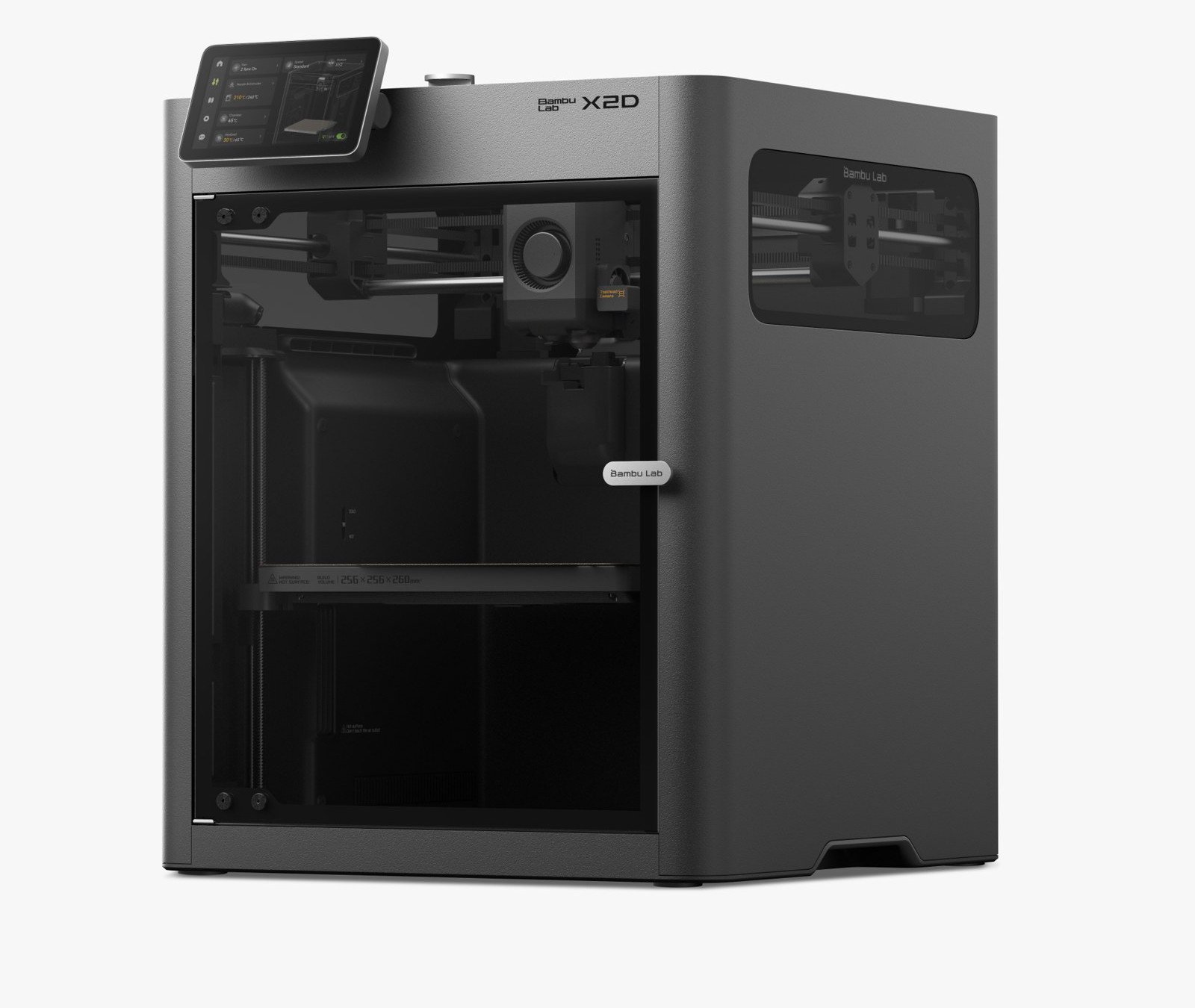
The Bambu Lab X2D and P2S look almost identical from the outside. Both are enclosed printers with the same 392 × 406 × 478 mm footprint, and both are sold as AMS combos for multi-color printing. Underneath, they are built for different jobs. The X2D adds a second nozzle, an actively heated chamber and HEPA filtration, while the P2S keeps one nozzle and a lower price. This comparison uses only Bambu Lab's official spec sheets and US store listings as of November 13, 2026. We have not tested either printer ourselves.

For the rest of the lineup, see our best Bambu Lab 3D printers guide. If you are buying for a classroom, our Bambu Lab for schools and students guide covers education pricing.
The short answer
- Choose the P2S if you mostly print PLA and PETG, want multi-color through the AMS, and would rather spend less. It is $449 on its own or $649 as a Combo.
- Choose the X2D if you print with support materials, want two materials in one part, or print engineering filaments that benefit from a heated chamber. It is $589 on its own or $789 as an AMS Combo.
- At combo level, the price difference was $140 on November 13, 2026 ($649 vs $789).
Price comparison
| Bundle | P2S | X2D |
|---|---|---|
| Printer only | $449 (typical $549) | $589 (typical $649) |
| With one AMS 2 Pro | $649 P2S Combo (typical $749) | $789 X2D AMS Combo (typical $899) |
| Other bundles | $836 Combo Print with Care Bundle; $1,049 Print More Bundle with two AMS 2 Pro units |
These are Bambu Lab US store prices during its November 2026 Black Friday sale, shown against higher "Typical Price" figures. Both product pages list the same store terms: free shipping in the 48 contiguous states, 30-day price protection, 30-day returns and a two-year warranty. Our Bambu Lab Black Friday 2026 news tracks the sale, and the shopping guide explains the policies.
Specs side by side
| Spec | P2S | X2D |
|---|---|---|
| Nozzles | One | Two (main and auxiliary) |
| Build volume | 256 × 256 × 256 mm | 256 × 256 × 260 mm (main nozzle); 235.5 × 256 × 256 mm for dual-nozzle printing |
| Max nozzle temperature | 300 °C, hardened steel | 300 °C, hardened steel |
| Max bed temperature | 110 °C | 120 °C |
| Chamber heating | None active; enclosure and flap-controlled airflow (Bambu Lab describes it as "50°C chamber ready") | Active heating up to 65 °C |
| Max toolhead speed | 600 mm/s | 1,000 mm/s |
| Max acceleration | 20,000 mm/s² | 20,000 mm/s² |
| Max hotend flow | 40 mm³/s | 40 mm³/s standard; 65 mm³/s with optional high-flow hotend |
| Filtration | Activated carbon | G3 pre-filter, H12 HEPA, activated carbon |
| Cameras | 1080p camera | 1080p live view plus 1600 × 1200 toolhead camera |
| Touchscreen | 5-inch 854 × 480 | 5-inch 1280 × 720 |
| Net weight | 14.9 kg | 16.25 kg |
| Max power (110 V) | 1,000 W | 1,100 W |
Both printers lack Ethernet and use dual-band Wi-Fi. Both work with Bambu Studio and accept standard G-code from slicers such as PrusaSlicer and Cura, although Bambu Lab notes that some advanced features may not be supported in third-party slicers.
The big difference: one nozzle or two

On the X2D, Bambu Lab says "the main nozzle prints the part" and "the auxiliary nozzle handles the support," each with its own material. Nozzle changes happen mechanically inside the toolhead: a lever taps a trigger arm that drives an internal gear train. Bambu Lab says the dual-nozzle system completed more than 1,000,000 switch cycles in its life-cycle testing.
Why that matters:
- Cleaner supports. You can print the part in PLA or PETG and the supports in a dedicated support material, which Bambu Lab promotes for "cleaner support removal."
- Faster multi-color printing. Bambu Lab lists "faster multi-color printing" alongside cleaner supports as the headline benefits of the dual-nozzle design.
- More colors. Bambu Lab says the X2D supports up to 25-color printing. The P2S FAQ lists up to 20-color printing.
Bambu Lab is open about the trade-offs. Its footnotes say print quality from the auxiliary nozzle is "slightly lower" than from the main nozzle, recommend official Bambu Lab filaments for the auxiliary nozzle, and note that flow dynamics calibration applies to the main nozzle only. Some filaments, such as PLA Silk and several carbon-fiber blends, are listed as "print with caution" on the auxiliary hotend.
Materials and chamber heat
Both printers reach 300 °C at the nozzle and use hardened steel parts, so both can run carbon- and glass-fiber blends. The P2S spec sheet lists PLA, PETG, ABS, ASA, TPU, PET, PA, PC and PVA, plus reinforced grades such as PLA-CF, PETG-CF, ASA-CF, PA6-CF and PPA-CF.
The difference is how they manage heat. The P2S has no active chamber heater. Bambu Lab's FAQ says it controls chamber temperature with its enclosure and an automatic flap that switches between internal and external air circulation, while filtering air through an activated carbon filter. The X2D adds active heating up to 65 °C, which Bambu Lab calls hot enough "for the majority of engineering filaments like ABS, ASA, and nylon," and a higher 120 °C bed.
If you print ABS or ASA only now and then, the P2S enclosure may be enough. If large ABS, ASA or nylon parts are routine, the X2D's actively heated chamber is aimed squarely at those materials.
Air filtration and noise
The X2D lists a three-stage setup: a G3 pre-filter, an H12 HEPA filter and granulated coconut-shell activated carbon, with both VOC and particulate filtration marked as supported. The P2S lists activated carbon and also marks both VOC and particulate filtration as supported, without a HEPA stage.

For noise, Bambu Lab says Active Motor Noise Canceling and a redesigned air duct keep the X2D "below 50 dB under typical conditions." It describes overnight printing as suitable when the printer is in a separate room from the sleeping area. Bambu Lab does not give a comparable decibel figure on the P2S pages we checked.
Monitoring and everyday use
Both printers use AI to watch for failures. The P2S page says its AI computer vision detects problems such as spaghetti failures and nozzle blobbing, and checks print-start settings.

The X2D adds a second camera on the toolhead. Bambu Lab says the two cameras scan the plate for foreign objects, check plate placement, and watch for spaghetti, nozzle clumping and purge-chute jams, pausing the job when they find one. Nozzle swaps are tool-free on the X2D.
AMS compatibility
Both printers ship in combos with the AMS 2 Pro, which adds filament drying. On the X2D, connecting more than two AMS units, including AMS 2 Pro or AMS HT, needs a 4-in-1 PTFE adapter. On the P2S, Bambu Lab says the printer can power drying for one AMS 2 Pro in standby. Additional units, or drying during a print, need their own power adapters. Our AMS lite vs AMS 2 Pro vs AMS HT guide has the full compatibility chart.
Which should you buy?
| If you... | Pick |
|---|---|
| Print mostly PLA and PETG for models, toys and household parts | P2S |
| Want the lowest-cost enclosed multi-color setup | P2S Combo ($649) |
| Print with soluble or breakaway support materials | X2D |
| Print ABS, ASA or nylon parts often | X2D |
| Want HEPA filtration in a shared living space | X2D |
| Need the biggest build area | Neither; see the H2S in our best-of guide |
Still weighing other options? See Bambu Lab H3C vs P2S for a tool-changer alternative, or ELEGOO Centauri Carbon 2 Combo vs P2S for a rival brand.
Bottom line
The P2S is the better value for most hobbyists who mostly print PLA and PETG. The X2D costs $140 more at combo level, and Bambu Lab's specs show what that buys: a second nozzle for supports and two-material parts, 65 °C active chamber heating, HEPA filtration, a second camera and a faster toolhead. If none of those solve a problem you have today, the P2S is the simpler buy.
References
- Bambu Lab. "Bambu Lab X2D - Technical Specifications." https://bambulab.com/en-us/x2d/specs (accessed November 13, 2026).
- Bambu Lab. "Bambu Lab P2S - Technical Specifications." https://bambulab.com/en-us/p2s/specs (accessed November 13, 2026).
- Bambu Lab US Store. "Bambu Lab X2D" product page, bundles and FAQ. https://us.store.bambulab.com/products/x2d (accessed November 13, 2026).
- Bambu Lab US Store. "Bambu Lab P2S" product page and FAQ. https://us.store.bambulab.com/products/p2s (accessed November 13, 2026).
Meet your guide
Lipeiguan
author
What to read next
 Best Makera CNC Machines (2026): Z1, Carvera Air, A1S and Carvera A research-based 2026 guide to official Makera Z1, Z1 Pro, Carvera Air, A1S and Carvera desktop CNC specs and November 20, 2026 U.S. prices, including work areas, tool changers, in...
 Makera A1S vs TwoTrees ED1: 600W Desktop CNC Specs, Pre-Order Prices and Shipping Compared A research-based comparison of official Makera A1S and TwoTrees ED1 600W enclosed desktop CNC specifications, November 20, 2026 pre-order prices, work areas, tool changers, and shi...
 Google Adds Computer Use to the Gemini App for Mac in the U.S. On November 19, 2026, Google said computer use is available in the Gemini app for Mac, in English in the U.S. Official requirements include an Apple Silicon Mac on macOS Sequoia 15...