
Xfinity vs AT&T Fiber: Prices, Upload Speeds, Contracts and Perks Compared
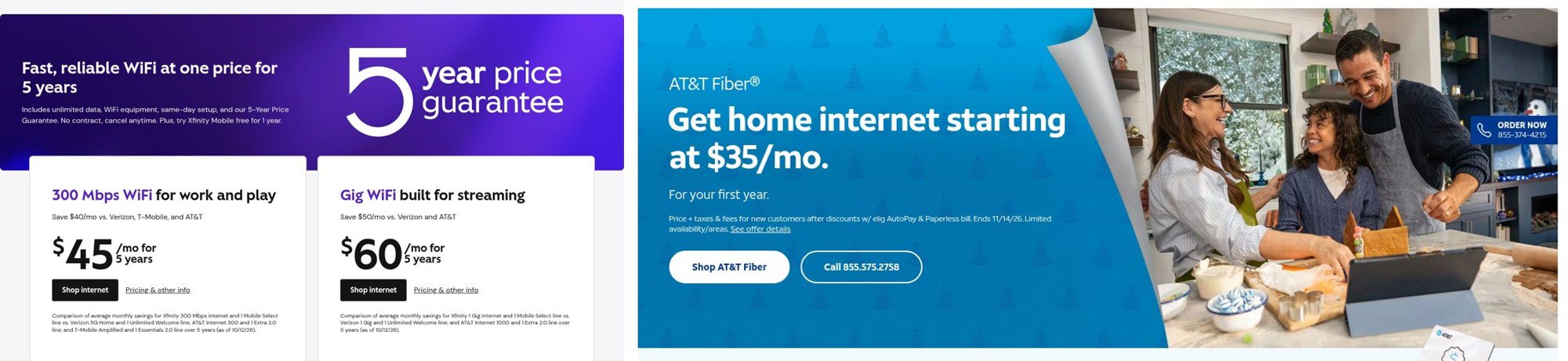
AT&T Fiber has matching upload speeds and a $35 first-year starting price. Xfinity locks its rate for five years and is $5 cheaper at 1 gig. Here is how prices, upload speeds, equipment, contracts and perks compare in November 2026.
Disclosure: This page may contain affiliate links. They do not influence our editorial conclusions. Read the disclosure.
Our pick
- See price at Xfinity
Top pick
Xfinity
Comcast's U.S. consumer brand for home internet, TV, streaming and Xfinity Mobile, selling no-contract internet plans with a 5-Year Price Guarantee for new memb...
If both Xfinity and AT&T Fiber serve your address, you are choosing between two different kinds of deal. Xfinity locks a price for five years on a network that reaches homes over coaxial cable. AT&T Fiber sells fiber to the home with upload speeds that match download speeds, at a lower advertised starting price. This comparison uses each company's official plan pages as of November 11, 2026, plus the broadband labels Xfinity publishes, so you can see where each one comes out ahead.

Prices side by side
Xfinity (new customers, 5-Year Price Guarantee, includes a $10 per month autopay and paperless discount, offers end December 1):
| Speed | Price | Crossed-out price |
|---|---|---|
| 300 Mbps | $45/mo for 5 years | $80/mo |
| 500 Mbps | $50/mo for 5 years | $95/mo |
| 1 Gig | $60/mo for 5 years | $110/mo |
| 1.2 Gig | $85/mo for 5 years | $140/mo |
Xfinity also offers 300 Mbps at $40 a month for one year as an alternative.
AT&T Fiber (plan cards on the fiber page, shown "without wireless plan," price plus taxes and fees after a $10 per month autopay and paperless discount):
| Speed | Price | Crossed-out price |
|---|---|---|
| Internet 300 | $35/mo | $60/mo |
| Internet 500 | $50/mo | $75/mo |
| Internet 1000 (1 GIG) | $65/mo | $90/mo |
| Internet 5000 (5 GIG) | $110/mo | $135/mo |
The banner at the top of AT&T's fiber page says home internet starts at $35 a month "for your first year," for new customers, with an offer end date of November 14, 2026. The page we reviewed does not say what the price becomes after the first year, so ask before you order. With an eligible AT&T wireless plan, the same page lists bundled prices of $20, $35, $45 and $85 a month for the four tiers.

What this means: at 300 Mbps, AT&T is $10 a month cheaper on its first-year price. At 500 Mbps the two are level at $50. At about 1 gig, Xfinity is $5 a month cheaper and keeps that price for five years. Bundled with AT&T wireless, AT&T is cheaper across the board, but only if you already use AT&T for your phones or plan to switch.
Xfinity sells its own bundle angle too. Every Xfinity plan includes an Xfinity Mobile Select line free for a year, and Xfinity's page claims average savings of $40 to $50 a month against AT&T and others when internet and one mobile line are combined. That is Xfinity's own comparison, based on prices as of October 12, 2026.
Upload speed: the biggest technical difference
AT&T's fiber FAQ is direct: "AT&T Fiber delivers equal upload and download speeds." A 500 Mbps AT&T plan uploads at up to 500 Mbps.
Xfinity describes its network as "powered by fiber and connected to premises by coaxial cable," and upload depends on how your neighborhood's network has been upgraded. Xfinity's machine-readable broadband label file shows three upload patterns for its 300 Mbps, 500 Mbps and 1 Gig plans: 35 Mbps (about 41 typical), 100 Mbps (about 117 typical) and, on some labels, upload equal to download. The 1.2 Gig labels in the file almost all show 35 Mbps upload.
If you upload often, for example livestreaming, posting large videos, backing up photos or working remotely with big files, this is the deciding factor. Check the broadband label Xfinity shows for your address before ordering. If it lists 35 Mbps up, AT&T Fiber at the same price is the stronger connection for uploads. If it shows symmetrical speeds, the gap disappears.
For a breakdown of which download tier you need, see our guide to which Xfinity speed to choose.
Top speeds
AT&T offers a 5 GIG tier where available. Its page notes that speeds are based on a wired connection and that the single-device wired maximum on 5 GIG is 4.7 Gbps. AT&T groups its fastest plans as "hyper-gig" and includes its All-Fi WiFi system with them.
Xfinity's fastest plan on the main internet page is 1.2 Gig. Its broadband label file also lists a 2 Gig plan at some addresses, so ask what's available where you live. Few households need more than 1 gig, but if you do, AT&T's ceiling is higher where fiber is available.
Contracts, data and equipment
These are closer than the marketing suggests.
- Contracts: Xfinity says there is no annual contract and no early termination fee, and you can cancel any time. AT&T's fiber page does not mention an annual contract on these plans. Confirm the terms in your cart.
- Data caps: Xfinity plans include unlimited data. AT&T Fiber offers "unlimited data with no data caps."
- Equipment: Xfinity includes WiFi equipment in the plan price. AT&T includes "a Wi-Fi gateway at no extra cost." AT&T also sells All-Fi Pro as an optional add-on for $25 a month, which adds Wi-Fi 7 equipment, an equipment upgrade program, ActiveArmor advanced security and extended WiFi coverage.
- Price stability: this is Xfinity's clearest advantage. The 5-Year Price Guarantee locks your base monthly rate for 60 months and, according to Xfinity, stays with you if you move to a new address in its service area. AT&T's banner frames its starting price as first-year pricing.
Our Xfinity shopping guide covers how the guarantee, moving and equipment returns work.
Extras and perks
Xfinity includes:
- WiFi Shield features at no extra cost, including WiFi Motion, Xfinity CyberSecure, Dark Watch and Family Settings parental controls (a compatible gateway is required for some features);
- a free Xfinity Mobile Select line for one year;
- Peacock Premium for two years on 1 Gig and 1.2 Gig (activate within 90 days).
AT&T Fiber includes:
- AT&T ActiveArmor standard security features;
- Internet Backup at no extra cost for customers with an eligible unlimited AT&T wireless plan, which switches you to wireless data if the fiber goes down. It requires AT&T's BGW320 gateway and does not work during power outages;
- on 1 GIG and faster plans ordered online, three months of YouTube TV for new YouTube TV subscribers and a $100 reward card, which requires redemption and keeping service for 90 days.

Reliability claims
Both companies market reliability, in different ways. Xfinity cites Opensignal's Fixed Broadband Experience Report (May 2026), which it says named Xfinity "the fastest & most reliable WiFi," and says it beat Verizon, AT&T and T-Mobile in that report. AT&T argues that fiber is less affected by rain, snow and storms than some older technologies and gives "more consistent performance during busy hours." Treat both as marketing. What matters most is the network at your address, which is why the broadband labels are worth reading.
Availability
Neither service is available everywhere. AT&T notes "limited availability/areas" on almost every fiber offer, and Xfinity offers vary by address. In practice, run both address checks first. If only one is available, the choice is made for you.
Which should you choose?
Choose AT&T Fiber if uploads matter to you, you want speeds above 1 gig, or you already have AT&T wireless and can get the bundled prices. Symmetrical upload is a real advantage for remote work, creators and households that back up a lot of photos and video.
Choose Xfinity if you want a price you can plan around. At 1 gig, Xfinity is $5 a month cheaper and locks the rate for five years, the price follows you if you move within its area, and there is no annual contract. It also makes sense if the label for your address shows 100 Mbps or symmetrical upload, since that closes most of the technical gap.
If it's close, compare the total cost over two to three years using each company's written terms in the cart, including what AT&T charges after the first year, and decide based on the upload speed on your address's label.
For more on Xfinity's plans and features, read our Xfinity internet review.
References
- Xfinity. Xfinity Internet: Home Internet Service (plans, offer terms and FAQ). Retrieved November 11, 2026, from https://www.xfinity.com/learn/internet-service
- Xfinity. Machine-readable broadband labels file (residential, USA). Retrieved November 11, 2026, from https://www.xfinity.com/.well-known/broadband-labels/2026-02-03-0003768165-USA-RESIDENTIAL.csv
- Xfinity. Xfinity Broadband and Mobile Facts labels. Retrieved November 11, 2026, from https://www.xfinity.com/support/articles/broadband-mobile-facts-labels
- AT&T. AT&T Fiber Internet (plan cards, offer details and FAQ). Retrieved November 11, 2026, from https://www.att.com/internet/fiber/
Meet your guide
Lipeiguan
author
What to read next
 Google Brings the Gemini App to Eligible Android Go and Lower-Memory Phones On November 18, 2026, Google said the Gemini app is available on eligible Android (Go edition) devices after a re-architecture for lower-memory phones. Official help adds a 2GB RAM... How to Use the Gemini App on Android Go and Other Lower-Memory Phones Official Google steps for the Gemini app on eligible Android (Go edition) devices with 2GB of RAM or more: update Google Search or install Gemini from Play, start a chat with a lon...
 Google Wallet Is Now Available on iOS in the U.S.; Tap-to-Pay Is Not Included On November 17, 2026, Google said Wallet is available to iOS users in the United States, with Gmail sync, loyalty-card scanning, payment-card management for online Google Pay check...