Turkey Temperature Chart: Where to Put the Thermometer, and 157°F vs 165°F
Where to put the thermometer in a turkey, the USDA and ThermoWorks doneness temperatures, and a thaw and roast timeline for Thanksgiving 2026.
Disclosure: This page may contain affiliate links. They do not influence our editorial conclusions. Read the disclosure.
Our pick
- See price at ThermoWorks
Top pick
ThermoWorks
Utah-based maker of cooking thermometers including Thermapen and the RFX wireless probe system.
What this guide covers
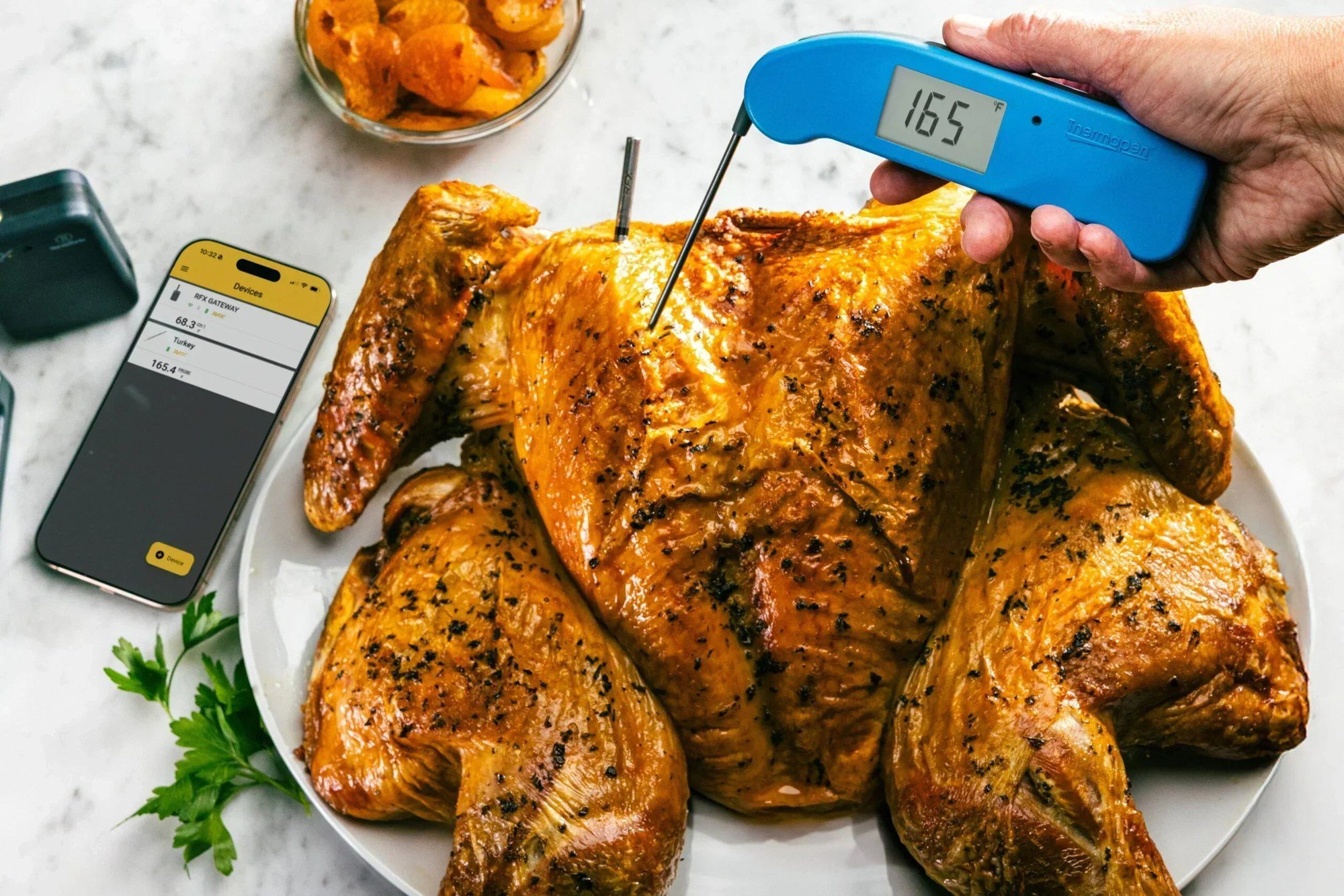
Two numbers cause most of the confusion on Thanksgiving. The USDA says a whole turkey is safe at 165°F. ThermoWorks, the thermometer maker, tells its customers to pull the breast at 157°F and the thigh at 175°F. Both are right in their own way, and the bigger problem is usually not the number at all. It is a thermometer placed in the wrong spot. This guide pulls together the USDA's official guidance and ThermoWorks' published method to cover where to put the thermometer in a turkey, which temperatures to aim for, and a thaw-and-roast timeline for Thanksgiving on Thursday, November 26, 2026.

Turkey temperature chart
| Where you measure | USDA safe minimum | ThermoWorks' target for juicy meat |
|---|---|---|
| Thickest part of the breast | 165°F (74°C) | 157°F (69°C), held about a minute |
| Thigh (between leg and body) | 165°F (74°C) | 175°F (79°C) or higher |
| Innermost wing | 165°F (74°C) | — |
| Center of the stuffing | 165°F (74°C) | 165°F (74°C) |
| Reheated leftovers | 165°F (74°C) | — |
Our recommendation: if anyone at the table is pregnant, elderly, very young or immunocompromised, or if you simply prefer the official rule, cook the whole bird to 165°F in every spot the USDA lists. If you use the 157°F breast target, measure the lowest point carefully and allow for the hold time, as explained below.
Why 157°F can be as safe as 165°F
The USDA's 165°F figure is the temperature at which Salmonella is killed almost instantly. Bacterial kill depends on time as well as temperature, though. ThermoWorks points to the USDA's own time-and-temperature tables for poultry. At 157°F, turkey (at 12% fat) reaches the same 7-log reduction of Salmonella after 50.4 seconds. A whole bird pulled at 157°F stays at or above that temperature for far longer than a minute while it rests, because the temperature keeps rising.

The reason to bother is texture. ThermoWorks notes that turkey breast starts pushing out moisture in the 150s °F and is dry by 165°F. If you pull a bird at 165°F, carryover cooking takes the breast even higher. Dark meat is the opposite. It is safe at the same temperature but is tougher until its connective tissue breaks down, which is why ThermoWorks aims for 175°F or more in the thigh.
Our view is that this is a quality choice with a safety basis, not a shortcut. The USDA's consumer guidance is still 165°F, and nothing in this guide overrides it.
Where to put the thermometer in a turkey
USDA: check the internal temperature in three places: the innermost part of the thigh, the innermost part of the wing, and the thickest part of the breast. If you use an oven-safe leave-in thermometer, the USDA suggests placing it in the thickest part of the inner thigh at the start. Once the thigh reaches 165°F, check the wing and breast.
ThermoWorks' leave-in probe method focuses on the breast's thermal center, the part farthest from any surface, which heats last:
- Line the probe up outside the bird to see how deep the tip needs to go, and mark that depth with your fingers.
- Insert it horizontally from near the neck cavity, parallel to the pan, to the depth you marked. Going in along the temperature layers, rather than straight down through them, makes it easier to land in the center.
- Keep the tip 1/2 to 1 inch from the internal cavity so it does not touch bone. Bone heats differently and gives a false reading.
- Add a second probe in the thigh if your thermometer has two channels. Push it deep between the leg and the body, and pull it back half an inch if you hit bone.
- Set alarms: 157°F for the breast and 175°F for the thigh with ThermoWorks' method, or 165°F with the USDA rule.
Even experienced cooks miss the exact center. ThermoWorks says it cooks dozens of turkeys a year and "rarely" hits the thermal center on the first try. That is why the next step matters.
Verify with an instant-read thermometer
A leave-in probe only reports the temperature at its tip. When the alarm sounds:
- Push an instant-read thermometer vertically through the breast all the way, then pull it slowly up, watching the display. The lowest reading is the one that counts.
- If any reading is below your target, move the leave-in probe to that cooler spot and keep cooking.
- Then check the thigh between the leg and the body.
- If the turkey has a pop-up timer, do not trust it alone. The USDA says to confirm with a food thermometer. ThermoWorks adds that pop-ups are set at about 180°F, well past juicy.
- Keep the oven or smoker closed until the alarm goes off. ThermoWorks says opening the door can drop the cooking temperature by as much as 50°F.
Our ThermoWorks thermometer buyer FAQ explains the difference between instant-read and leave-in models. Our RFX MEAT vs RFX MEAT Mini comparison covers which wireless probe fits a turkey breast.

Thanksgiving 2026 thaw schedule
A partly frozen turkey cooks unevenly. The USDA's refrigerator method allows about 24 hours for every 4 to 5 pounds at 40°F or below. Counting back from Thursday, November 26, 2026, put the turkey in the fridge by:
| Turkey weight | Fridge thaw time (USDA) | Put it in the fridge by |
|---|---|---|
| 4–12 lb | 1–3 days | Monday, Nov 23 |
| 12–16 lb | 3–4 days | Sunday, Nov 22 |
| 16–20 lb | 4–5 days | Saturday, Nov 21 |
| 20–24 lb | 5–6 days | Friday, Nov 20 |
ThermoWorks' rule of thumb is one day per 4 pounds, and it suggests starting the thaw on the Saturday before Thanksgiving. To check, push an instant-read thermometer into the deepest part of the breast. ThermoWorks says it should read 30°F or higher throughout.
Running late? The USDA's cold-water method takes about 30 minutes per pound: keep the turkey wrapped, submerge it in cold tap water, change the water every 30 minutes and cook it right after thawing. You can also cook a turkey from frozen. The USDA says it takes at least 50% longer.
Roasting times at 325°F (USDA)
Set the oven no lower than 325°F. The times are approximate, so always go by the thermometer.
| Weight | Unstuffed | Stuffed |
|---|---|---|
| 8–12 lb | 2¾–3 hr | 3–3½ hr |
| 12–14 lb | 3–3¾ hr | 3½–4 hr |
| 14–18 lb | 3¾–4¼ hr | 4–4¼ hr |
| 18–20 lb | 4¼–4½ hr | 4¼–4¾ hr |
| 20–24 lb | 4½–5 hr | 4¾–5¼ hr |
ThermoWorks uses a two-stage roast: 425°F for the first hour, then 325°F until the bird reaches its target temperature. The USDA recommends cooking stuffing in a separate dish. If you do stuff the bird, the center of the stuffing must reach 165°F.
Resting and carryover cooking
The USDA suggests letting the turkey stand 20 minutes before carving. ThermoWorks recommends 30 minutes. A large bird can rise as much as 15°F internally as heat from the outside moves inward, and this carryover is what turns a 157°F pull into a safe, evenly cooked breast. Leave the probe in to watch the temperature climb.
Leftovers
From the USDA:
- Refrigerate turkey, stuffing and gravy within 2 hours of cooking, or within 1 hour if the room is above 90°F.
- Store leftovers in shallow containers and use them within 3 to 4 days, or freeze them for 2 to 6 months.
- Reheat to 165°F.
Thermometer checklist for the big day
- An instant-read thermometer to verify doneness in several spots.
- A leave-in alarm thermometer (wired or wireless) so you can keep the oven closed.
- Fresh batteries in both, charged the night before.
- Alarms set: breast at 157°F or 165°F, thigh at 175°F.
- A plan for the thaw date in the table above.
ThermoWorks posts a last day for standard shipping of thermometers on its turkey page. If you need a thermometer, check that date well before Thanksgiving week. For the newest wireless option, see our news on the RFX MEAT Mini launch. If you are ordering the main course instead, our holiday food gifts guide covers delivery timing.
Editorial disclosure
This guide is research-based and summarizes USDA and ThermoWorks published guidance as of November 1, 2026. We did not cook test turkeys for it. SurfGirl may earn a commission if you buy through links on our ThermoWorks pages. That does not change the temperatures we recommend.
References
- USDA Food Safety and Inspection Service. Let's Talk Turkey: A Consumer Guide to Safely Roasting a Turkey. Retrieved November 1, 2026, from https://www.fsis.usda.gov/food-safety/safe-food-handling-and-preparation/poultry/lets-talk-turkey-roasting
- ThermoWorks. How to Cook a Perfect Turkey. Retrieved November 1, 2026, from https://www.thermoworks.com/blogs/thermoblog/turkey-temps
- ThermoWorks. Proper Thermometer Probe Placement in Turkeys. Retrieved November 1, 2026, from https://www.thermoworks.com/blogs/thermoblog/turkey-probe-placement
- ThermoWorks. Rotisserie Turkey for Thanksgiving. Retrieved November 1, 2026, from https://blog.thermoworks.com/rotisserie-turkey/
Meet your guide
Lipeiguan
author
What to read next
 Best ThermoWorks Thermometers: Which Model to Buy, With Buyer FAQ ThermoWorks thermometers sorted by job, compared on published specs and checked prices, with answers to common buyer questions.
 VEVOR Launches a Chamber Vacuum Sealer Built for Wet Foods, With a Two-Stage Anti-Overflow Cycle
 VEVOR Chamber Vacuum Sealers: Models, Specs, Warranty and How to Choose How VEVOR's chamber vacuum sealers compare, what its new FlavorKeep model adds, how to choose a wattage, and VEVOR's 30-day return and 12-month warranty terms, with food safety rul...